Monday, 9 September 2019

Ogdoad the Realm of Eight Leviticus 23:36
Ogdoad the Realm of Eight Leviticus 23:36


"My son, write this book for the temple at Diospolis in hieroglyphic characters, entitling it 'The Eighth Reveals the Ninth.'" (The Discourse on the Eighth and Ninth The Nag Hammadi Library)

Eight. The number eight was also used to add emphasis to the completeness of something (one more than seven, the number generally used for completeness), thus sometimes representing abundance. God reassured his people of deliverance from the threat of Assyria, saying that there should be raised up against the Assyrian “seven shepherds, yes, [not merely seven, but] eight dukes of mankind.” (Mic 5:5) As a fitting climax to the final festival of the sacred year, the Festival of Booths, the eighth day was to be one of holy convention, solemn assembly, a day of complete rest.—Le 23:36, 39; Nu 29:35.


eight; the eighth; octave; aggregation; accretion; increased; fattened; enlarged; excelling;

H8083 shᵉmôneh, shem-o-neh'; or שְׁמוֹנֶה shᵉmôwneh; feminine שְׁמֹנָה shᵉmônâh; or שְׁמוֹנָה shᵉmôwnâh; apparently from H8082 through the idea of plumpness; a cardinal number, eight (as if a surplus above the 'perfect' seven); also (as ordinal) eighth:—eight(-een, -eenth), eighth.


In Hebrew, number eight comes from the root "SHAHMEYN" H8082 meaning "to make fat," or to "cover with fat," to "super abound."


Ogdoad is a Greek word ogdoas, ogdoad-, from ogdoos ‘eighth’, from oktō ‘eight’
3590. ὄγδοος ogdoos og’-do-os; from 3638; the eighth: —  eighth. 


Every place the Greek word ὄγδοος is used in the septuagint Genesis 17:14 Genesis 21:4 Exodus 22:30 Leviticus 9:1 Leviticus 12:3 Leviticus 14:10 Leviticus 14:23 Leviticus 15:14 Leviticus 15:29 Leviticus 22:27 Leviticus 23:36 Leviticus 23:39 Leviticus 25:22 Numbers 6:10 Numbers 7:54 Numbers 29:35 1 Kings 6:1 1 Kings 8:66 1 Kings 12:32 2 Kings 15:8 1 Kings 12:33 2 Kings 22:3 2 Kings 24:12 1 Chronicles 12:12 1 Chronicles 24:10 (LXX_WH) 1 Chronicles 25:15 (LXX_WH) 1 Chronicles 26:5 (LXX_WH) 1 Chronicles 27:11 (LXX_WH) 2 Chronicles 7:9 (LXX_WH) 2 Chronicles 16:1 (LXX_WH)

In 2 Chron. 6, there are eight appeals of Solomon for his prayer to be heard. Seven times, "hear thou from heaven" and once (v. 21) "hear thou from thy dwelling place from heaven." Notice also the parallel passage in 1 Kings 8.


Circumcision, (that which typifies the cutting off of flesh or mortality), was on the eighth day, pointing forward to the eight thousandth year, when death shall be swallowed up in victory.


The feast of tabernacles, that which points forward to the great harvest of flesh was kept eight days: Lev. 23:39; cp. verses 34-36; Num. 29:39; Neh. 8:18.


Hanukkah The celebration lasted eight days from Chislev 25 onward. (1 Maccabees 4:59) There was a great blaze of light in the courts of the temple, and all private dwellings were lighted up with decorative lamps. The Talmud refers to it as the “Feast of Illumination.” Later on, some had the practice of displaying eight lamps on the first night and reducing the number on each night by one, others starting with one and increasing to eight. This is the Engkainia of John x. 22.


Eight is double four, and the city that "lieth foursquare," the New Jerusalem, refers to man perfected, fully rounded out on every side and in every way. 


Barnabas 9:7 For the scripture saith; And Abraham circumcised of his household eighteen males and three hundred. What then was the knowledge given unto him? Understand ye that He saith the eighteen first, and then after an interval three hundred In the eighteen 'I' stands for ten, 'H' for eight. Here thou hast JESUS (IHSOYS). And because the cross in the 'T' was to have grace, He saith also three hundred. So He revealeth Jesus in the two letters, and in the remaining one the cross.


As an introductory gem of intrigue we find the numerical value of Jesus = 888.


888 is the special number of Jesus Christ as “He who is that Resurrection and the Life.” He is the great opponent of the 666, the number of the Beast, the number of Man.


Just as 666 speaks to us of the ultimate in that for which six stands, even the man of sin; so eight, the number of immortality represents the ultimate in the first begotten of the new creation.

The number of the physical world is six, the number of the spiritual world is eight.

600 is the number of "COSMOS", while 800 is the number of the lord of the cosmos.
The Eighth Day of the Week 
In the 2Enoch 33:1 Enoch is told by the Deity that the eighth day is the beginning of the Ages of the Ages: 

2 Enoch 33:1”On eighth day I likewise appointed, so that the eighth day might be the 1st, the first-created after my week, and that it should revolve in the revolution of seven thousand, so that at the beginning of the eighth thousand there should be a time of not-counting, endless, with neither years nor months nor weeks nor days nor hours.

63 Now the repose of the spiritual elements on the Lord's Day, that is, in the Ogdoad, which is called the Lord's Day, is with the Mother, who keeps their souls, the (wedding) garments, until the end; but the other faithful souls are with the Creator, but at the end they also go up in the Ogdoad. Then comes the marriage feast, common to all who are saved, until all are equal and know each other. (Extracts from the Works of Theodotus)


80 He whom the Mother generates is led into death and into the world, but he whom Christ regenerates is transferred to life into the Ogdoad. And they: die to the world but live to God, that death may be loosed by death and corruption by resurrection. For he who has been sealed by Father, Son and Holy Spirit is beyond the threats of every other power and by the three Names has been released from the whole triad of corruption. “Having borne the image of the earthly, it then bears the image of the heavenly.” (
Extracts from the Works of Theodotus)

God created the world in six days and rested on the seventh, which was a Saturday. Jesus rose from the dead on a Sunday, which for the early Christians became the "eighth" day, symbolizing the new spiritual creation and the regeneration of time. 


The number 8, the Ogdoad, symbolizes the new order of Christianity, and Jesus, 888, was known as the Ogdoad to the early Christian Gnostics.


In relation to the first day of the seven, the law says, "it shall be a holy convocation: ye shall do no servile work therein." This was what we call Sunday. The statute then continues, "on the eighth day," also Sunday, "shall be a holy convocation unto you, and ye shall offer an offering made by fire unto the Lord: it is a solemn assembly; and ye shall do no servile work therein." Again, "on the first day shall be a Sabbath, and on the eighth day shall be a Sabbath" (Lev 23:34-43).


As seven was the number of the original Creation, so eight may be considered as the Day of Regeneration.

Ogdoad in Clement of Alexandria

Seven symbolizes for Clement of Alexandria a place of rest and completion, and eight a higher state wherein the divine presence resides. Many times, when Clement invokes a symbolic seven, he then notes the need to transcend it to reach the number eight. The hebdomad symbolizes rest, but it is surpassed by the ogdoad, wherein is the promise of gnostic perfection. For example, in Book 6 (108.1), Clement says that those who reach the highest levels of perfection have not remained in the hebdomad of rest, but have advanced into the inheritance of the benefit of the ogdoad 


It was only, then, when a father and mother, a son and daughter died, that the priest was allowed to enter, because these were related only by flesh and seed, to whom the priest was indebted for the immediate cause of his entrance into life. And they purify themselves seven days, the period in which Creation was consummated. For on the seventh day the rest is celebrated; and on the eighth he brings a propitiation, as is written in Ezekiel, according to which propitiation the promise is to be received. And the perfect propitiation, I take it, is that propitious faith in the Gospel which is by the law and the prophets, and the purity which shows itself in universal obedience, with the abandonment of the things of the world; in order to that grateful surrender of the tabernacle, which results from the enjoyment of the soul. Whether, then, the time be that which through the seven periods enumerated returns to the chiefest rest, or the seven heavens, which some reckon one above the other; or whether also the fixed sphere which borders on the intellectual world be called the eighth, the expression denotes that the Gnostic ought to rise out of the sphere of creation and of sin. After these seven days, sacrifices are offered for sins.

Clement of Alexandria Quoting from Clement of Rome, the Apostle Clement also, 

"Now all those things are confirmed by the faith that is in Christ. 'Come, ye children,' says the Lord, ' hearken to me, and I will teach you the fear of the Lord. Who is the man that desireth life, that loveth to see good days?' Then He subjoins the gnostic mystery of the numbers seven and eight. 'Stop thy tongue from evil, and thy lips from speaking guile. Depart from evil, and do good. Seek peace, and pursue it.' For in these words He alludes to knowledge (gnosis), with abstinence from evil and the doing of what is good, teaching that it is to be perfected by word and deed. ' The eyes of the Lord are on the righteous, and His ears are to their prayer. But the face of God is against those thai do evil, to root out their memory from the earth. The righteous cried, and the Lord heard, and delivered him out of all his distresses.' ' Many are the stripes of sinners; but those who hope in the Lord, mercy shall compass about.'" "A multitude of mercy," he nobly says, "surrounds him that trusts in the Lord."

The number eight is referred to perhaps in the last verse, in commands to turn away (ἔκκλινον), seek (ζήτησον), and pursue (δίωξον), presumably the realm of the ogdoad.


Ogdoad, the realm of eight aeons.
The realm of eight recalls the seven archangels (hebdomad)  plus the eighth the Monad. The realm of eight is beyond the universe it is the eighth heaven is the realm of light above.

hebdomad meaning the seven heavens symbolized by the the seven planets ruled by the seven archangels


Above these heavens is the Ogdoad, also called he mesotes, and Jerusalem above, the abode of Achamoth, who herself also is called Ogdoad (Iren. I. v. 2, p. 24; Hippol. vi. p. 191). Over the Ogdoad is the Pleroma, the abode of the Aeons. 

Heracleon makes six, seven, and eight the symbols of material evil, the aeonic realm, and spiritual perfection respectively.
Six represents the created, material world; and eight, spiritual perfection, the divine realm.

Valentinus divided his Pleroma into three parts, an Ogdoad, a Decad, and a Duodecad.

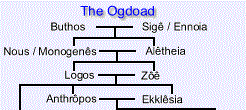
The Ogdoad, as the name suggests, is a group of eight Aeons.

The emanation takes place in the following manner: Depth-and-Silence gives birth to Mind-and-Truth (Nous and Aletheia), who gives birth to Word-and-Life (Logos and Zoë), who gives birth to Man-and-Church (Anthropos and Ecclesia). These Aeonic pairs comprise the Fullness of Godhead (Pleroma), and the first eight Aeons that have been expounded here are the Valentinian Ogdoad.

The Only-Begotten, perceiving with what intention he had been produced, on his part projected with his consort the pair Word (m.) and Life (fem.), respectively father of all things coming after him, and beginning and form-mother of the whole Pleroma.
From them came forth Man and Church (Ecclesia: female), and this is the original Ogdoad. These Aeons, produced to the glory of the Father, wished to glorify the Father by their own creations, and produced further emanations. From Word and Life issued ten additional Aeons, from Man and Church twelve, so that out of Eight and Ten and Twelve is constituted the Fullness (Pleroma) of thirty Aeons in fifteen pairs.

The Apocalypse of Paul

The Spirit spoke, saying, "Give him the sign that you have, and he will open for you." And then I gave him the sign. He turned his face downwards to his creation and to those who are his own authorities.

And then the <seventh> heaven opened and we went up to the Ogdoad. And I saw the twelve
apostles. They greeted me, and we went up to the ninth heaven. I greeted all those who were in the ninth heaven, and we went up to the tenth heaven. And I greeted my fellow spirits.

Paul gives a sign the spirit opens for him the doors of the eighth heavenly realm


The Discourse on the Eighth and Ninth:

"My father, yesterday you promised me that you would bring my mind into the eighth and afterwards you would bring me into the ninth. You said that this is the order of the tradition."

This refers to the eighth stage of ascent to the divine. Prayers to God opens the Nous (that is the mind of the believer) to spiritual vision.


"My son, what is fitting is to pray to God with all our mind and all our heart and our soul, and to ask him that the gift of the eighth extend to us, and that each one receive from him what is his. Your part, then, is to understand; my own is to be able to deliver the discourse from the fountain that flows to me." 


By praying (that is joining the "powers" in silent praise) we can ascend to the eighth: 

"Lord, grant us a wisdom from your power that reaches us, so that we may describe to ourselves the vision of the eighth and the ninth. We have already advanced to the seventh, since we are pious and walk in your law. 


I am Mind, and I see another Mind, the one that moves the soul! I see the one that moves me from pure forgetfulness. You give me power! I see myself! I want to speak! Fear restrains me. I have found the beginning of the power that is above all powers, the one that has no beginning. I see a fountain bubbling with life. I have said, my son, that I am Mind. I have seen! Language is not able to reveal this. For the entire eighth, my son, and the souls that are in it, and the angels, sing a hymn in silence. And I, Mind, understand."

"What is the way to sing a hymn through it (silence)?"
"Have you become such that you cannot be spoken to?"
"I am silent, my father. I want to sing a hymn to you while I am silent."

"Then sing it, for I am Mind."


No hidden word will be able to speak about you, Lord. Therefore, my mind wants to sing a hymn to you daily. I am the instrument of your spirit; Mind is your plectrum. And your counsel plucks me. I see myself! I have received power from you. For your love has reached us."


From that place, the three powers came forth, the three ogdoads that the Father brings forth in silence with his providence, from his bosom, i.e., the Father, the Mother, (and) the Son. (The Gospel of the Egyptians)


Friday, 6 September 2019

Valentinian Cosmology Explained


Valentinian Cosmology


Valentinian Cosmology: The Structure of the Pleroma and the Drama of the Aeons

Valentinian Cosmology is a complex doctrinal system. In modern discussions of Gnosticism, some people claim that Gnosticism is “post-doctrinal” and that doctrine or dogma are negative things. However, this idea does not reflect the reality of the classical Gnostic schools. For the ancient Gnostics—especially the Valentinians—doctrine was essential. Cosmology was not merely speculative mythology but a structured theological framework explaining the origin of the universe and the nature of humanity.

Cosmology directly determines anthropology. Cosmogony is the study of the creation of the universe, while Christian anthropology is the study of the human being in relation to the Deity. For the Valentinians, understanding the structure of reality reveals the nature and destiny of humanity. Human existence is interpreted through the cosmic drama that unfolds in the divine realm.

Valentinian cosmology is rooted primarily in the prologue of the Gospel of John. Valentinians interpreted the opening verses of John as describing the primordial structure of divine reality prior to the creation of the visible universe. The prologue, in their view, reveals the divine attributes that exist within the Deity and which together form the Pleroma.

The Valentinians believed that certain Greek terms appearing in the prologue of John and in the letters of Paul describe the full range of divine attributes. These attributes are personified as Aeons—divine realities that together form the fullness of existence beyond the visible universe.

To explain the divine attributes, Valentinian teachers referred to the opening lines of the Gospel of John, where it is written that the Word existed in the beginning. They interpreted this passage not merely as referring to speech but to the internal activity of divine consciousness. According to the Valentinian teacher Theodotus:

“Through his own Thought as the one who knew himself, he (the Father) brought forth the spirit of knowledge, which is in knowledge, the Only-Begotten (Son)” (Excerpts of Theodotus 7:1).

Thus the Word refers to the internal manifestation of the divine mind.

The Pleroma

The central concept of Valentinian cosmology is the Pleroma.

The word Pleroma means “fullness.” It refers to the complete totality of divine existence beyond the visible universe. It is the realm of the Aeons, the heavens, or the spiritual universe.

The Pleroma, however, was not believed to exist eternally in its present form. According to Valentinian tradition, it was produced through a process called emanation. The Eternal Spirit generated the divine fullness through a process of self-manifestation.

As the Bruce Codex states:

“He created the holy Pleroma in this way.” (The Untitled Text in the Bruce Codex)

The source of the Pleroma is Bythos, a term meaning “Depth.” The term is associated with the language of Paul in Romans:

“O the depth of the riches both of the wisdom and knowledge of God!” (Romans 11:33)

In Valentinian interpretation, this “Depth” represents the ultimate divine source from which all existence proceeds.

The Aeons are the manifestations of this divine source. They are not merely symbolic ideas but living expressions of divine qualities. The Tripartite Tractate explains their nature:

“For each of the aeons is a name corresponding to each of the Father's qualities and powers.” (Tripartite Tractate)

Thus each Aeon corresponds to a particular attribute of the divine mind.

The Pleroma is therefore both the dwelling place of the Aeons and the essential nature of the ultimate Deity. It represents the fullness of divine being.

Valentinian teachers also described the Pleroma as a state of consciousness. It is the realm where divine attributes exist in perfect unity and harmony.

The lower regions of the Pleroma are closest to darkness—that is, the physical universe. The physical cosmos represents the furthest extension of the divine unfolding.

Different Forms of the Myth

Valentinian cosmology appears in different forms across various texts. The basic structure remains the same, but some details differ.

For example, in the Tripartite Tractate the fall occurs because of the actions of the Logos rather than Sophia, which is the explanation found in many other texts.

Another important point is that Valentinian mythology does not use certain terms that appear in other Gnostic traditions. Names such as Barbelo or Yaldabaoth belong to Sethian mythology rather than Valentinian cosmology.

Valentinians also described the emanations of the divine fullness in terms of syzygies, meaning pairs. Each pair consists of a masculine and feminine principle representing complementary aspects of divine reality.

Examples include:

Logos (male) and Zoe (female)
Anthropos (male) and Ekklesia (female)

These pairs express the balance of complementary attributes within the divine nature.

Valentinian teachers did not necessarily consider this cosmological system to be a literal myth. Instead, it was understood as a symbolic description of the internal life of the Deity prior to creation. It may therefore be better described as a primordial drama rather than a myth.

The Pattern of Heavenly Things

The Pleroma is described as the archetypal realm—the pattern upon which the visible universe was modeled.

This idea appears in several passages of the New Testament that speak about heavenly patterns shown to Moses.

Acts records:

“Our ancestors had the tent of testimony in the wilderness, as God directed when he spoke to Moses, ordering him to make it according to the pattern he had seen.” (Acts 7:44)

The Epistle to the Hebrews expands on this idea:

“Who serve unto the example and shadow of heavenly things, as Moses was admonished of God when he was about to make the tabernacle: for, See, saith he, that thou make all things according to the pattern shewed to thee in the mount.” (Hebrews 8:5)

And again:

“It was therefore necessary that the patterns of things in the heavens should be purified with these; but the heavenly things themselves with better sacrifices than these.” (Hebrews 9:23)

These passages were interpreted as referring to the heavenly archetypes that exist within the Pleroma.

The Jewish philosopher Philo of Alexandria described a similar concept:

“The incorporeal world then was already completed, having its seat in the Divine Reason; and the world, perceptible by the external senses, was made on the model of it; and the first portion of it, being also the most excellent of all made by the Creator, was the heaven, which he truly called the firmament, as being corporeal; for the body is by nature firm....called it the heaven, either because it was already the Boundary of everything, or because it was the first of all visible things which was created.”

Philo explains that the visible universe was created according to an earlier intellectual model existing in the divine mind. Valentinian cosmology interprets this model as the structure of the Pleroma.

The Father

Valentinian theology begins with the supreme source known as the Father.

According to the ancient sources, the Father is beyond direct perception. As Irenaeus reports:

“uncontained, incomprehensible and cannot be seen or heard” (Against Heresies 1:2:5).

Because of this, the Father cannot be described in ordinary terms. He is infinite, without beginning or end, and is the origin of everything that exists.

The Father encompasses all things while remaining greater than them. As the texts explain, everything exists within him even while appearing distinct.

The divine nature unfolds itself through a process of manifestation. This process produces the multiplicity of beings while preserving the unity of the divine source.

Valentinian writers emphasized that the divine nature includes both masculine and feminine aspects. These aspects represent the dual functions of form and substance within creation.

The feminine aspect is associated with Silence, Grace, and Thought. Silence represents the primordial state of divine tranquillity and self-awareness.

As one text explains:

“Silence is God's primordial state of tranquillity.” (Valentinian Exposition 22:24)

Thought represents the active creative principle through which subsequent states of being are produced.

The masculine aspect is associated with names such as Ineffable, Depth, and First Father. Depth represents the incomprehensible dimension of the Deity.

Some sources describe the masculine aspect as passive until activated by the creative Thought.

However, Valentinian writers emphasized that these two aspects are not separate beings. Rather, they represent simultaneous states within the divine nature.

As Hippolytus explains:

“They exist as simultaneous states of being within the Godhead.” (Refutation of Heresies 30:8)

Thus the divine unity remains intact.

The Son

The origin of the universe begins with the emanation of the Son.

In the beginning nothing existed as a separate creation. The divine fullness existed only as potential within the Father.

One source explains:

“the self-begotten contained in himself everything, which was in him in unawareness.” (Panarion 5:3)

For the process of emanation to occur, a boundary had to be established.

This boundary is called the Limit or Cross. It allows the Aeons to exist separately from the Father without dissolving back into him.

As Irenaeus explains:

“It consolidates the All and keeps it outside of the Ineffable Greatness.” (Against Heresies 1:2:2)

Through this structure the Father manifests himself in a comprehensible form.

This manifestation is the Only-Begotten Son.

The Son is the image of the incomprehensible Father. Through the Son the divine nature becomes knowable.

As the text explains:

“He who came forth from knowledge, that is, from the Father's thought became himself knowledge, that is, the Son, because 'through the Son the Father is known'.” (Excerpts of Theodotus 7:1)

Thus the Son is the mediator through whom the divine nature becomes intelligible.

The Aeons

The Son then begins the process of further emanation. From him proceed additional pairs of Aeons.

The first pair is Word and Life.

The second pair is Humanity and Church.

These pairs are described in the prologue of the Gospel of John.

Valentinian interpreters claimed that when John wrote:

“The Word existed in the Beginning” (John 1:1)

he was referring to the divine attributes Mind and Truth.

When John wrote:

“What was made had Life in union with the Word.” (John 1:4)

he referred to Word and Life.

And when he wrote:

“Life was the light of human beings.” (John 1:4)

he referred to Humanity and Church.

These eight Aeons together form what is called the Ogdoad—the first eight emanations of the divine fullness.

The texts explain their significance:

“The Eight are the root and substance of all things.” (Against Heresies 1:1:1)

From them proceed the remaining Aeons.

Ten Aeons proceed from Word and Life, and twelve Aeons proceed from Humanity and Church.

Together they form the complete set of thirty Aeons.

This structure represents the full manifestation of divine attributes within the Pleroma.

The Fall of Wisdom

Despite the harmony of the Pleroma, a crisis eventually occurs.

The Aeons desire to know the ultimate source from which they originated.

Valentinus describes this longing:

“The All went about searching for the one from whom they had come forth.” (Gospel of Truth 17:4-9)

This search leads to error.

The youngest Aeon, Wisdom (Sophia), attempts to comprehend the ultimate Father without the mediation of the Son.

This attempt produces a defective state of thought.

The text describes the result:

“ignorance of the Father caused agitation and fear.” (Gospel of Truth 17:10)

Sophia’s defective thought is described metaphorically as an abortion.

“she wished to be like the Father.” (Refutation of Heresies 30:6)

The defect is separated from the Pleroma through another boundary.

Sophia herself is restored to the fullness, but the defective thought remains outside the divine realm.

This defective state becomes the origin of the lower world.

The Lower Wisdom and the Material Realm

The defective thought remains in a realm of ignorance and suffering. This state is called the deficiency.

The lower Wisdom—often called Achamoth—represents the archetype of humanity trapped in ignorance.

She experiences grief, fear, and confusion while searching for the divine.

Eventually she repents and seeks help.

In response, the Savior descends into the deficiency.

As the text states:

“He emptied himself.” (Philippians 2:7)

Through the intervention of the Savior, Wisdom receives knowledge and is liberated from illusion.

From this encounter she produces spiritual seeds.

These seeds represent the spiritual element within human beings.

The Material Creation

The material world is then formed as a place where these spiritual seeds can develop.

Wisdom influences a figure called the Craftsman to create the universe.

Through him she forms the heavens and the earth.

The Craftsman creates seven heavens corresponding to the seven days of creation.

Human beings are formed in the image of the primordial Humanity within the Pleroma.

Each human contains multiple elements including the spiritual seed capable of receiving knowledge.

The ultimate restoration occurs when all spiritual seeds attain knowledge.

At that time the deficiency will disappear.

The text concludes with a dramatic description of the final transformation:

“the fire which is hidden in the world will blaze up and ignite and destroy all matter and consume itself at the same time and pass into nothingness.” (Against Heresies 1:7:1)

When this occurs the restoration of the Pleroma will be complete.


Who is Adam Kadmon?

Adam Kadmon 


Adam Kadmon, the architypal man was compounded of these qualities of the Spirit. Jesus, after his baptism, being the final repository of the Spirit, for it had rested in him, could now confer its several gifts on those who accepted him

Anthropos

A number of Hebrew and Greek terms refer to man. ´Adham´ means “man; human; earthling man; mankind” (generic); ´ish, “man; an individual; a husband”; ´enohsh´, “a mortal man”; ge´ver, “an ab
le-bodied man”; za·khar´, “a male”; a few other Hebrew words are also sometimes translated “man.” 

The Greek anthropos means “man; mankind” (generic); aner´, “a man; a male person; a husband.”

444. ἄνθρωπος anthropos anth’-ro-pos; from 435 and ωψ ops (the countenance; from 3700); man-faced, i.e. a human being: —  certain, man. 


 Elohim (the Powers) said: “Let us make man [´a·dham´] in our image, according to our likeness.” (Ge 1:26, 27; Pr 8:30, 31; compare Joh 1:1-3; Col 1:15-17.) 


Man was made "in the image" of the Elohim (Powers), and inasmuch as they are "sons of God," the image is divine (though the nature of man is not). James makes the point that "we are made after the similitude of God," "even the Father" (James 3:9).


"While image, then, hath reference to form or shape, 'likeness' hath regard to mental constitution, or capacity... Adam's mental capacity enabled him to comprehend and receive spiritual ideas, which moved him to veneration, hope, conscientiousness, the expression of his views, affections, and so forth. Seth was capable of the like display of intellectual and moral phenomena; and of an assimilation of character to that of his father. He was therefore in the likeness as well as in the image of Adam; and, in the same sense, they were both 'after the likeness of the Elohim.

Adam was made in the likeness of his heavenly counterpart the Adam Kadmon, the architypal man, who is the logos or the anointing spirit (Messiah or Christ)

Adam and Seth being two versions of the "Archetypal Man" or Anthropos

Ro 5:14  Nevertheless death reigned from Adam to Moses, even over them that had not sinned after the similitude of Adam’s transgression, who is the figure of him that was to come.


The word ''figure" signifies type. Rotherham translates this: "Adam, who is a type of the coming one". The Greek word tupos describes a pattern, or mould, into which a final product is fitted or poured; an impression, or mark, which is made by percussion.

the One created the Anthropos in its own image, as an androgynous angel (i.e. male and female). This was the First Man Adam Kadmon,
"Adam Kadmon" (= אדם קדמון) and "Nakhash Kadmon" (= נחש קדמון), 

Anthrôpos is the pure mind a mind conceived hypostatically as emanating from God

the Anthropos -- an aeon in the Pleroma, one of the attributes of the Ultimate Oneness, 


Adam Kadmon


the Jewish concept of Adam Kadmon is the Christian concept of the “Mystical Body of Christ"

However the Christian understanding of Adam Kadmon is very different from the Jewish concept which is a primordial heavenly man. It is he that is the true “image of God,” a majestic vessel of divine glory, the ideal human (Deut. 4:32; PdRK 4:4, 12:1, Lev. R. 20:2). All earthly humans (Gen. 2-3) are in his image 


What is most striking to me is Paul’s insistence on the “order” of being. Paul pointedly states the “spiritual Adam” was not first.

So, too, it is written, "The first man, Adam, became a living being," the last Adam a life-giving spirit. But the spiritual was not first; rather the natural and then the spiritual. 

The first man was from the earth, earthly; the second man, from heaven. As was the earthly one, so also are the earthly, and as is the heavenly one, so also are the heavenly. 

Just as we have borne the image of the earthly one, we shall also bear the image of the heavenly one. (I Corinthians 15:45-50)

This indicates to me that Paul is both aware of and modified an already well-known doctrine of a “spiritual Adam” that people believed preceded the earthly Adam. Since Jesus came millenia after human creation, Paul finds it necessary for the spiritual Adam be the crowning moment of humanity, rather then its origin.

Jesus sometimes use the term "Son of man" not to refer Himself but the Heavenly Adam Kadmon, the perfect man the full grown Christ


Therefore the true Adam Kadmon is a Corporate Being the mystical body of Christ

Jesus is the head of this Adam Kadmon or son of man the true believers are the body of Adam Kadmon


“Now you are Christ’s body, and members individually,” in a spiritual sense. 1Co 12:27


Adam Kadmon also refers to a the higher state of consciousness which Jesus' atonited message produces. Jesus is the first fruits or prototype of this higher consciousness the Christ-consciousness. Jesus' aonited teachings put the body of Christ-consciousness in reach of us all.


Adam Kadmon is a Corporate Being called the Son of Man (Dan 7 Rev 1) others call it the mystical body of Christ it refers to large number/body of people who are in the Christ consciousness or the Corporate Being the Son of Man the multitudinous Christ


Wednesday, 4 September 2019

What is Repentance?

What is Repentance?


Repent is, in the original Greek, "change your mind."

repentance can mean a reformation from within see Mt 3:8  bear, therefore, fruits worthy of the reformationYoung's Literal Translation

Young's Literal Translation Mt 3:1 ¶  And in those days cometh John the Baptist, proclaiming in the wilderness of J
udea,
2  and saying, ‘Reform, for come nigh hath the reign of the heavens,’
3  for this is he who was spoken of by Isaiah the prophet, saying, ‘A voice of one crying in the wilderness, Prepare ye the way of the Lord, straight make ye His paths.’
4  And this John had his clothing of camel’s hair, and a girdle of skin round his loins, and his nourishment was locusts and honey of the field.
5  Then were going forth unto him Jerusalem, and all Judea, and all the region round about the Jordan,
6  and they were baptized in the Jordan by him, confessing their sins.
7 ¶  And having seen many of the Pharisees and Sadducees coming about his baptism, he said to them, ‘Brood of vipers! who did shew you to flee from the coming wrath?
8  bear, therefore, fruits worthy of the reformation,

Reformation The act of reforming, or the state of being reformed; change from worse to better; correction or amendment of life, manners, or of anything vicious or corrupt; as, the reformation of manners; reformation of the age; reformation of abuses. 

Jesus himself knew the heart of men and he knew that the revolution must come from within because defilement comes from within

Mark 7:17 When he had entered a house away from the crowd, his disciples began to question him about respecting this illustration.18 So he said to them, "Are you thus without understanding also? Do you not perceive that whatever enters a man from outside cannot defile him, 19 because it does not enter his heart but his stomach, and then goes out into the sewer.” 20 And he said, "What comes out of a man, that defiles a man. 21 For from within, out of the heart of men, proceed evil thoughts, adulteries, fornications, murders, 22 thefts, covetousness, wickedness, deceit, lewdness, an evil eye, blasphemy, pride, foolishness. 23 All these evil things come from within and defile a man." 

The Greek word found in strong’s 3341 metanoia is translated "repentance," does not mean an admission to God of sorrow for past sin and a resolve to be good in the future. literally means is after-knowing (in contrast to foreknowing) and signifies a change in one’s mind, attitude, or purpose.

In Greek, two verbs are used in connection with repentance: me·ta·no·e´o and me·ta·me´lo·mai. The first is composed of me·ta´, meaning “after,” and no·e´o (related to nous, the mind, disposition, or moral consciousness), meaning “perceive, discern, mentally grasp, or be aware.” Hence, me·ta·no·e´o literally means afterknowing (in contrast to foreknowing) and signifies a change in one’s mind, attitude, or purpose. Me·ta·me´lo·mai, on the other hand, comes from me´lo, meaning “care for or have interest in.” The prefix me·ta´ (after) gives the verb the sense of ‘regretting’ (Mt 21:30; 2Co 7:8), or ‘repenting.’

Thus, repentance stresses the changed viewpoint or disposition, a rejecting of the past or intended course or action as undesirable. It is clear that the mission of John the baptist was to bring about a change of mind. The fundamental idea taught by the Scriptures is not that man must know sorrow, but rather that he must undergo a change, a change not merely of conduct but of the thinking and attitude.

Repentance means change of mind, transformation of the mind, change of thought and purpose.

A proper translation of the mission of John the baptist is: He came into all the region around the Jordan preaching submersion of reformation into a forgiveness of sins;


The Revolution of Consciousness is the FIFTH GOSPEL, we urgently need a radical, total and definitive change, and this is only possible through the Revolution of Consciousness. Intimate Self-Realization is only possible in isolated individuals with the help of adequate knowledge and methods. Such an intimate revolution can only occur within the individual and is in fact against the interests of Nature.

Wednesday, 28 August 2019

Symbolic Meaning to Henry Sulley's Temple

Symbolic Meaning to Henry Sulley's Temple

The squared circle has been a popular theme in the occult and in Alchemy for centuries and it still an important symbol within it. The square represents the physical world, because it represents the four elements, the four cardinal directions, the four seasons etc. The circle represents the spirit because it is infinite and it goes out in all directions. 

 In ICorinthians 6:19 and in II Corinthians 6:16 we learn that man's body is the temple or house of God

Ezekiel's Temple is a symbol of the spiritual body of man. when he attain it, he will never again leave. This enduring temple is built in the understanding of Spirit as the one and only cause of all things..


Here You can see a diagram of Henry Sulley's Temple it is a circle within a square 

Ezekiel 40-48:35. This section is in the tone of Love and it speaks of the city foursquare and the temple’s measurements.

The 4 corners of the square represents the 4 letter of the name of God YHWH Yahweh the divine name

The circle represents the fellowship of the believers and fellowship with God by sharing his divine nature 2 peter 1:4


The circle therefore represents infinite or the Pleroma 


A squared circle represents the perfection of spirit and flesh combined.


The altar is representative of the divine presence” - therefore it must be at the center


It represents the perfection of Man


The circle is the symbol of wholeness and completion


It is a symbol of the One becoming the Many without ever ceasing to be the One.


The Threefold Nature of Man

The Threefold Nature of Man
the flesh the soul and spirit


54 From Adam three natures were begotten. The first was the irrational, which was Cain's, the second the rational and just, which was Abel's, the third the spiritual, which was Seth's. Now that which is earthly is “according to the image,” that which is psychical according to the “likeness” of God, and that which is spiritual is according to the real nature; and with reference to these three, without the other children of Adam, it was said, “This is the book of the generation of men.” And because Seth was spiritual he neither tends flocks nor tills the soil but produces a child, as spiritual things do. And him, who “hoped to call upon the name of the Lord” who looked upward and whose “citizenship is in heaven” – him the world does not contain. (Extracts from the Works of Theodotus)


Man is a creation of the Demiurgus or the Elohim. He is formed from matter (hulê), receives a soul (psuchê) from the Demiurgus, and a spirit (pneuma) from Achamoth. The nature of man is thus a compound formed of three elements, Body, Soul, and Spirit.


Man has three natures spirit and soul and body


1 Thessalonians 5:23 May the very God of peace sanctify YOU completely. And sound in every respect may the spirit and soul and body of YOU [brothers] be preserved in a blameless manner at the presence of our Lord Jesus Christ. 24 He who is calling YOU is faithful, and he will also do it.


The “spirit” (Heb., ruach; Gr., pneuma) should not be confused with the “soul” (Heb., nephesh; Gr., psykhe´), for they refer to different things. Thus, Hebrews 4:12 speaks of the Word of God as ‘piercing even to the dividing of soul and spirit, and of joints and their marrow.’ (Compare also Php 1:27; 1Th 5:23.) As has been shown, the soul (nephesh; psykhe´) is the creature itself. The spirit (ruach; pneuma) generally refers to the life-force of the living creature or soul, though the original-language terms may also have other meanings.

The spirit is the mind of man the soul is the heart or emotions and of course the body is a physical nature

The “spirit” (Heb., ruach; Gr., pneuma) should not be confused with the “soul” (Heb., nephesh; Gr., psykhe´), for they refer to different things.


Definition: A Body is a physical or spiritual vessel. In other words a human or angelic body.

Definition: A Soul is a human body.

Definition: A Dead Soul is a dead body

Definition: A Spirit is a character, a personality. It is 'you'.


"Operating upon the brain [physical (body)], it [indwelling sin] excites the 'propensities' (the outward senses), and these set the 'intellect' [mental (spirit)], and 'sentiments' [moral (soul)] to work. The propensities are blind, and so are the intellect and sentiments in a purely natural state; when therefore, the latter operate under the sole impulse of the propensities, 'the understanding is darkened through ignorance, because of the blindness of the heart'". Ephesians 4:18


Man has three natures spirit and soul and body


The Flesh or hylics

hylics, also called somatics (from Gk σώμα (sōma) "body"),

An extension of the idea that flesh composes the visible, tangible parts of the body is the use of the word “flesh” to refer in a general way to the whole body. (Le 17:14; 1Ki 21:27; 2Ki 4:34) It is also used to refer to the person, or individual, as a human of flesh. (Ro 7:18; Col 2:1, 5

. “Flesh” is often used in the Bible to represent man in his imperfect state, ‘conceived in sin’ as an offspring of rebellious Adam. (Ps 51:5; Ro 5:12; Eph 2:3) In humans who are trying to serve God, ‘the spirit [impelling force emanating from the figurative heart] is eager, but the flesh is weak.’ (Mt 26:41) Within these servants of God there is a constant conflict; God’s holy spirit is a force for righteousness, but the sinful flesh continually wars against the spirit’s influence and exerts pressure to induce the individual to perform the works of the flesh. (Ro 7:18-20; Ga 5:17) The works of sinful flesh are contrasted with the fruitage of the spirit, at Galatians 5:19-23.

The Spiritual Man and The soulful.

The apostle contrasts the spiritual man with the physical man. He says: “But a physical [literally, soulical] man does not receive the things of the spirit of God, for they are foolishness to him.” (1Co 2:14) This “physical man” does not mean merely one living on earth, one with a fleshly body, for, obviously, Christians on earth have fleshly bodies. The physical man here spoken of means one who has no spiritual side to his life. He is “soulical” in that he follows the desires of the human soul to the exclusion of spiritual things.

Paul continues about the “physical man,” that he cannot get to know the things of the spirit of God “because they are examined spiritually.” Then he says: “However, the spiritual man examines indeed all things, but he himself is not examined by any man.” The spiritual man has understanding of the things God reveals; he sees also the wrong position and course of the physical man. But the spiritual man’s position, actions, and course of life cannot be understood by the physical man, neither can any man judge the spiritual man, for God only is his Judge. (Ro 14:4, 10, 11; 1Co 4:3-5) The apostle says by way of illustration and argument: “For ‘who has come to know the mind of Jehovah, that he may instruct him?’” No one, of course. “But,” Paul says of Christians, “we do have the mind of Christ.” By getting the mind of Christ, who reveals Jehovah and his purposes to Christians, they are spiritual men.—1Co 2:14-16.

James chapter 1 "A double minded man is unstable in all his ways" — The word "double-minded" is a translation of dipsuchos which signifies two-souled! One soul is for God, and one is for self! The double-minded man has feet in both camps. Jas 3:15 This wisdom is not one, from above, coming down, but is earthly, born of the soul, demoniacal!


Jude 1:19 These, are they who make complete separation, mere men of soul, Spirit, not possessing.

The Unknown God


Acts 17:23 For as I passed by, and beheld your devotions, I found an altar with this inscription, TO THE UNKNOWN GOD. Whom therefore ye ignorantly worship, him declare I unto you.

Justin Martyr says that men referred to Yahweh as "the completely hidden One."

The building of an altar to an unknown god indicated that the people of Athens desired to know God.

In his oration Paul said to the Athenians, “I found also an altar with this inscription, TO AN UNKNOWN GOD.” In intellectual consciousness what does this altar indicate? The dedication of an altar to the unknown God is an admission of ignorance, but it is often boasted of as indicative of tolerance and religious generosity. The broad-minded man with a devotional turn of mind points to his altar to the unknown God and says, “Although we know nothing about your omnipresent, spiritual God, this altar shows that we are not narrow; that we welcome all concepts of God.”

“An Unknown God,” thereby avoiding all cause for offense. At the same time, he awakened in his listeners a desire to know something of the real God, which their idol typified

The character of God as Absolute Being cannot be comprehended by the intellect. The Truth, therefore, makes a total denial of all beliefs about God of a temporal character. God does not require anything at our hands, being the source of all. Even personality is not recognized by the Divine Mind; he knows only unity and oneness in all men and all nations.


Saturday, 24 August 2019

Spiritual Evolution

Spiritual evolution


Image result for Spiritual evolution bible

evolution--comes from the word evolve meaning to develop gradually.

The development obtained by a believer through accurate knowledge of the law of Christ. It is the result of the development of the divine Logos in mind. What we are and what we are to be come is the result of the evolving of our consciousness, and this state of mind or new awareness is the result of seed spirit-word sown in the mind.


God implanted His perfect word--developed this seed word in each true believer.


Jesus said: Look, the sower went out, he filled his hand (and) cast (the seed). Some fell upon the road; the birds came, they gathered them. Others fell upon the rock, and struck no root in the ground, nor did they produce any ears. And others fell on the thorns; they choked the seed and the worm ate them. And others fell on the good earth, and it produced good fruit; it yielded sixty per measure and a hundred and twenty per measure.


Thus spiritual evolution is the unfolding in consciousness of that which God has implanted in a believer.


the evolving of our consciousness is the transforming of our mind


Romans 12:2 Do not conform to the pattern of this world, but be transformed by the renewing of your mind. Then you will be able to test and approve what God's will is--his good, pleasing and perfect will.


Therefore spiritual evolution, is the unfolding of the Spirit of God into action. The mind of a believer is the garden of God, of which the seed is the spirit-word sown into our mind and heart. The Christ consciousness or Christ mind evolution in a believer is plainly taught in the Scriptures as the most important realization of every believer.


1 Corinthians 2:16 For WHO HAS KNOWN THE MIND OF YAHWEH, THAT HE WILL INSTRUCT HIM? But we have the mind of Christ.


Romans 8:9 However, you are not in the flesh but in the Spirit, if indeed the Spirit of God dwells in you But if anyone does not have the Spirit of Christ, he does not belong to Him.


Colossians 3:10 and have put on the new man who is renewed in knowledge according to the image of Him who created him, 
11 where there is neither Greek nor Jew, circumcised nor uncircumcised, slave nor free, but Christ is all and in all.
12 Therefore, as the elect of God, holy and beloved, put on tender mercies, kindness, humility, meekness, longsuffering; 
13 bearing with one another, and forgiving one another, if anyone has a complaint against another; even as Christ forgave you, so you also must do. 
14 But above all these things put on love, which is the bond of perfection.

Without some evidence in us of the Christ consciousness or the mind of Christ we are little better than animals. When through faith in the reality of things spiritual we begin conscious evolution there is great rejoicing; "we rejoice in hope of the glory of God."


The old man and the new man

The old man is the outward senses, the carnal mind, the thinking of the flesh, the ego or personality. The old man is separate in consciousness from God. This is a believer before he or she receives the new life that is in Christ.

We must crucify the old man and remove him out of our consciousness so that the Christ may be resurrected in us. This we do by the renewing of our mind.

Do not conform to the pattern of this world, but be transformed by the renewing of your mind
and have put on the new self who is being renewed to a true knowledge according to the image of the One who created him

The "new man" is born of the word of God.  A birth is a coming into a state of being. The "new birth" is the coming into a higher state of being. The realisation by the believer of his or her spiritual identity, the Christ consciousness the real seal.

The contrast between the old man and the new man is similar to that which Paul draws in 1 Cor. 15:45 between the “first man”, Adam, and the “last” man, Christ. Therefore I suggest that the “old man” here is a reference to our status in Adam; by baptism we pass from that status to that of the “new man”, Christ. Eph. 4:22-24 exhorts baptized believers to put off the old man and put on the new man- i.e. to live out in practice the change in status which occurred in baptism.

“The new man” is composed of both Jew and Gentile (Eph. 2:15; Col. 3:10,11)- connecting with how Gal. 3:27-29 explains that baptism into Christ likewise gives us a status of “in Christ” which thereby removes any difference between Jew and Gentile. If “the old man” refers to our status in Adam which has now ended, been crucified, then we need no longer be phased by the fact that no baptized believer manages to totally avoid sinning; none of us have put to death the old manner of life in totality. All our days we seek to respond to the change of status which has occurred, living appropriate to that change.

We must " put off the old man" (Eph. 4:22); and yet " ye have put off the old man" (Col. 3:9). Have we, or haven't we? In God's eyes we have, in that the new man has been created, and the old man died in the waters of baptism. But of course we are still in the flesh; and the old man must yet be put off. What happened at our baptism must be an ongoing process; of laying the old man to rest in death, and rising again in the newness of life. The Gospel 'instructs us to the intent that, having once and for all put away ungodliness (i.e. in baptism) and worldly lusts, we should live in a holy manner' (Tit. 2:12 Gk.). Having put these things off in baptism, we must live a life of putting them off.

Thursday, 22 August 2019

Male and Female Demons The Gospel of Philip

Male and Female Demons The Gospel of Philip


The Gospel of Philip: 

The forms of evil spirit include male ones and female ones. The males are they which unite with the souls which inhabit a female form, but the females are they which are mingled with those in a male form, though one who was disobedient. And none shall be able to escape them, since they detain him if he does not receive a male power or a female power, the bridegroom and the bride. One receives them from the mirrored bridal chamber. When the wanton women see a male sitting alone, they leap down on him and play with him and defile him. So also the lecherous men, when they see a beautiful woman sitting alone, they persuade her and compel her, wishing to defile her. But if they see the man and his wife sitting beside one another, the female cannot come into the man, nor can the male come into the woman. So if the image and the angel are united with one another, neither can any venture to go into the man or the woman.
He who comes out of the world, and so can no longer be detained on the grounds that he was in the world, evidently is above the desire of the [...] and fear. He is master over [...]. He is superior to envy. If [...] comes, they seize him and throttle him. And how will this one be able to escape the great [...] powers? How will he be able to [...]? There are some who say, "We are faithful" in order that [...] the unclean spirits and the demons. For if they had the Holy Spirit, no unclean spirit would cleave to them. Fear not the flesh nor love it. If you fear it, it will gain mastery over you. If you love it, it will swallow and paralyze you.

in this part of the Gospel of Philip 65.1-66.7 the "evil spirit" and the "unclean spirits and the demons" are the passions of the flesh that is why Philip uses these expressions together "For if they had the Holy Spirit, no unclean spirit would cleave to them. Fear not the flesh nor love it. If you fear it, it will gain mastery over you. If you love it, it will swallow and paralyze you."


 thus unclean spirits are the thinking of the flesh and therefore we should not fear nor love the flesh only if we have the spirit of Christ (the Christ-Consciousness) can we fight against the flesh

male demons=wrath 
female demons=lust

The forms of evil spirit include male ones and female ones [evil spirits (thoughts and intents) are restricted to the “waters below” and therefore are male and female in form]. The males are they which unite with the souls which inhabit a female form [the physical female body], but the females are they which are mingled with those in a male form, though one who was disobedient [so these male forms were able to “hear the word” but fell out of the way - it seems to be more clearly explained below]. (Philip 46)

And none [who are “disobedient”] shall be able to escape them, since they detain him [“they do not go in yet hinder those who are from going in” this is about our personal battle between the spirit and the flesh] if he does not receive a male power [i.e. Christ in you”] or a female power [the “holy spirit”], the bridegroom and the bride [one needs both of these to unite in the bridal chamber (our heart) to conceive “regeneration” i.e. a son of God]. One receives them from the mirrored bridal chamber [the spiritual body (the image)]. When the wanton women [female demon] see a male [one who has the seed of Christ] sitting alone [not yet having received holy spirit (still using his own intellect and knowledge and not being guided by the spirit of truth)], they [the demons] leap down on him and play with him and defile him [they are able to subvert his mind towards the carnal nature]. So also the lecherous men [male demons], when they see a beautiful woman [one who has received holy spirit] sitting alone [has not yet received the seed of Christ (masculine seed) in them], they persuade her and compel her, wishing to defile her [they “wish to” but cannot for the holy spirit cannot be defiled – this one WILL eventually be drawn to and set-apart to Christ]. (Philip 47)

But if they see the man and his wife sitting beside one another [one who has both Christ (the masculine seed) in them and the holy spirit (truth and enlightenment of who and what you are) united as one in your heart] the female [demons] cannot come into the man, nor can the male [demons] come into the woman. So if the image [of God i.e. the heart of “man”] and the angel [holy spirit] are united with one another, neither can any venture to go into the man or the woman. (Philip 48) [Hence “What God has yoked together, let no man put asunder” – this is not the same as what men yoke together i.e. flesh to flesh – the Father yokes spirit to spirit (once you belong to Him it’s the end of the matter). Judas having not yet received holy spirit (true apprehension of who and what he is) was left vulnerable to the evil demon (the adversary which is that carnal nature which beguiles one into evil intent) who easily overcame him and used him for God’s own purpose – demons (evil thoughts and intentions) whether male (appealing to the brutish animal nature) of female (appealing to the emotions) are from within, they are the carnal and perverted nature of our subjective minds to the influences of others i.e. spiritual thievery and we all have these until they are destroyed (cast out of our hearts)]