Thursday, 21 February 2019

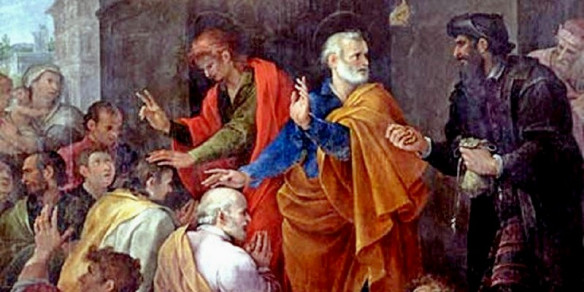
Simon Magus was not a Wicked Man Acts 8:24


Simon The Great One, Simon the Sorcerer or Simon the Magician,

A Sorcerer in the city of Samaria who so amazed the nation with his magical arts that the people said of him: “Everyone, from the least to the greatest, often spoke of him as “the Great One—the Power of God.” (Acts 8:10 New Living Translation compare Berean Study Bible)

In Acts 8:9-13 he is represented as having been held in awe by the Samaritans as the manifestation of the hidden power of God, and as being called by them "The Great One."

The early Christian Clementine "Recognitiones" (vii.-x.) represent Simon as a Jewish magician instead of a Samaritan, stating that he was a member of a Jewish household in Cæsarea, and that, when pursued by Peter, he fled to Judea. Mention is made, moreover, of a magician named Simon who lived in this very city of Cæsarea about the year 40 of the common era (Josephus, "Ant." xx. 7, § 2); so that some scholars consider the two to be identical (Hilgenfeld, "Ketzergeschichte," p. 170; Albert, "Die Ersten Fünfzehn Jahre der Christlichen Kirche," p. 114, Münster, 1900; Waitz, in "Zeitschrift für Neutestamentliche Wissenschaft," v. 128). (Jewish encyclopedia)

Because of Philip’s ministry, Simon “became a believer” and was baptized.

But to what extent was Simon really converted to the Truth (Acts 8:18-21)? His old way of life reasserted itself. Why? Because he reacted to the miracles rather than the Word. He acted in much the same way as those whom he had previously deceived! Which means that his "conversion" was not complete.

When the apostles became aware of the increase that was taking place in Samaria, they sent Peter and John there. Upon arriving, the two apostles laid their hands on the new disciples, whereupon each one received the holy spirit. When Simon saw this, he was fascinated. “Give me also this authority,” he told the apostles, “that anyone upon whom I lay my hands may receive holy spirit.” Simon even offered them money, hoping to buy this sacred privilege!—Acts 8:14-19

Simon decided to make a profession of true religion. His motivation was open to question. It is possible for men and women to profess an acceptance of the Truth, but without possessing a genuine motive.

Peter strongly reproved Simon, telling him that his heart was not right in God’s sight and urging him to repent and pray for forgiveness. In response, Simon asked these apostles to pray to the Lord on his behalf.—Acts 8:9-24.

Repent, therefore, of this badness of yours,” Peter urged Simon, “and supplicate the Lord that, if possible, the device of your heart [“this scheme of yours,” New Jerusalem Bible] may be forgiven you; for I see you are a poisonous gall and a bond of unrighteousness.”—Acts 8:22, 23.

Happily, Simon saw the seriousness of his wrong desire. He begged the apostles: “You men, make supplication for me to the Lord that none of the things you have said may come upon me.” (Acts 8:24)

Undoubtedly, Simon was not a wicked man; he wanted to do what was right, but he was momentarily misguided. So he pleaded with the apostles: “Both of you pray to the Lord for me that none of the things you have said will happen to me.”—Acts 8:20-24.
Simon the sorcerer as an allegory
Simon the sorcerer is the ambition of the ego or the sin consciousness to possess the power of Spirit without paying the price through faith and love. The offer of money for spiritual power involves the thought of man's putting a price on the free gift of God.

The power of the Holy Spirit is obtained only by unselfish service; therefore one's own power and glorification have "neither part nor lot" in the spiritual realm, the kingdom of heaven.

The only way to loose the bonds of self-hood, to make the heart right toward God, is through repentance, Sincere prayer, and meditation, which transforms selfishness into unselfishness, the ego into the true self;.

Romans 12:2 Do not conform to the pattern of this world, but be transformed by the renewing of your mind. Then you will be able to test and approve what God's will is--his good, pleasing and perfect will.

Col 3:10 And have put on the new man, which is renewed in knowledge after the image of him that created him:

Tit 3:5 Not by works of righteousness which we have done, but according to his mercy he saved us, by the washing of regeneration, and renewing of the Holy Ghost;

Friday, 15 February 2019

The Preexistence of the Church


The Preexistence of the Church


**The Preexistence of the Church**

The idea of preexistence, particularly as it relates to the people of the Deity, is rooted deeply in the Scriptures and is expressed through the language of foreknowledge, purpose, and divine intention. The concept does not suggest that individuals consciously existed prior to their birth, but rather that they existed within the knowledge, plan, and purpose of the Deity before they came into being. This understanding is essential when examining what may be termed the “preexistence of the Church,” that is, the collective body of believers who were known, chosen, and marked out beforehand.

One of the clearest early expressions of this idea is found in the calling of Jeremiah. The prophet records the words spoken to him: “Before I formed thee in the belly I knew thee; and before thou camest forth out of the womb I sanctified thee, and I ordained thee a prophet unto the nations” (Jeremiah 1:5). This statement establishes a foundational principle: the Deity’s knowledge of an individual precedes their physical formation. Jeremiah did not consciously exist prior to his birth, yet he was fully known, set apart, and appointed within the divine purpose.

This same principle extends into the New Testament and is applied not merely to individuals, but to the collective body of believers—the Church. In Ephesians 1:4, Paul writes: “according as He did choose us in him before the foundation of the world, for our being holy and unblemished before Him, in love.” Here, the Church is described as having been chosen before the foundation of the world. This does not imply that the Church existed as a conscious entity in a prior state, but that it existed within the foreknowledge and intention of the Deity.

The origins of this pre-existent Church are therefore tied directly to divine foreknowledge. Paul’s language reflects a consistent biblical pattern: what is foreknown is, in a sense, already established within the purpose of the Deity. This idea is further clarified in Romans 8:29: “For whom he did foreknow <4267>, he also did predestinate <4309> to be conformed to the image of his Son, that he might be the firstborn among many brethren.”

The word translated “foreknow” is the Greek *proginosko*, derived from *pro* (before) and *ginosko* (to know intimately). It signifies more than simple awareness; it denotes an intimate, relational knowledge that brings together. The Deity declares “the end from the beginning, and from ancient times the things that are not yet done” (Isaiah 46:10), and “calls those things which be not as though they were” (Romans 4:17). In this way, the past, present, and future are united within divine knowledge. What does not yet exist in human experience is already fully known and integrated within the divine purpose.

This foreknowledge forms the basis of divine selection. The choice of Jacob over Esau illustrates this principle: “Jacob have I loved, but Esau have I hated” (Malachi 1:2–3). This choice was not arbitrary but grounded in foreknowledge of their respective developments and characteristics. The Deity, knowing how each would respond and what each would become, made a selection consistent with His purpose.

The same principle applies to the calling of believers. The invitation goes out to those who have the capacity and desire to reflect the divine glory, as indicated in passages such as 1 Peter 1:2 and 2 Timothy 2:19. The Church, therefore, is not an afterthought in history but the result of a deliberate and foreknown purpose.

The usage of *proginosko* throughout the New Testament reinforces this understanding. In Romans 11:2, the Deity is said to have foreknown Israel as His people. In Acts 2:23, the term appears in the form *prognosis*, referring to the foreknowledge by which Jesus was delivered. In 1 Peter 1:20, the mission and sacrifice of Christ were foreknown before the foundation of the world. In Romans 8:29–30, those who are foreknown are also predestined. In 1 Peter 1:2, the election of the saints is according to foreknowledge. Even in Acts 26:5 and 2 Peter 3:17, the word is used in a more general sense of knowing beforehand.

Closely connected to foreknowledge is the concept of predestination, expressed by the Greek word *proorizo*. This term combines *pro* (before) and *horizo* (to mark out, determine, or set boundaries). It conveys the idea of defining a limit or horizon in advance. Thus, predestination refers not to the forcing of individual actions, but to the setting of a defined outcome or destiny.

As Paul states, those who are foreknown are “predestinate… to be conformed to the image of his Son” (Romans 8:29). The predetermined element is not the individual’s every action, but the standard to which they are called. The “horizon” has been set: conformity to the image of the Son.

This idea is further developed in Ephesians 1:9–12: “having made known unto us the mystery of His will, according to His good pleasure which He hath purposed in Himself: that in the dispensation of the fulness of times He might gather together in one all things in Christ... in whom also we have obtained an inheritance, being predestined according to the purpose of Him who worketh all things after the counsel of His own will.” The Church, as the body gathered into one in Christ, exists as part of this predetermined purpose.

Importantly, this predestination does not negate human responsibility. The Scriptures make clear that individuals are not forced into obedience. “Work out your own salvation with fear and trembling” (Philippians 2:12) emphasizes the necessity of personal response. The Deity has established the conditions and the outcome, but individuals must willingly conform to the required standard.

The foundation of this purpose can be traced back to the beginning. In the garden of Eden, after the failure of mankind, the way of life was preserved: “So he drove out the man; and he placed at the east of the garden of Eden Cherubims, and a flaming sword which turned every way, to keep the way of the tree of life” (Genesis 3:24). This act demonstrates that even in judgment, provision was made for future restoration.

The promise continues throughout Scripture, culminating in the assurance given to the faithful: “To him that overcometh will I give to eat of the tree of life, which is in the midst of the paradise” (Revelation 2:7). This inheritance is described as “incorruptible, and undefiled, and that fadeth not away” (1 Peter 1:4).

The principle of predestination is succinctly expressed in the statement: “He that believeth and is baptised shall be saved” (Mark 16:16). This is not an arbitrary decree but a defined and certain outcome for those who meet the established conditions. The destiny is set, but participation in that destiny depends on response and faithfulness.

Thus, the preexistence of the Church is to be understood not as a literal prior existence of individuals, but as their existence within the foreknowledge and purpose of the Deity. The Church was known, chosen, and marked out before the foundation of the world. Its members come into being in time, but their place within the divine plan was established from the beginning.

In this way, the Church stands as a manifestation of a purpose that transcends time. What is seen in history is the unfolding of what was already known. The believers, though living in the present, are part of a reality that was determined in advance—a community foreknown, predestined, and called to reflect the image of the Son, and to inherit the promises prepared from the foundation of the world.

**The Church “Before the Foundation”**

The language of Scripture concerning things “before the foundation of the world” must be carefully understood within the framework already established—namely, that of foreknowledge and predestination. Having seen that the Church exists within the purpose and knowledge of the Deity prior to its historical manifestation, it is now necessary to refine that understanding. Paul is not teaching the literal pre-existence of the Church as a conscious entity, but rather the pre-selection of believers according to divine foreknowledge.

This distinction is essential. To speak of pre-existence in a literal sense would suggest that individuals existed personally before their birth. Yet the consistent testimony of Scripture does not support such an idea. Instead, it presents a Deity who knows all things in advance, and who orders His purpose accordingly. Thus, when Paul speaks of believers being chosen “before the foundation of the world,” he is referring to their selection within the divine plan, not their personal existence in a prior state.

This principle is illustrated with clarity in Romans 9:11–14: “For the children being not yet born, neither having done any good or evil, that the purpose of the Deity according to election might stand, not of works, but of him that calleth; It was said unto her, The elder shall serve the younger. As it is written, Jacob have I loved, but Esau have I hated. What shall we say then? Is there unrighteousness with the Deity? God forbid.” This passage provides a concrete example of divine election operating prior to human action.

Jacob and Esau had not yet been born, nor had they performed any works, whether good or evil. Yet a declaration was made concerning them: “The elder shall serve the younger.” This was not a random or arbitrary choice, but one grounded in the foreknowledge of the Deity. As previously established, foreknowledge (*proginosko*) is not mere awareness, but an intimate and complete knowledge that encompasses the entirety of a person’s development.

The statement “Jacob have I loved, but Esau have I hated” (Malachi 1:2–3, cited in Romans 9) must therefore be understood in this light. It reflects a judgment based on what each would become, not an arbitrary preference imposed without cause. The Deity, knowing the end from the beginning, could declare this outcome before either individual had acted. Thus, the purpose of election stands “not of works, but of him that calleth,” meaning that it originates in divine knowledge and purpose rather than human effort as its cause.

This directly supports the idea of pre-selection rather than pre-existence. Jacob was not chosen because he existed beforehand in a spiritual realm, nor because he had already performed righteous deeds. He was chosen because the Deity foreknew his character and response. The same applies to Esau. The distinction lies not in prior existence, but in prior knowledge.

Paul anticipates the objection that such a teaching might imply injustice: “Is there unrighteousness with the Deity? God forbid.” The answer is emphatic. There is no unrighteousness, because the selection is not arbitrary. It is perfectly aligned with divine wisdom and complete knowledge. What appears to human perspective as a decision made “before” action is, from the perspective of the Deity, a decision made with full awareness of all action.

This understanding preserves both divine sovereignty and human responsibility. The Deity does not compel individuals to act in a certain way, nor does He arbitrarily assign destinies without regard to character. Rather, He foreknows how individuals will respond and establishes His purpose accordingly. Thus, election is based on foreknowledge, and predestination defines the outcome for those who align with that purpose.

When this principle is applied to the Church, the meaning of being chosen “before the foundation of the world” becomes clear. It does not mean that the Church existed as a gathered body in a prior realm. Instead, it means that the Deity, from the beginning, determined to call out a people who would conform to a defined standard—the image of His Son—and inherit the promises associated with that calling.

The Church, therefore, is pre-selected in the sense that its composition is known in advance. The Deity knows those who will respond to the call, who will believe, and who will remain faithful. This is consistent with the statement: “The Lord knoweth them that are his” (2 Timothy 2:19). The knowledge precedes the historical formation, but it does not imply prior personal existence.

This perspective also aligns with the broader biblical pattern in which the Deity speaks of future realities as though they are already present. He “calls those things which be not as though they were” (Romans 4:17). In this way, the Church can be spoken of as chosen before the foundation of the world, because it exists fully within the divine purpose, even before it appears in history.

Furthermore, the emphasis on election “not of works” highlights that human action is not the origin of the calling, but the response to it. Works do not cause election; rather, they manifest the reality of a calling that has its origin in the foreknowledge of the Deity. This maintains the proper order: divine purpose first, human response second.

At the same time, this does not remove the necessity of obedience. The condition remains unchanged: “He that believeth and is baptised shall be saved” (Mark 16:16). The destiny is defined, but participation in that destiny depends on meeting the conditions established. The Deity has predetermined the outcome for those who conform, but He has not forced anyone into conformity.

Thus, the Church “before the foundation” is best understood as a community foreseen and pre-selected, rather than pre-existent. Its members are known in advance, their calling is established beforehand, and their destiny is marked out according to a defined purpose. Yet they come into being in time, respond within history, and are judged according to their faithfulness.

In this way, the teaching of Romans 9 reinforces and clarifies the earlier discussion of foreknowledge and predestination. It demonstrates that divine election operates prior to human action, but not apart from divine knowledge of that action. The Deity’s purpose stands, not because He overrides human will, but because He perfectly knows it.

The result is a coherent understanding: the Church did not exist as a literal entity before the foundation of the world, but it did exist fully within the mind and purpose of the Deity. Its members were not living in a prior state, but they were known, selected, and appointed according to foreknowledge. This preserves the integrity of the Scriptural teaching while avoiding the confusion of attributing personal pre-existence to believers.

Therefore, when Paul speaks of things “before the foundation of the world,” he is not describing a past existence, but a prior determination. The Church is the product of a purpose that precedes creation, a body of believers chosen in advance—not because they already existed, but because they were fully known.

The Preexistence of the Church (Part 3: Early Christian Witness)

The idea that the Church is in some sense “before the foundation of the world” is not only derived from Pauline language of foreknowledge and predestination, but is also reflected in early Christian writings. These texts often speak of the Church as existing “before time,” “before the ages,” or “before creation,” yet they do so in ways that are frequently symbolic, theological, and rooted in the same framework of divine foreknowledge rather than literal pre-existence. When read carefully, they reinforce the idea that the Church is pre-selected in the purpose of the Deity, not pre-existent as a conscious entity.

One of the clearest examples comes from Ignatius of Antioch, who writes to the Ephesians:

“Ignatius, who is also called Theophorus, to the Church which is at Ephesus, in Asia, deservedly most happy, being blessed in the greatness and fulness of the Deity the Father, and predestinated before the beginning of time (‘before the ages’), that it should be always for an enduring and unchangeable glory, being united and elected through the true passion by the will of the Father, and Jesus Christ, our Deity: Abundant happiness through Jesus Christ, and His undefiled grace.”

Here the Church is described as “predestinated before the beginning of time” and “before the ages.” The language is strong, yet consistent with the biblical idea of foreordination. The emphasis is not on the Church existing as a formed entity prior to creation, but on its election within the eternal purpose of the Deity. The phrases “before the ages” and “before time” reflect the same conceptual framework found in Paul’s writings, where divine purpose transcends temporal sequence. The Church is therefore “before” in the sense of being within the eternal intention of the Deity.

A similar conceptual pattern appears in the so-called Second Epistle of Clement. In 2 Clement 2:1, we read:

“Rejoice, thou barren that barest not. Break out and cry, thou that travailest not; for more are the children of the desolate than of her that hath the husband. In that He said Rejoice, thou barren that barest not, He spake of us: for our Church was barren, before that children were given unto her.”

The Church is here described as “barren before children were given unto her.” This again expresses a transition from non-manifestation to manifestation. The “barrenness” is not a state of literal non-existence in a prior realm, but a description of the Church prior to its historical expansion and visible formation. The emphasis lies on the emergence of the Church in time, rather than its existence outside of time.

In 2 Clement 9:5, another statement is made:

“If Christ the Lord who saved us, being first spirit, then became flesh, and so called us, in like manner also shall we in this flesh receive our reward.”

This passage reflects early interpretive development regarding Christology. Christ is described as “first spirit, then became flesh,” a way of expressing the transition from divine purpose to historical manifestation. In parallel, the calling of believers is understood within the same pattern: what is first in divine intention is later revealed in fleshly reality. The structure is consistent with the broader theme that what is “first” is not chronological existence, but priority in divine purpose.

Further clarification appears in 2 Clement 14:1–2:

“Wherefore, brethren, if we do the will of the Deity our Father, we shall be of the first Church, which is spiritual, which was created before the sun and the moon; but if we do not the will of the Lord, we shall be of the scripture that saith, My house was made a den of robbers. So therefore let us choose rather to be of the Church of life, that we may be saved.”

And again:

“And I do not suppose ye are ignorant that the living Church is the body of Christ: for the scripture saith, God made man, male and female. The male is Christ and the female is the Church. And the Books and the Apostles plainly declare that the Church existeth not now for the first time, but hath been from the beginning: for she was spiritual, as our Jesus also was spiritual, but was manifested in the last days that He might save us.”

The language here is highly figurative. The “first Church” is described as “spiritual” and “created before the sun and the moon.” Yet the same passage clarifies that the Church “existeth not now for the first time, but hath been from the beginning” in a spiritual sense. This is not a claim of literal pre-existence as a conscious ecclesial body, but a theological assertion that the Church exists eternally within divine purpose.

The contrast between “spiritual” and “manifested” is key. The Church “was spiritual” and later “was manifested in the last days.” This mirrors the pattern already seen in Scripture: what is foreknown is later revealed in history. The term “spiritual” in this context does not necessarily imply immaterial existence, but rather existence in the realm of divine intention, as opposed to historical visibility.

The writer further develops the imagery:

“Now the Church, being spiritual was manifested in the flesh of Christ, thereby showing us that if any of us guard her in the flesh and defile her not, he shall receive her again in the Holy Spirit: for this flesh is the counterpart and copy of the spirit. No man therefore, when he hath defiled the copy, shall receive the original for his portion.”

Here the Church is described as having a “spiritual” reality and a “fleshly” manifestation. The distinction between “copy” and “original” reflects a symbolic framework in which earthly reality reflects a prior divine intention. However, this does not necessitate literal pre-existence of the Church as a conscious entity; rather, it reinforces the idea of correspondence between divine purpose and historical expression.

The broader theological idea expressed is that the Church is a unified body in Christ:

“A community of such individuals as these constitutes the mystical body of Christ… ‘Your bodies are the members,’ or flesh and bones, ‘of Christ; and he that is joined unto the Lord is one spirit’ (1 Corinthians 6:15–17). ‘I have espoused you to one husband,’ says Paul, ‘that I may present you as a chaste virgin to Christ’ (2 Corinthians 11:2).”

This language of body, membership, and union further supports the idea of corporate identity in Christ. The Church is not a pre-existing collective consciousness, but a body formed through union with Christ in time, yet always foreknown in divine purpose.

Thus, when early Christian writers speak of the Church as existing “before the ages,” “from the beginning,” or “before the sun and moon,” they are not necessarily describing literal ontological pre-existence. Rather, they are expressing the same principle found in Paul: the Church is eternally present in the purpose, knowledge, and election of the Deity, and is manifested in history according to that purpose.

In conclusion, the early Christian witness aligns with the biblical framework already established. The Church is “before” not in the sense of conscious pre-existence, but in the sense of divine foreknowledge and predestination. It is a reality grounded in the eternal intention of the Deity, revealed progressively in history, and manifested fully in Christ and his body of believers.

The Preexistence of the Church (Part 4: Gnostic / Valentinian Interpretation)

The concept of the Church as existing “before the foundation of the world” takes on a distinctive and highly developed form within Valentinian and related interpretive traditions. In these systems, the Church is not merely a community foreknown by the Deity, nor simply a symbolic expression of divine purpose, but is integrated into a broader cosmological framework involving the Pleroma, the Aeons, and the emanations of the Eternal Source. While this framework differs significantly in structure from later theological formulations, it shares with them the language of pre-temporal existence, divine fullness, and archetypal reality.

At the foundation of Valentinian cosmology is the concept of the Pleroma. It is commonly understood as the “Fullness,” referring to the totality of divine emanations beyond the visible order. In this system, the Pleroma is not identical with the visible universe, but represents the realm of Aeons—the structured expression of divine reality. Bythos, the ineffable source, is regarded as the origin from which all emanations proceed.

As expressed in Valentinian and related texts, “He created the holy Pleroma in this way” (The Untitled Text in the Bruce Codex). The implication here is that the Pleroma is not eternally self-existing in an ungenerated sense, but is brought into structured existence through emanation from the Eternal Source. Thus, “first of all the Pleroma did not always exist; it was produced and formed by the Eternal Spirit through emanation.” The term “emanation” describes a process in which fullness proceeds outward from the source without division or loss, forming ordered realities that reflect the nature of their origin.

The term Pleroma itself means “fullness,” and refers to all existence beyond the visible realm. It encompasses the world of the Aeons, sometimes described as the heavenly or spiritual universe. Within this structure, Bythos functions as the ultimate source, the hidden depth from which all orders of existence derive. The Pleroma is therefore both the abode of divine fullness and the expression of the divine nature itself.

This cosmological background provides the interpretive context for reading scriptural texts such as the Prologue of John. The passage states:

“In the beginning was the Word, and the Word was with the Deity, and the Word was the Deity. He was in the beginning with the Deity. All things were made through him, and without him was not any thing made that was made. In him was life, and the life was the light of men.” (John 1:1–4)

In Valentinian interpretation, this passage is read not merely as a statement of creation, but as a disclosure of structured emanation within the Pleroma. The text is understood to reveal a series of paired realities. As one interpretation explains:

“But furthermore (he says), ‘That which came into being in it was Life.’ Here he discloses a pair. For he says that the entirety came into being through it, but Life is in it. Now, that which came into being in it more intimately belongs to it than what came into being through it: it is joined with it and through it it bears fruit. Indeed, inasmuch as he adds, ‘and Life was the light of human beings,’ in speaking of human beings he has now disclosed also the Church by means of a synonym, so that with a single word he might disclose the partnership of the pair. For from the Word and Life, the Human Being and the Church came into being. And he called Life the light of human beings because they are enlightened by her, i.e. formed and made visible. Paul, too, says this: ‘For anything that becomes visible is light.’ So since Life made the Human Being and the Church visible and engendered them, she is said to be their light.”

In this interpretation, the Prologue of John is read as encoding a structured metaphysical system. The “Word” and “Life” function as foundational Aeonic principles, while “Human Being” and “Church” are understood as their corresponding manifestations. Thus, the text is not merely describing creation ex nihilo, but the unfolding of ordered relationships within the divine Fullness. The Church, therefore, is not a later historical institution, but an ontological reality disclosed within the structure of the Aeons.

The interpretation continues:

“Now among other things, John plainly made clear the second quartet, i.e. the Word; Life; the Human Being; the Church. But what is more, he also disclosed the first quartet, describing the Savior, now, and saying that all things outside the Fullness were formed by him, he says that he is the fruit of the entire fullness. For he calls him a light that ‘shines in the darkness’ and was not overcome by it… And he calls him Son, Truth, Life, and Word become flesh… And he speaks as follows: ‘And the Word became flesh and dwelt among us; we have beheld its glory, glory as of the Only-Begotten from the Father.’ So he precisely discloses also the first quartet when he speaks of the Father; Grace; the Only-Begotten; Truth. Thus did John speak of the first octet, the mother of the entirety of aeons.”

Here the structure expands into a dual quartet system, forming an “octet” of Aeonic principles. The Church appears within this structure as one of the foundational realities of the Pleroma. It is not an external institution, but an intrinsic component of the divine fullness, revealed through symbolic reading of the Gospel of John.

Within Valentinian mythology, Ecclesia (the Church) is explicitly identified as one of the Aeons of the primal Ogdoad. As noted:

“Ecclesia or Church is in the mythology proclaimed by Valentinus one of the Aeons of the primal Ogdoad was named Ecclesia (Adv. Haer. 1.11.1). This Aeon was the consort to Anthropos, and from this consort pair emerged twelve powers (cf. Adv. Haer. 1.1.1; cf. Heracleon, Comm. John 13.51).”

In this framework, Ecclesia is paired with Anthropos (the divine Human Being), forming a syzygy or paired Aeonic principle. From this pairing, further emanations proceed, including twelve subordinate powers. The Church is therefore not merely a collective of believers but an Aeonic reality embedded within the structure of the Pleroma itself.

In later Valentinian thought, particularly in The Tripartite Tractate, the concept of the Church becomes even more expansive:

“In a later Valentinian text, The Tripartite Tractate (third century), Church is the third member of the primal triad that ‘existed from the beginning’ (57.34–35).”

Here the Church is not only an Aeon but part of a primordial triadic structure, existing “from the beginning.” This language mirrors the scriptural idiom of pre-foundational existence but situates it within a metaphysical system of emanation and fullness.

Furthermore, the Church is identified with the heavenly Jerusalem, drawing on texts such as Galatians 4:26, which speaks of “the Jerusalem which is above,” as well as apocalyptic and apocryphal traditions found in 4 Ezra 7:26, 1 Enoch 90:28–29, 2 Baruch 4:2–7, and Revelation 21:2. In this symbolic framework, the Church is both cosmic and eschatological, representing the perfected city or order of divine reality.

The Tripartite Tractate further describes the Church as a composite reality:

“In the Tripartite Tractate, Church is a composite entity, ‘consisting of many men that existed before the aeons’ (58.30–31). In this sense, Church is not a single aeon but a composite of individual aeons. Therefore the Church is identical with the Pleroma.”

This statement brings the interpretation to its fullest expression: the Church is not merely within the Pleroma, but in a sense identical with it as a structured totality of divine fullness expressed through multiple Aeonic realities.

Thus, within Valentinian interpretation, the Church is understood as pre-temporal not merely in the sense of divine foreknowledge, but as an ontological reality embedded within the eternal structure of the Pleroma. It is an Aeonic principle, a cosmic body, and a manifestation of divine fullness expressed through ordered emanation.




Jeremiah 1:5: Before I formed thee in the belly I knew thee; and before thou camest forth out of the womb I sanctified thee, and I ordained thee a prophet unto the nations.

The idea occurs in the NT: The existence of the church


Eph 1:4  according as He did choose us in him before the foundation of the world, for our being holy and unblemished before Him, in love,


The origins of the pre-existent spiritual Church to Ephesians 1:4,1 where Paul speaks about believers having been chosen in Christ before the foundation of the world. This speaks somewhat to the idea of pre-existence but only in the sense of the foreknowledge of God, and that was not unique to Paul’s letter to the Ephesians. 


Rom 8:29  For whom he did foreknow <4267>, he also did predestinate <4309> to be conformed to the image of his Son, that he might be the firstborn among many brethren.

The word proginosko comes from pro, before, and ginosko, to know intimately, and signifies

a knowledge that brings together. Yahweh "knows the end from the beginning, and from ancient times the things that are not yet done" (Isa. 46:10); He "calls those things which be not as though they were" (Rom. 4:17) — thus He "brings together" the past, present and future, having a complete knowledge of all things, and is able to see the future as clearly as the past. Divine foreknowledge is the basis of the divine purpose. It enables Him to extend His calling for salvation knowing the ultimate results of that calling. So He could select with perfect wisdom and justice a Jacob rather than an Esau (Mai. 1:2-3), because He knew how each would develop, and the characteristics that they would manifest. With similar ability the divine call goes out today to invite those who have the capacity and desire to reflect the divine glory (IPet. 1:2; 2Tim. 2:19).

The Greek word proginosko occurs only in the following places: Rom. 11:2- God foreknew the Jews as His people. Acts 2:23 (prognosis); IPet. 1:20 - God foreknew (foreordained) the mission and sacrifice of Jesus Christ. Rom. 8:29-30 - God foreknows those who will conform to the image of His Son. IPet. 1:2 - God foreknows {prognosis) the election of the saints. Acts 26:5 (proginosko) - Certain Jews knew Paul from before. 2Pet. 3:17 (proginosko) - We can know before the events of the future, for God has shared part of His foreknowledge with us through the scriptures.


"He also did predestinate" — The word proorizo comes from pro, before, and horizo, to mark out or bound (from which we have our word "horizon"). Thus the idea is to limit in advance; predetermine, to "divide or separate one part from another". The word refers to God's ability to mark out the ultimate destiny of His chosen ones (see Eph. 1:5,11). He has determined the "horizon" of our future, having laid out the "line" of our life. This was accomplished in the garden of Eden, when, notwithstanding the failure of mankind to live up to the obedience required, Yahweh "preserved" the "way of life" (Gen. 3:24); He provided the means by which faithful believers might ultimately enter into the promised inheritance (Rev. 2:7).

Therefore God has predetermined their destiny on the basis of His foreknowledge of how they would act. Paul says that God has "made known unto us the mystery of  His will, according to His good pleasure which He hath purposed in Himself: that in the dispensation of the fulness of times He might gather together in one all things in Christ... in whom also we have obtained an inheritance, being predestined according to the purpose of Him who worketh all things after the counsel of His own will" (Eph. 1:9-12). God has marked out beforehand the program of His actions with mankind, and therefore is able to see the results of that work before it comes to pass.
He did not, however, determine the actions of His creatures, nor force them to do what they would not willingly have done (see Phil. 2:12). The thing predeterminedis the standard of Christ, to which all must conform. God required beforehand that those whom He foreknew should conform to that image of His Son. Predestination, or the prediction of what would occur, is only possible through the prescience of Yahweh, and only divine wisdom and power can foretell the future with unerring accuracy. The principle of predestination is summed up in the phrase: "He that believeth and is baptised shall be saved" (Mk. 16:16): it is a certain, established and defined destiny of those who remain faithful. Thus we have hope of "an inheritance incorruptible, and undefiled, and that fadeth not away" (IPet. 1:4), and which God will grant to all who conform to His precepts.

The Church “Before the Foundation

Paul is not talking about the pre-existence of the Church but about the pre-selection of believers.

Romans 9:11-14 For the children being not yet born, neither having done any good or evil, that the purpose of God according to election might stand, not of works, but of him that calleth; It was said unto her, The elder shall serve the younger. As it is written, Jacob have I loved, but Esau have I hated. What shall we say then? Is there unrighteousness with God? God forbid.

Early Christian Witness

The predestinated of the Church is well known from early Christian literature; 


Ignatius, who is also called Theophorus, to the Church which is at Ephesus, in Asia, deservedly most happy, being blessed in the greatness and fulness of God the Father, and predestinated before the beginning of time ("before the ages."), that it should be always for an enduring and unchangeable glory, being united and elected through the true passion by the will of the Father, and Jesus Christ, our God: Abundant happiness through Jesus Christ, and His undefiled grace.


2Clem 2:1 Rejoice, thou barren that barest not. Break out and cry, thou that travailest not; for more are the children of the desolate than of her that hath the husband. In that He said Rejoice, thou barren that barest not, He spake of us: for our Church was barren, before that children were given unto her.

2Clem 9:5 If Christ the Lord who saved us, being first spirit, then became flesh, and so called us, in like manner also shall we in this flesh receive our reward.


Here Christ the Lord is the logos the anointing spirit which descended upon Jesus in bodily shape at his baptism in the Jordan, and took possession of him. This was the anointing which constituted him Christ (or the anointed), and which gave him the superhuman powers of which he showed himself possessed.


Clem. 14:1-2

2Clem 14:1 Wherefore, brethren, if we do the will of God our Father, we shall be of the first Church, which is spiritual, which was created before the sun and the moon; but if we do not the will of the Lord, we shall be of the scripture that saith, My house was made a den of robbers. So therefore let us choose rather to be of the Church of life, that we may be saved.


By “spiritual” he means something like “figuratively” (cf. Rev 11:8)


The Church pre-existed however not as a spirit being, but spiritually it seems clear that this was the case. He writes, “we will belong to the first church, the spiritual church, the church that was created before the sun and moon” (14.1), and again, “the church was spiritual, it became manifest in Christ’s flesh” (14.3). This is allegorical language figurative or spiritual

2Clem 14:2 And I do not suppose ye are ignorant that the living Church is the body of Christ: for the scripture saith, God made man, male and female. The male is Christ and the female is the Church. And the Books and the Apostles plainly declare that the Church existeth not now for the first time, but hath been from the beginning: for she was spiritual, as our Jesus also was spiritual, but was manifested in the last days that He might save us.


Again the writer is being figurative, that the church pre-existed as an idea in the foreknowledge of God, in the same way that Jesus pre-existed. So, our understanding is that Jesus only pre-existed in a figurative sense and not literally. 

2Clem 14:3 Now the Church, being spiritual was manifested in the flesh of Christ, thereby showing us that if any of us guard her in the flesh and defile her not, he shall receive her again in the Holy Spirit: for this flesh is the counterpart and copy of the spirit*. No man therefore, when he hath defiled the copy, shall receive the original for his portion. This therefore is what He meaneth, brethren; Guard ye the flesh, that ye may partake of the spirit.

A community of such individuals as these constitutes the mystical body of Christ. By faith, its elements are "members of His body, of His flesh, and of His bones." Hence, they are "bone of His bone, and flesh of His flesh;" and, therefore, the beloved Eve of the last Adam, the Lord who is to come from heaven, and make her of the same spiritual nature as His own. Thus, the church is figuratively taken out of the side of her Lord; for every member of it believes in the remission of sins through His shed blood; and they all believe in the real resurrection of His flesh and bones, for their justification unto life by a similar revival from the dead. "Your bodies are the members," or flesh and bones, "of Christ; and he that is joined unto the Lord is one spirit" (1Cor 6:15-17). "I have espoused you to one husband," says Paul, "that I may present you as a chaste virgin to Christ" (2Cor 11:15-17). 


*the reference here is to spiritual things, but not to the Holy Spirit directly. This is also true in several places that follow.

2Clem 14:4 But if we say that the flesh is the Church and the spirit is Christ, then he that hath dealt wantonly with the flesh hath dealt wantonly with the Church. Such and one therefore shall not partake of the spirit, which is Christ>.

Gnostic / Valentinian Interpretation

Ptolemy's Commentary on The Gospel of John Prologue 
http://www.gnosis.org/library/ptl.htm

Ptolemy's Commentary is should be understood as a Commentary on the Pleroma


First of all the Pleroma did not always exist it was produced and formed by the Eternal Spirit this we call the emanation.

(He created the holy Pleroma in this way The Untitled Text in the Bruce Codex)

The word Pleroma means "fullness". It refers to all existence beyond visible universe In other words it is the world of the Aeons, the heavens or spiritual universe. Bythos is the spiritual source of everything which emanates the pleroma.

The Pleroma is both the abode of and the essential nature of the True Ultimate Deity or Bythos.


John 1:1–4 In the beginning was the Word, and the Word was with God, and the Word was God. 2 He was in the beginning with God. 3 All things were made through him, and without him was not any thing made that was made. 4 in him was life, and the life was the light of men.


But furthermore (he says), "That which came into being in it was Life."[Jn 1:4] Here he discloses a pair. For he says that the entirety came into being through it, but Life is in it. Now, that which came into being in it more intimately belongs to it than what came into being through it: it is joined with it and through it it bears fruit. Indeed, inasmuch as he adds, "and Life was the light of human beings", [Jn 1:4] in speaking of human beings he has now disclosed also the Church by means of a synonym, so that with a single word he might disclose the partnership of the pair. For from the Word and Life, the Human Being and the Church came into being. And he called Life the light of human beings because they are enlightened by her, i.e. formed and made visible. Paul, too, says this: "For anything that becomes visible is light." [Eph 5:13] So since Life made the Human Being and the Church visible and engendered them, she is said to be their light.

Now among other things, John plainly made clear the second quartet, i.e. the Word; Life; the Human Being; the Church.

But what is more, he also disclosed the first quartet. describing the Savior, now, and saying that all things outside the Fullness were formed by him, he says that he is the fruit of the entire fullness. For he calls him a light that "shines in the darkness" [Jn 1:5] and was not overcome by it, inasmuch as after he had fitted together all things that had derived from the passion they did not become acquainted with him. And he calls him Son, Truth, Life, and Word become flesh. We have beheld the latter's glory, he says. And its glory was like that of the Only- Begotten, which was bestowed on him by the Father, "full of grace and truth". [Jn 1:14] And he speaks as follows: "And the Word became flesh and dwelt among us; we have beheld its glory, glory as of the Only-Begotten from the Father." [Jn 1:14] So he precisely discloses also the first quartet when he speaks of the Father; Grace; the Only-Begotten; Truth. Thus did John speak of the first octet, the mother of the entirety of aeons. For he referred to the Father; Grace; the Only-Begotten; Truth; the Word; Life; the Human Being; the Church.

Ecclesia or Church is in the mythology proclaimed by Valentinus one of the aeons of the primal ogdoad was named Ecclesia (Adv. Haer.1.11.1). This aeon was the consort to Anthropos, and from this consort pair emerged twelve powers (cf. Adv. Haer. 1.1.1; cf. Heracleon, Comm. John 13.51).


In a later Valentinian text, The Tripartite Tractate (third century), Church is the third member of the primal triad that “existed from the beginning” (57.34-35). 


Here the Church is also identified with the heavenly Jerusalem. which occurs by itself in Gal. 4:26  additional explanation from 4 Ezra 7.26; 1 Enoch 90:28-29; Book of Elijah 10; 2 Baruch 4:2-7; cf.Rev 21:2.

In the Tripartite Tractate, Church is a composite entity, “consisting of many men that existed before the aeons” (58.30-31). In this sense, Church is not a single aeon by composite of individual aeons, Therefore the Church is identical with the Pleroma. 


The Tripartite Tractate

the son and the church 


this is where he introduces the two parts the other two parts of God the Son and the church and the church later would sometimes be interchange with the holy spirit

Just as the Father exists in the proper sense, the one before whom there was no one else, and the one apart from whom there is no other unbegotten one, so too the Son exists in the proper sense, the one before whom there was no other, and after whom no other son exists.

The message here is that God has everything in mind from the beginning. Whatever he produces from the beginning and as the Brethren of that beginning Christ is the eternal forever in the past or at the beginning at the time of which he conceived the concept of the son as being part of the story of humankind. This does not really matter because for us humans from our perspective it is the beginning of everything anyway and that’s really all we need to know and we’ll probably likely ever know anyway.

Not only did the Son exist from the beginning, but the Church, too, existed from the beginning.

Now, he who thinks that the discovery that the Son is an only son opposes the statement (about the Church) because of the mysterious quality of the matter, it is not so. For just as the Father is a unity, and has revealed himself as Father for him alone, so too the Son was found to be a brother to himself alone, in virtue of the fact that he is unbegotten and without beginning.

Not only did the Son as it goes on to say exist from the beginning but the church too existed from the beginning. And here’s well what I was talking about we starts to introduce these ideas that everybody was with God from the beginning and what does he mean by beginning? You see some can argue that he means beginning as in God forever and eternal past. But if that’s the case, there really is no beginning with God others might argue well beginning in the sense that when God conceived of creating the perfect sons and daughters of God the human beings. Whatever other beings he might have created in the universe that was the beginning and the son was there from the beginning and the church as well.

And the church here is referring to married partner of Christ that he marries the church and the church is all the all the people that make up the third type of person which is the spiritual beings. So now he who thinks the discovery that the Son is an only Son opposed to the statement about the church because of the mysterious quality of the matter it is not so. The writer saying here that the Son is the only Son and that should not be a discovery to you for just as the father is a unity and has revealed himself as father for him alone so to the son was found to be a brother to himself alone.

virtue the fact that he is unbegotten without beginning everybody can be a son and daughter of God and even Christ talked about have I not told you there ye are all gods. And throughout the canonical text and within Gnosticism a continuing he talks about everyone being able to or having been from the beginning sons and daughters of God.

But this writer is trying to somehow bring forth the specialness of Christ I think and whether or not you agree or disagree. The and in the way in which this writer is doing it I think it’s more important of what I believe the writers trying to convey to us that Christ holds the unique place within the story. and I think we all can agree with that at least the writer goes on to say he wonders it himself along with the father and he gives himself glory and honour in love.

Furthermore he too is the one whom he conceives of as son in accordance with the dispositions without beginning and without. In thus is the matter something which is fixed being innumerable and illimitable his offspring are indivisible those which exist have come forth from the son and the Father like kisses. Because of the multitude of some who kiss one another with the good insatiable thought the kiss being a unity although it involves many kisses this is to say it is the church.

Consisting of many men that existed before the Aeons which is called in the proper sense quote the Aeons of the Aeons unquote this is the nature of the Holy impressionable spirits upon which the Son rests. since it is his essence just as the father rests upon the Son so he really is trying to bring forth the elevation of not only God but those that follow God to the point of which he’s bringing Christ and the followers of Christ all the way back to the very beginning. Whatever that means whether it’s the beginning of creation or it means beginning meaning whenever God was which we all would probably presume would be forever in the past. 


But more importantly he points out that Christ and the church existed even before the Aeons number 4 Aeons emanations and we don't know where the starts but we'll disturber says dot dot the church exists in the dispositions and properties in which the father and the son exists as I have said from the start .

Therefore its subsets in the procreation of innumerable Aeons. Christ the father and the church are all a Godhead. That goes about creating everything else and that’s an interesting concept perhaps there’s a reason we were called sons and daughters of God also in an uncountable way they to beget by the properties and dispositions and which it the church exists.

So then, the church is able to beget that its people whatever the followers of God are for these comprise its association, which they form toward one another and toward those who have come forth from them toward the Son or whose glory they exist. now this is another impression that you get from proto Orthodox the idea that God is a worshipful figure or Christ should be glorified in some way typically with the Gnosticism we don’t look at God as someone that needs to be worshipped even Christ said you know don’t worship me.

You know some of this is implied as you read through this it’s a little different from what we typically get from most of the other book are being presented with in the Nag Hammadi. so you can see how these different influences impacting each other the proto Orthodox under Peter and the more Gnostic approach of Paul and then the early church fathers Valentina’s Irenaeus and how these all kind of clash with the different followers within those different sects.

Therefore, it is not possible for mind to conceive of him he was the perfection of that place nor can speech express them for they are ineffable and unnameable and inconceivable. They alone have the ability to name themselves and to conceive of themselves elevating the followers of God along almost at the level of Christ and the Father. For they have not been rooted in these places. those of that place are inevitable and innumerable in the system which is both the manner in the size the joy the gladness of the unbegotten nameless unnameable inconceivable invisible and comprehensible One is the fullness of the paternity. so that his abundance is a beginning of the Aeons. 


Again it’s just reiterating that from this writers perspective the Aeons followed after the church the Christ and God they were forever in thought for the Father was like a thought and a place for them. so it’s almost like he’s suggesting that the aeons were merely there to be part of carrying out the prime purpose which was to create humans and then everything else kind of served that and you know indirectly or directly. they were forever in thought for the Father was like a thought and a place for them. When their generations had been established the who is completely in control wish to lay hold of and to bring forth that which was deficient in the whatever and he brought forth those in blank him when their generations had been established. the one who is completely in control wish to lay hold of but since he is as he is he is a spring which is not diminished by the water which abundantly flows from him while they were in the Father’s thought that is in the hidden depth.

The depth knew them but they were unable to know the depth in which they were nor was it possible for them to know themselves nor for them to know anything else. that is they were with the Father they did not exist for themselves rather they only had existence in the manner of a seed so that it has been discovered that they existed like a fetus. 


it’s good this writers clarifying what he means that he’s saying the church in Christ were more seeds of thought you can think of it that way. not so much entities if that’s the case then I can say that’s a little more agreeable to The way I think Gnostic Christians might might think of a place that you’d put this in the whole puzzle.


 like the word he begat them subsisting spermaticlly. and the ones whom he was to beget had not yet come into being from him the one who first thought of them the Father not only so that they might exist for him but also that they might exist for themselves as well. That they might then exist in his thought as mental substance and that they might exist for themselves too so to thought like a spermatic seed. 1 Peter 1:23 1 John 3:9


1 Peter 1:23 For YOU have been given a new birth, not by corruptible, but by incorruptible [reproductive] seed (Greek spoas´; Latin., semine.), through the word of [the] living and enduring


1 John 3:9 Everyone who has been born from God does not carry on sin, because His [reproductive] seed (Greek 4690 spora) remains in such one, and he cannot practice sin, because he has been born from God. 


4701. σπορά spora spor-ah’; from 4687; a sowing, i.e. (by implication) parentage: —  seed. σποράσπορᾶς (σπείρω, 2 perfect ἐσπορα), seed1 Peter 1:23((equivalent to a sowing, figuratively, origin, etc., from AeschylusPlatodown))


4690. σπέρμα sperma sper’-mah; from 4687; something sown, i.e. seed (including the male "sperm"); by implication, offspring; specifically, a remnant (figuratively, as if kept over for planting): —  issue, seed.  


Now in order that they might know what exists for them he graciously granted the initial form. Wow in order that they might recognize who is the Father who exists for them gave them the name Father by means of a voice proclaiming to them that what exists. Exists through that name which they have by virtue of the fact that they came into being because the exultation which has escaped their notice is in the name alright. 


So the concept of the idea of a Father we all have a Father rather adopt him we know that Father or not or we were in a family where we’re not adopted the idea the concept of the Father is there and that experience allows us to know God the Father in heaven. so against the same concept that Christ came to represent the Father in name and so to all the Fathers here that we have on this earth representing in name the concept of the Father. so ultimately these are archetype here’s the Father so put in a name here’s God put in the name in this case would be Christ the infant while in the form of the fetus has enough for him itself before ever seeing the one who sewed it therefore they had the sole task of searching for him

The Church as Body and Bride


Hebrews 12:23 to the church of the firstborn, whose names are written in heaven. You have come to God, the Judge of all, to the spirits of the righteous made perfect,

Whosoever believeth that Jesus is the Christ is born of God" (1 Jn. 5:1). Our spiritual man is what is born of God. All true believers are here spoken of as if they are their spiritual man. All true believers in Christ therefore have a spiritual man within them, which we must seek out, even imagine at times, and with which we should fellowship

Our spiritual man is not limited by the bonds of space. Thus Paul was bodily absent from Corinth, " but present in spirit" (1 Cor. 5:3), i.e. his spiritual man was present with them. It was the same with Colosse: " I be absent in the flesh, yet am I with you in the spirit" (Col. 2:5). When our spiritual man groans, Christ groans too in Heaven, an infinite distance away (Rom. 8:23 cp. 26). There is no time barrier, either. Thus our spiritual man is in close fellowship with " the spirits of just men made perfect" , having died many years ago (Heb. 12:23). This is the glorious unity of the Spirit; we are not just connected with all living saints, wherever they may be, but with the spiritual characters of all true saints throughout history.


Tuesday, 12 February 2019

The Mystically Afterlife

The Mystically Afterlife


There are two conceptions of afterlife: Metaphor and literal. After spiritual ego death, one's mortal corruptible self has been sacrificed and has died, and one is by definition in the afterlife, in the kingdom of god, ascended, beyond the last judgement.

This type of death and immortal life after death is certain and is the ultimate experience for which we have evidence. What about literal bodily death and some literalist type of eternal life in heaven? There's little support for it in Biblical scripture. Scripture lends itself more to the mystical, "awakening to the kingdom of god" approach, with "death" and "immortal life" is interpreted first mystically than we consider that eternal life is achieved through the resurrection of the body at the time of the second coming. The very same bodies that once constituted persons shall rise again, in order to be judged for the reward of immortal or eternal life in the kingdom of God or the second death .

The "mystery" of the scriptures is set up through deliberate, playful conflation of literal with mystical death. there is much more about the kingdom of god, than a future kingdom upon the earth and nothing about the traditional heavenly afterlife in the scriptures.

Mystically or spiritually it is certain that we are to awake to the newness of timeless life in the kingdom of God. This kind of eternal life is certain. Literal eternal life in heaven is an illusion entirely unfounded in the bible

The Mystically Afterlife is timeless rebirth after ego death.

There is also another literal eternal life which is also clearly shown to be a biblical teaching is bodily existence in the kingdom of god after the second coming resurrection and judgement of the dead

The Two Aeons Before Creation The 2nd Book of Enoch


Chapter 25, XXV1 I commanded in the very lowest (parts), that visible (physical) things should come down from invisible (spiritual), and Adoil came down very great, and I beheld him, and lo! He had a belly of great light.
2 And I said to him: Become undone, Adoil, and let the visible (physical) (come) out of you.
3 And he came undone, and a great light came out. And I (was) in the midst of the great light, and as there is born light from light, there came forth a great age, and showed all creation, which I had thought to create.
4 And I saw that (it was) good.
5 And I placed for myself a throne, and took my seat on it, and said to the light: Go thence up higher and fix yourself high above the throne, and be A foundation to the highest things.
6 And above the light there is nothing else, and then I bent up and looked up from my throne.

Chapter 26, XXVI1 And I summoned the very lowest a second time, and said: Let Archas come forth hard, and he came forth hard from the invisible (spiritual).
2 And Archas came forth, hard, heavy, and very red.
3 And I said: Be opened, Archas, and let there be born from you, and he came undone, an age came forth, very great and very dark, bearing the creation of all lower things, and I saw that (it was) good and said to him:
4 Go thence down below, and make yourself firm, and be a foundation for the lower things, and it happened and he went down and fixed himself, and became the foundation for the lower things, and below the darkness there is nothing else.


Chapters 24-27 of 2 Enoch can be viewed as the climax of angelic and divine revelations to Enoch during his heavenly tour.


The book tells that Yahweh decided to reveal to Enoch the secrets of His creation, which he never explained even to his angels. Further the term "secrets" is applied only to this account of God's creation, conveyed to Enoch by Yahweh himself, "face to face."


The content of these revelations includes the following details:


1. Prior to the Creation Yahweh decided to establish the foundation of all created things;


2. He commanded one of the invisible "things" to come out of the very highest things and become visible;


3. By Yahweh's command a primordial "great aeon," bearing the title the spirit of the Light of creation (Adoil), descended and, disintegrating itself, revealed all creation which Yahweh "had thought up to create;"


4. Yahweh created a throne for himself. He then ordered the light to become the foundation for the highest things;


5. Yahweh called out the second aeon, bearing the title the spirit of the foundation of creation (Arukhas), which became the foundation of the lowest things;


the spirit of the Light of creation (Adoil) could come from a Hebrew translation of the phrases "The hand of God another understanding would be "the light of God" this means that Adoil is the hand of creation or light of creation


Arukhas may have originated from the Hebrew word "firmament" or it is the formation of creation or the foundation of creation the beginnings

both Adoil and Arukhas are personified they are not described as the agents but rather as the objects which are transformed and emanate creation


Adoil and Arukhas, are not primordial beings controlled by God they are aspects of the mind of God or mental powers, unfolding or expanding from its thought or idea to become a reality


From this point on we will call Adoil the spirit of the Light of creation


As for Arukhas we shall call it the spirit of the foundation of creation


by the term spirit we should understand this as a word of command from God: Psalm 33:6, compare Isaiah 34:16


It can also be used of the mind of God


for, "Who has known the mind of the Lord so as to instruct him?" But we have the mind of Christ. 1 Corinthians 2:16


Who is able to advise the Spirit of Yahweh? Who knows enough to give him advice or teach him? Isaiah 40:13


Who comprehends the mind of Yahweh, or gives him instruction as his counselor? Isaiah 40:13


I have also, on one occasion, heard a more ingenious train of reasoning from my own soul, which was accustomed frequently to be seized with a certain divine inspiration, even concerning matters which it could not explain even to itself; which now, if I am able to remember it accurately, I will relate. It told me that in the one living and true God there were two supreme and primary powers--goodness and authority; and that by his goodness he had created every thing, and by his authority he governed all that he had created; (28) and that the third thing which was between the two, and had the effect of bringing them together was reason, for that it was owing to reason that God was both a ruler and good. (A Treatise on the Cherubim)

Before anything existed at all, from the very beginning, whatever exists I created from the non-existent, and from the invisible the visible....For before any visible things had come into existence, I the ONE, moved around in the invisible things, like the sun, from east to west and from west to east. But the sun has rest in it's self; yet I did not find rest, because everything was not yet created. And I thought up the idea of establishing a foundation, to create a visible creation.


"And I thought up the idea of establishing a foundation, to create a visible creation."


Here we have the forethought of God or foresight it is God's plan of creation and also his plan of salvation. the first movement of creation is self-reflective self-conscious thought, the expanding of the thought into an idea to be come a reality


God explains to Enoch how the visible and the invisible come forth from the very highest things.


And I commanded the highest things: “Let one of the invisible (concealed and hidden) things descend visibly!” (spiritual or ethereal)


And the spirit of the Light of creation descended, extremely large. And I looked at him, and behold, in his belly he had a great light. And I said to him, “Disintegrate yourself, O spirit of the Light of creation, and let what is born from you become visible.” (that is the establishment of the spiritual cosmos or the divine realms of light)


And he disintegrated himself, and there came out a very great light.


The word Disintegrate is not a good translation the word means to issue forth or to give birth therefore we should understand Disintegrate to mean an emanation. Another translation says


And I said to him: Become undone and let the visible come out of you.


the great light is the divine light which is without end it is the aeon of light of the upper foundation


The Great Light born from or with another Light!


this is the waters above of the Heavens, the light is the water Psalms 148:4 Ps 104:3


And I was in the midst of the |great| light. And light out of light is carried thus. And the great age came out, and it revealed all the creation which I had thought up to create. And I saw how good it was. And I placed for myself a throne, and I sat down on it. And then to the light I spoke: “You go up higher than the throne, and become solid |much higher than the throne|, and become the foundation for the highest things.” And there is nothing higher than the light, except nothing itself. And again I bowed myself, and I looked upward from my throne.


the primordial aeon called the spirit of the Light of creation, it has been noted that it seems to be identified with the upper sacred foundation that serves as the basis for the heavenly Temple represented by the Throne of God.


The light out of light that is the light expanding and emanating from within the Deity


the great light emanating from within is the pure light or the divine light which is without end. In the divine fullness or pleroma it always comes first into consciousness.


The light is the aeon which is the foundation for the highest things upon which the deity establish his throne


The light is the illumining power it is a heavenly light, such as surrounds angels, or of God. God is light. Yahweh is light Isaiah 10:17, Psalm 27:1; Isaiah 60:19,20.


The seat of the Deity thus serves here as the location from which God supervises the unfolding creation. The Throne plays an important role in the process of creation, being envisioned as the center of the created universes.


God initiates an invisible personified process called the spirit of the Light of creation. the primordial vessel of light is the first creative act of the Deity that gives life to the visible order of everything.


This is the Highest Light-world or Realm of Light.


God summons from the very lowest things this time, so that the spirit of the foundation of creation, both heavy and black, should come out.


And I called out a second time into the very lowest things, and I said, “Let one of the invisible ((concealed and hidden) things come out visibly, solid. (physical) |And| the spirit of the foundation of creation came out, solid and heavy and very black. And I said, to the spirit of the foundation of creation,“Open yourself up, and let what is born from you become visible!” (physical) And he disintegrated himself. There came out an age, dark, very large, carrying the creation of all lower things. And I saw how good it was. And I said to him, “Come down low and become solid! (physical) And become the foundation of the lowest things!” |And it came about.| And he came down and became solid. (the expansion of the universe) And he became the foundation of the lowest things. And there is nothing lower than the darkness, except nothing itself.


the opening of the spirit of the foundation of creation lays the foundation of lower things that is the physical creation


Darkness hides the glory of the heavens or the upper foundation and Light shines on the inferior physical universe


And I gave the command: “Let there be taken some of the light and some of the darkness.” And I said, “Become thickened, and be wrapped around with light!” And I spread it out, and it became water. (the formation of galaxies) And I spread it out above the darkness, below the light. And thus I made the solid waters, that is to say, the Bottomless.


the solid waters are the surface of the physical creation this may also be the Firmament


and I made foundation of light around the water, and created seven great circles inside it, and I gave them an appearance of crystal wet and dry, that is to say like glass and ice, and to be the circuit for waters and the other elements, and I showed each one of them its road, and the seven stars each one of them in its own heaven, so that they might travel accordingly.


the seven spheres contain the mobile celestial bodies


And I saw how good it was. And I made a division between the light and between the darkness, that is to say, in the middle of the waters, this way and that way. And I said to the light that it should be day, and to the darkness I commanded that it should be night. And Evening came, and again morning came, that is the first day.


— 2 Enoch 25-27


Nothing


Adoil -> the great light -> Upper Foundation


waters the Bottomless


Ar(u)khas -> darkness -> Lower Foundation


Nothing