Showing posts with label Epicurean. Show all posts

Tuesday, 17 March 2026

Inside the Brain of the Deity: Logos, Forms, and the Atomic Mind

**Inside the Brain of the Deity: Logos, Forms, and the Atomic Mind**

The ancient philosophers and theologians often spoke of the **Logos**, the **Mind**, and the **plans of creation** in ways that resemble the activity of thought within a brain. When these traditions are brought together—Plato, the Hermetic writers, Philo of Alexandria, and the Gospel of John—they present a coherent idea: the universe first existed **as thought inside the mind of the Deity**. The visible world is therefore the outward realization of those thoughts.

The opening of the Gospel of John expresses this principle:

> “In the beginning was the Logos, and the Logos was with Theos, and the Logos was Theos. The same was in the beginning with Theos. All things were made by him; and without him was not anything made that was made. In him was life; and the life was the light of men.” (John 1:1–4)

This passage describes a relationship between **Theos** and **Logos** that resembles the relationship between **mind and expression**. Logos is the articulation of intelligence; it is thought made active.

Dr. John Thomas explained the relationship using a striking analogy:

> “No Logos, then there would be no Theos; and without Theos, the Logos could have no existence. This may be illustrated by the relation of reason, or intelligence and speech, to brain, as affirmed in the proposition, No brain,—no thought, reason, nor intelligence. Call the brain Theos; and thought, reason, and understanding intelligently expressed, Logos; and the relation and dependence of Theos and Logos, in John's use of the terms, may readily be conceived. Brain-flesh is substance, or the hypostasis, that underlies thought; so Theos is substance which constitutes the substratum of Logos.”

In this analogy the **brain corresponds to Theos**, while **thought and speech correspond to Logos**. Thought cannot exist without a brain, and speech cannot exist without thought. In the same way the Logos depends upon the substance of the Deity.

The text continues:

> “Theos is the substance called Spirit; as it is written, ‘Theos is Spirit.’”

In this understanding, spirit is not immaterial or abstract. The Deity is **corporeal**, possessing real substance. Spirit is the **material essence of the Deity**, tangible and physical. The analogy of a brain therefore makes sense: intelligence requires an organized physical structure capable of thought.

This perspective aligns with the ancient philosophy of **Epicurus**, who argued that **everything that exists is composed of atoms**. According to Epicurean physics, reality consists of atoms moving in the void. If everything is atomic, then the Deity himself must also possess an atomic structure. His intelligence, therefore, operates through a physical organism, just as human intelligence operates through the brain.

Within such a framework the **Logos becomes the thinking activity of the Deity**—the rational order produced by divine intelligence.

The Hermetic writings present a similar concept. In the text often called *Poimandres* we read:

> “That light, said he, am I, Nous, thy god, who existed before the watery nature that appeared out of darkness; and the luminous Word (Logos) that issued from the Mind is the Son of God.”

Here the Logos is said to **issue from the divine Mind**. It is not independent of the Deity; it is the **expression of the Deity’s intelligence**.

Another Hermetic statement explains the sequence:

> “The Deity is the source of all; Mind comes from him, and from Mind comes the Word.”

This creates a clear structure:

The Deity → Mind → Logos.

The Logos therefore functions as the **spoken or active reasoning of the divine mind**.

The Hermetic texts also state:

> “The Deity is life and light, and from life and light Mind came forth.”

Mind proceeds from the Deity, and Logos proceeds from Mind. In this way the rational structure of the universe originates within the intelligence of the Deity.

This concept closely resembles the philosophy of **Plato**, who taught that the universe is shaped according to eternal **Forms** or **Ideas**. These Forms are perfect patterns that exist prior to the physical world. In philosophical terms, they can be understood as **the thoughts and plans of the Deity**.

Plato explained how thinking involves the formation of images within the mind. In the dialogue *Philebus* he wrote:

> “The soul in itself has a scribe and a painter… the scribe writes the speeches (logoi) in the soul, and the painter after him draws the images of what is said.” (Philebus 38c–39b)

This description portrays the mind as a place where **logoi and images are produced**. The “scribe” records rational statements, while the “painter” forms mental images. In other words, thought consists of structured reasoning accompanied by mental representations.

If this principle applies to human thinking, it may also apply to divine thinking. The **Forms of Plato** can therefore be understood as the **images and plans existing within the mind of the Deity**. Before the universe existed physically, it existed intellectually as the blueprint of divine intelligence.

Plato expresses a related idea in the *Timaeus*:

> “The creator… brought intelligence into soul and soul into body, that the universe might be a living creature endowed with reason.” (Timaeus 37b–38c)

The cosmos itself becomes a rational organism because it is produced by intelligence. The structure of the world reflects the reasoning activity of the divine mind.

The Jewish philosopher **Philo of Alexandria** later combined Platonic philosophy with biblical thought. Philo explicitly identified the Logos with the **intelligible pattern through which the world was created**. In *On the Creation* he wrote:

> “When the Deity determined to create this visible world, He first formed the intelligible world, in order that He might use it as a pattern… This intelligible world is nothing else than the Logos of the Deity.”

The intelligible world—the realm of Forms—exists within the Logos. It is the mental blueprint used to construct the visible universe.

Philo further explains the nature of the Logos:

> “The Logos of the living Deity is the bond of everything, holding all things together and binding all the parts.” (*Allegorical Interpretations* III.96)

The Logos is therefore the **rational structure that organizes the cosmos**.

Another passage emphasizes its origin in the divine mind:

> “The Logos of the Deity is the image of God, by which the whole universe was framed.” (*Who is the Heir of Divine Things?* 205)

And again:

> “The Logos is the eldest of the things that have come into existence.”

These statements show that the Logos is the **first expression of the divine intellect**, the organizing principle through which the world takes shape.

When these traditions are placed together, a consistent picture emerges. The Deity possesses a **physical, atomic nature**, and within that nature exists a **mind capable of thought**. Inside that mind are formed rational structures—logoi—and mental images that correspond to what Plato called Forms.

Those Forms are the **design plans of the universe**.

Before stars, planets, and living creatures appeared, their structures existed as **ideas within the divine mind**. The Logos is the reasoning activity that articulates those ideas and brings them into expression.

Thus the cosmos originates **inside the brain of the Deity**. The visible universe is the outward manifestation of thoughts that first existed within divine intelligence. Just as human creations begin as ideas in the mind before becoming physical objects, the universe began as **thought within the atomic mind of the Deity**.

The Logos therefore represents the bridge between **divine thought and physical reality**. Through the Logos the plans of the Deity become the structure of the world. The cosmos is, in this sense, the realization of the thoughts that once existed within the living, thinking substance of the Deity himself.

Monday, 9 March 2026

How the Epicurean Swerve Explains Quantum Entanglement


How the Swerve Explains Quantum Entanglement

The ancient Epicurean doctrine of the swerve (clinamen) is often treated as a primitive attempt to rescue free will from strict determinism. Yet when examined carefully, the swerve also offers a remarkably powerful conceptual framework for understanding phenomena that modern physics would not formally describe until over two thousand years later—most notably, quantum entanglement. Though Epicurus and Lucretius lacked mathematics, instrumentation, and experimental physics, their atomism contains a structural insight into non-linearity, relationality, and indeterminacy that aligns strikingly with quantum behavior.

Epicurus taught that reality consists of atoms and void, and that atoms are in eternal motion. As he states:

“The atoms are in continual motion through all eternity. Some of them rebound to a considerable distance from each other, while others merely oscillate in one place when they chance to have got entangled or to be enclosed by a mass of other atoms shaped for entangling.”

This short passage already contains the conceptual seed of entanglement. Atoms can become “entangled,” enclosed, or mutually constrained in their motion, no longer behaving as isolated units but as relational systems. Motion is not merely linear translation through space; it includes oscillation, mutual constraint, and shared behavior. Epicurus is describing a universe where interaction fundamentally alters the identity and behavior of atoms.

Lucretius expands this idea in De Rerum Natura, introducing the swerve explicitly:

“When particles are borne by their own weight on a downward path straight through empty space, at undetermined times and random places, they swerve a little—not much, just enough so you can say they have changed direction. Unless they had this habit of swerving, all of them would fall through deep empty space.”

Here the swerve is not a violation of materialism but its completion. Without deviation, atoms would never meet; without meeting, there would be no compound bodies, no worlds, no living beings, and no thought. The swerve introduces indeterminacy at the most fundamental level of nature. This indeterminacy is not chaos, but relational possibility.

Modern quantum mechanics arrives at a similar conclusion by a different route. At the quantum level, particles do not possess fully determined properties independent of observation or interaction. Instead, they exist as probability distributions, wave functions, and relational states. Quantum entanglement occurs when two particles interact in such a way that their states become inseparable. Measuring one immediately constrains the state of the other, regardless of the distance between them.

The parallel with Epicurean atomism becomes clear when the swerve is viewed not merely as randomness, but as the condition that allows atoms to form relational systems. In a strictly deterministic, Democritean universe, atoms would move like billiard balls in perfectly predictable trajectories. There would be no genuine novelty, no emergent structure, and no persistent correlation beyond local contact. The swerve breaks this closed system.

In Epicurean terms, the swerve is the catalyst for interaction. It is what allows atoms to collide, rebound, oscillate, and become mutually constrained. In quantum terms, interaction is what allows particles to become entangled. Prior to interaction, particles may be described independently. After interaction, they must be described as a single system. Their properties are no longer separable.

This correspondence can be clarified through comparison:

  • Breaking determinism:
    The Epicurean swerve introduces an uncaused deviation from a straight path.
    Quantum mechanics introduces probabilistic outcomes and indeterminate states until measurement.

  • Catalyst for interaction:
    Without the swerve, atoms would never meet.
    Without interaction, particles never become entangled.

  • Relational ontology:
    Epicurean atoms can become entangled, enclosed, or oscillatory within compound bodies.
    Quantum particles lose independent identity and exist as correlated pairs or systems.

Quantum entanglement appears mysterious only when approached from a classical, linear worldview. The Epicurean framework dissolves much of this mystery by rejecting linearity at the foundation of reality. Motion is not simply straight-line descent through void; it is deviation, collision, oscillation, and mutual constraint. Once atoms interact, their future motion is no longer independent. The swerve initiates a chain of interactions whose consequences persist.

Seen this way, entanglement is not “spooky action at a distance,” but the persistence of relational structure established through prior contact. When two particles interact, their histories become linked. Measurement does not transmit information across space; it reveals a correlation already embedded in the system. Epicurus anticipated this by insisting that atoms that become entangled do not immediately separate into independent trajectories, but may oscillate together within a larger structure.

The swerve also undermines the assumption that causation must be linear and local in a simple sense. Epicurean causation is material, but not rigidly deterministic. Likewise, quantum causation is statistical and relational, not teleological. Neither system requires a divine planner or external intelligence guiding outcomes. Reality unfolds through spontaneous, material interactions governed by probability and constraint.

Importantly, both Epicurean atomism and quantum physics reject teleology. There is no cosmic purpose embedded in atomic motion. The swerve is not directed toward an end; it simply happens. Entanglement is not meaningful in itself; it is a natural consequence of interaction. Order emerges without intention, structure without design.

There is, however, a philosophical correction that must be acknowledged. Epicurus introduced the swerve partly to preserve individual agency—to explain how living beings could act freely rather than as mechanical automata. Quantum entanglement moves in the opposite direction. It demonstrates that at the deepest level, individuality dissolves. Two particles become one system; their identities blur into a single wave function.

Yet even here, the Epicurean insight remains relevant. Individuality, in Epicurean thought, is always provisional. Bodies are temporary compounds of atoms. Persistence is relational, not absolute. Entanglement simply reveals this truth at the most fundamental scale.

In this sense, quantum mechanics does not refute Epicurus; it fulfills him. The swerve explains why the universe is not a dead cascade of falling atoms, but a dynamic web of relationships. Entanglement is the modern mathematical expression of that web. Where Epicurus spoke of atoms oscillating together when entangled, quantum physics speaks of correlated states across space. Different languages, same insight.

The swerve is not obsolete philosophy. It is an early articulation of a non-deterministic, relational universe—one in which connection, not isolation, is fundamental.

Saturday, 7 March 2026

Why Jesus in the Gnostic Gospels Is Superior


Why Jesus in the Gnostic Gospels Is Superior

The depiction of Jesus in the Gnostic texts, particularly the Gospel of Mary and the Gospel of Philip, presents a figure far superior to the Jesus of the canonical Bible in terms of understanding human thought, vision, and reality. Whereas the biblical Jesus, as seen in Mark 7:20-23 and Matthew 15:18-20, teaches that sin originates from the heart—the center of thoughts, desires, and motives—the Gnostic Jesus understands the mind as the true seat of perception, knowledge, and vision. This distinction reflects a more accurate, modern perspective on consciousness and human physiology.

“The Savior answered and said, He does not see through the soul nor through the spirit, but the mind that is between the two that is what sees the vision and it is [...]” —Gospel of Mary

In these words, the Gnostic Jesus emphasizes that neither soul nor spirit mediates perception. Instead, the mind—the integrated seat of thought, vision, and understanding—produces insight. From a contemporary scientific perspective, this is entirely consistent with what is now understood about human cognition: thoughts, perceptions, and visions are the emergent product of neural and biochemical processes. Consciousness is not an immaterial soul observing reality; it is material, molecular, and biochemical. Serotonin receptors in the brain, particularly those activated by psychedelics, demonstrate how extraordinary visions can arise entirely from neural activity.

By contrast, the Jesus of the canonical gospels exhibits a rudimentary understanding of human physiology. When he states in Mark 7:20-23 and Matthew 15:18-20 that sin comes from the heart, he reflects older, primitive beliefs about human anatomy:

“He said, ‘What comes out of the man is what defiles him. For from within, out of the heart of men, come evil thoughts, sexual immorality, theft, murder, adultery, coveting, wickedness, deceit, licentiousness, envy, slander, pride, foolishness.’” —Mark 7:20-23

The biblical Jesus thus situates moral and cognitive functions in the heart, rather than in the brain. From a modern perspective, this is demonstrably inaccurate. The heart is merely a muscle that pumps blood through the body; it is not the center of thought, reasoning, or morality. Even Hippocrates recognized the brain as the primary organ responsible for cognition, a view supported by Lucretius in On the Nature of Things:

“Thus, the nature of mind cannot arise without body, or live on its own, apart from blood and sinew. If—and this is far more likely to occur—the power of mind itself were able to live in the head, or heel, or shoulder, or could be born in any part you wish, it would still be accustomed to remain in the same man, in the same container. However, since we see in our bodies where the mind and soul can exist and grow in their own place, so we must all the more deny they can be born and continue totally outside the body.” —Lucretius, On the Nature of Things, Book 3

Here, Lucretius clarifies that mind is intrinsically tied to the body, particularly the brain, and cannot exist independently. The Gnostic Jesus of the Gospel of Mary reflects a remarkable advance over the biblical Jesus in this regard, asserting that perception and vision are functions of the mind, not of a heart or immaterial essence.

Similarly, the Gospel of Philip presents a radically different understanding of Jesus’ origins and the nature of conception, rejecting the miraculous notions imposed by orthodox Christianity:

“Some said, 'Mary conceived by the Holy Spirit.' They are in error. They do not know what they are saying. When did a woman ever conceive by a woman? Mary is the virgin whom no power defiled. She is a great anathema to the Hebrews, who are the apostles and the apostolic men. This virgin whom no power defiled [...] the powers defile themselves. And the Lord would not have said ‘My Father who is in Heaven’ (Mt 16:17), unless he had had another father, but he would have said simply ‘My father’.” —Gospel of Philip

In this passage, the Gnostic Jesus demonstrates clarity and rationality, rejecting supernatural claims and affirming an adoptionist view of his origin. He recognizes Joseph as his biological father, removing the mystical overlay of a miraculous conception. Unlike the biblical Jesus, whose narrative supports notions of the Trinity and divine parentage, the Gnostic Jesus presents a logically coherent, materialist understanding of human birth.

The Gnostic Jesus also emphasizes the primacy of correct knowledge and vision over blind adherence to inherited traditions. In the Gospel of Mary, he indicates that true discipleship relies on understanding the mind’s operations:

“The Savior answered and said, He does not see through the soul nor through the spirit, but the mind that is between the two that is what sees the vision and it is [...]”

This contrasts sharply with the biblical Jesus’ reliance on outdated beliefs about the heart as the source of thought and sin. While the biblical author projects a primitive physiology, the Gnostic Jesus aligns with modern insights into the brain as the locus of cognition and moral deliberation. His teaching anticipates the neurobiological understanding that visions, thoughts, and insights arise from neural activity rather than any mystical organ or immaterial essence.

Furthermore, the Gnostic Jesus distinguishes between natural and artificial sources of life, highlighting a philosophical clarity that surpasses biblical accounts:

“, 'Those who do not hate their [father] and their mother as I do cannot be [disciples] of me. And those who [do not] love their [father and] their mother as I do cannot be [disciples of] me. For my mother [has given me death] But my true [mother] gave me life.'” —Gospel of Thomas 101

Here, adoptionism is explicit: the earthly mother represents material limitation and death, whereas the “true mother” corresponds to life and understanding. This mirrors the Gnostic emphasis on insight and rational comprehension as the source of spiritual life, rather than inherited authority or dogma. The biblical Jesus’ reliance on moralization from the heart lacks this clarity, reflecting a failure to integrate available anatomical and philosophical knowledge of his time.

In summary, the Jesus of the Gnostic texts demonstrates intellectual and philosophical superiority. He understands human cognition accurately, locating vision and insight in the mind rather than in an immaterial soul or the heart. He rejects miraculous claims and the dogmas of later orthodox tradition, presenting a rational, adoptionist account of his origin. Where the biblical Jesus reflects outdated physiology and a primitive worldview, the Gnostic Jesus aligns with both Epicurean materialism and modern neuroscience: thoughts and visions are products of the mind, emerging from material processes.

“The mind... that is what sees the vision.” —Gospel of Mary

Through these teachings, the Gnostic Jesus provides a model of rational insight, eschewing superstition and supernaturalism. He bridges the gap between spiritual experience and material reality, demonstrating a profound understanding of consciousness that anticipates modern scientific thought. In every respect—epistemologically, physiologically, and philosophically—the Jesus of the Gnostic Gospels is superior to the Jesus of the canonical Bible.


The Mind, Vision, and the Myth of the Third Eye


---

## The Mind, Vision, and the Myth of the Third Eye

Throughout human history, mystical traditions have described a “third eye” that grants perception beyond the ordinary senses. In Hinduism, Taoism, and esoteric systems, this eye is said to provide spiritual insight, clairvoyance, or a connection to divine reality. From a modern scientific perspective, however, there is no anatomical or physiological basis for such a mystical organ. What these traditions interpret as the “third eye” is, in reality, the functioning of the brain itself, particularly its neural circuits and neurotransmitter systems, which produce experiences of vision, insight, and altered consciousness.

Psychedelic drugs, including psilocybin, LSD, and DMT, provide a clear example of how extraordinary visions and mystical experiences arise purely from the brain. These substances operate at a molecular level by binding to serotonin receptors, primarily the 5-HT2A receptor subtype, in the cerebral cortex. Activation of these receptors alters sensory processing, emotional regulation, and the integration of information across cortical networks. The visions reported under psychedelics—whether geometric patterns, profound feelings of unity, or encounters with apparent beings—are not mediated by any immortal soul or external spiritual organ, but emerge entirely from the biochemical and electrophysiological activity of neurons.

The Gospel of Mary provides an early reflection that resonates with this understanding:

> “The Savior answered and said, He does not see through the soul nor through the spirit, but the mind that is between the two that is what sees the vision and it is [...]”

This passage emphasizes that perception is a function of the mind, rather than an immaterial soul or spirit. From a scientific standpoint, what the text refers to as the “mind” corresponds to the integrated activity of neural networks. Neuroimaging studies have demonstrated that hallucinations and visionary experiences involve coordinated activity between the prefrontal cortex, visual association areas, and the default mode network. In other words, the brain itself generates the contents of vision and insight, without requiring an independent consciousness to perceive reality.

Modern medical science further supports the materialist view of consciousness. All mental phenomena—perception, memory, imagination, and self-reflection—are mediated by neurons, glial cells, and their chemical messengers. When psychedelics or other psychoactive compounds modulate the activity of neurotransmitters, particularly serotonin, the resulting experiences can feel profoundly spiritual. Yet they are the product of molecular interactions: the release of serotonin, the activation of receptors, and the downstream signaling cascades that alter the firing of neurons. There is no evidence of an immortal, disembodied consciousness observing these visions; rather, consciousness itself is emergent from biochemical processes.

This perspective aligns with Epicurean philosophy, which held that everything in the universe—including thought and perception—is composed of atoms moving in the void. Epicurus wrote that the mind is a material entity, subject to physical laws, and that sensations and visions are the product of interactions between atoms in the body. He rejected the notion of supernatural intervention in human experience, emphasizing that understanding the natural causes of phenomena eliminates fear of gods and the afterlife. In the context of the “third eye,” the Epicurean view would recognize mystical visions as fully natural, explainable events arising from the organization and activity of material brain structures.

In contemporary philosophy of mind, similar ideas have been explored by Paul Churchland, who advanced eliminative materialism. Churchland argued that common-sense mental concepts such as beliefs, desires, and even consciousness are often misleading, and that a complete neuroscience will explain these phenomena in purely physical terms. Under this framework, notions of the soul, spirit, or immaterial mind are replaced with molecular, biochemical, and electrical descriptions. The “seeing” that the Gospel of Mary attributes to a mind between soul and spirit can thus be understood as emergent neural activity that produces the phenomenology of insight and vision.

Modern clinical research demonstrates this principle. Functional MRI studies of participants under psilocybin reveal decreased activity in the default mode network, which is associated with the sense of self. Simultaneously, cross-network connectivity increases, leading to novel patterns of perception and thought. These neural dynamics correspond with subjective reports of ego dissolution, mystical unity, and spiritual insight. In other words, what mystics describe as the opening of a third eye is simply the brain functioning in an unusual, chemically induced state. It is not evidence of an independent spiritual organ or immortal consciousness, but of highly dynamic molecular interactions.

Medical neuroscience also confirms that the biochemical basis of consciousness is consistent with the decay of cognitive and perceptual function in disease or injury. Damage to cortical areas or imbalances in neurotransmitter systems results in altered perception, hallucinations, and changes in awareness—again highlighting that conscious experience is contingent upon material substrates. The “mind” is therefore inseparable from the brain and its molecular processes; there is no separate entity that observes reality independently.

Psychedelic studies also illuminate the mechanisms behind visions historically attributed to spiritual insight. Activation of serotonin receptors enhances the brain’s ability to form novel associations, intensifies sensory input, and disrupts hierarchical processing, producing complex, immersive visual imagery. Neuropharmacology demonstrates that these experiences are predictable and reproducible across human subjects based on receptor binding and neural circuit dynamics. The mystical interpretation of these visions is a culturally and psychologically mediated overlay, not a literal perception by a third eye or an immortal soul.

From a purely scientific perspective, therefore, the third eye is a metaphor for certain patterns of brain activity, particularly those modulated by serotonin and other neuromodulators. Psychedelic drugs serve as tools for studying these patterns, revealing the underlying biochemical machinery responsible for extraordinary mental phenomena. Conscious experience, including visionary experiences, is a product of molecular and electrical activity, emerging from the organization and interaction of neurons. There is no independent observer or immaterial essence; the mind is entirely material, and consciousness is a biological phenomenon.

In conclusion, mystical and religious traditions describing the third eye reflect subjective experiences of the mind’s capacity for perception and insight. Modern neuroscience and psychopharmacology explain these experiences in terms of receptor activation, neurotransmitter signaling, and neural network dynamics. Epicurean philosophy anticipated this view by emphasizing the material basis of thought, and Paul Churchland’s eliminative materialism extends it by advocating for a purely scientific understanding of mind and consciousness. The Gospel of Mary’s statement that the mind, not the soul or spirit, sees the vision aligns remarkably well with contemporary scientific knowledge: it is the brain, through its molecular and biochemical processes, that produces the vivid and often mystical experiences previously attributed to spiritual faculties.

Thus, visions experienced through meditation, prayer, or psychedelics are not evidence of a supernatural third eye or an immortal soul; they are the emergent property of a material brain, operating within the laws of chemistry, physics, and biology. The “third eye” is a poetic expression of neurobiological reality, and understanding it scientifically provides a more accurate and predictive account of consciousness and perception. The mind is not separate from the body—it is the body’s most complex and dynamic organ, and all mystical visions are ultimately the work of molecular biochemistry at the intersection of neurons, neurotransmitters, and cortical networks.

---


Monday, 2 March 2026

The Broken Jars in the Gospel of Thomas and the Gospel of Truth

The Broken Jars in the Gospel of Thomas and the Gospel of Truth: Greek Philosophy and the Parable of the Vessel

The image of the broken or leaking jar is one of the most striking metaphors to travel from Classical Greek philosophy into early Christian literature. In Plato’s moral psychology, the jar represents the condition of the human interior. In Cynic practice, the jar becomes a physical protest against excess. In Epicurean thought, it becomes a demonstration of mortality. In the Gospel of Thomas and the Gospel of Truth, however, the jar becomes an image of spiritual disorder, loss, purification, judgment, and restoration. Across these traditions, the vessel stands for the human condition itself.


The Leaky Jar in Greek Philosophy

Image

Image

Image

Image

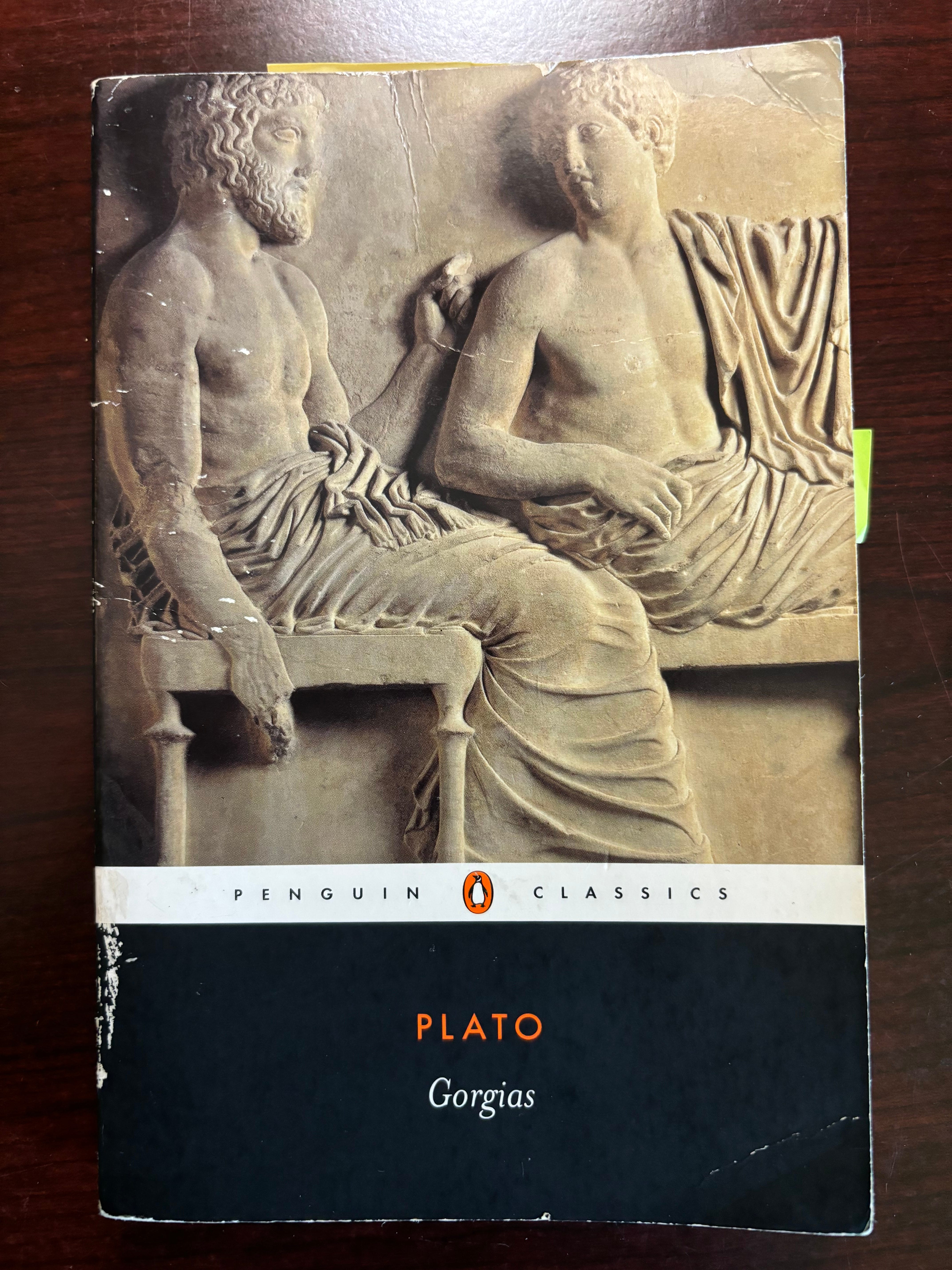
In Gorgias (493d), Plato has Socrates debate Callicles about the nature of the good life. Socrates compares the undisciplined person to a leaky jar. If someone attempts to fill a broken vessel with water, the liquid continually drains away. The more one pours in, the more one must labor. The effort never ends.

The holes in the jar symbolize uncontrolled desires—luxury, ambition, sensuality without measure. For Socrates, the miserable life is not the life of deprivation but the life of endless craving. The temperate person, by contrast, possesses a sound jar. Once filled with moderate and necessary pleasures, it remains full. Contentment comes not from increasing intake but from repairing the vessel.

The jar thus represents the structure of the inner person. Disorder produces leakage. Order produces rest.


Diogenes and the Jar of Autarky

Image

Image

Image

Image

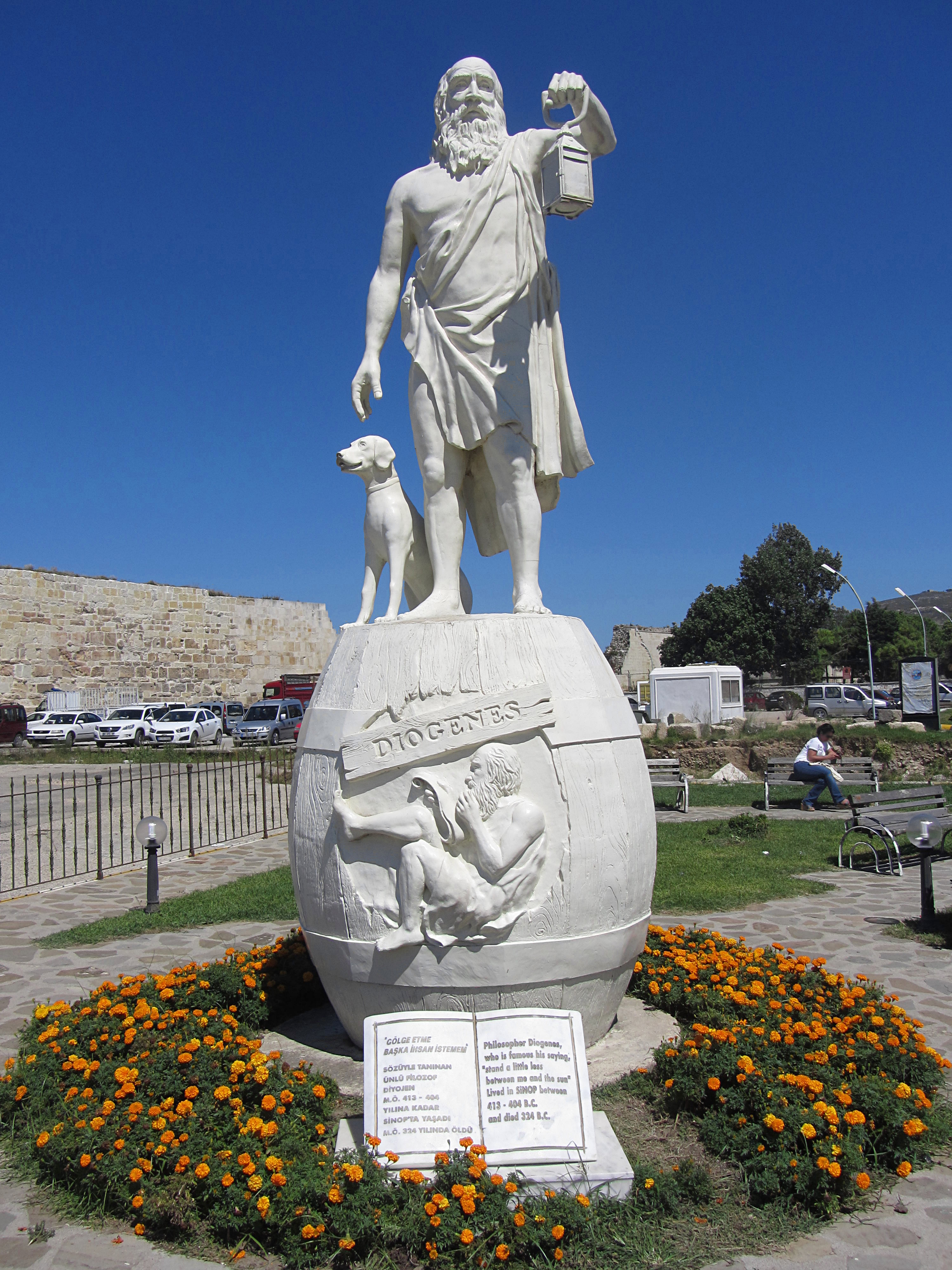
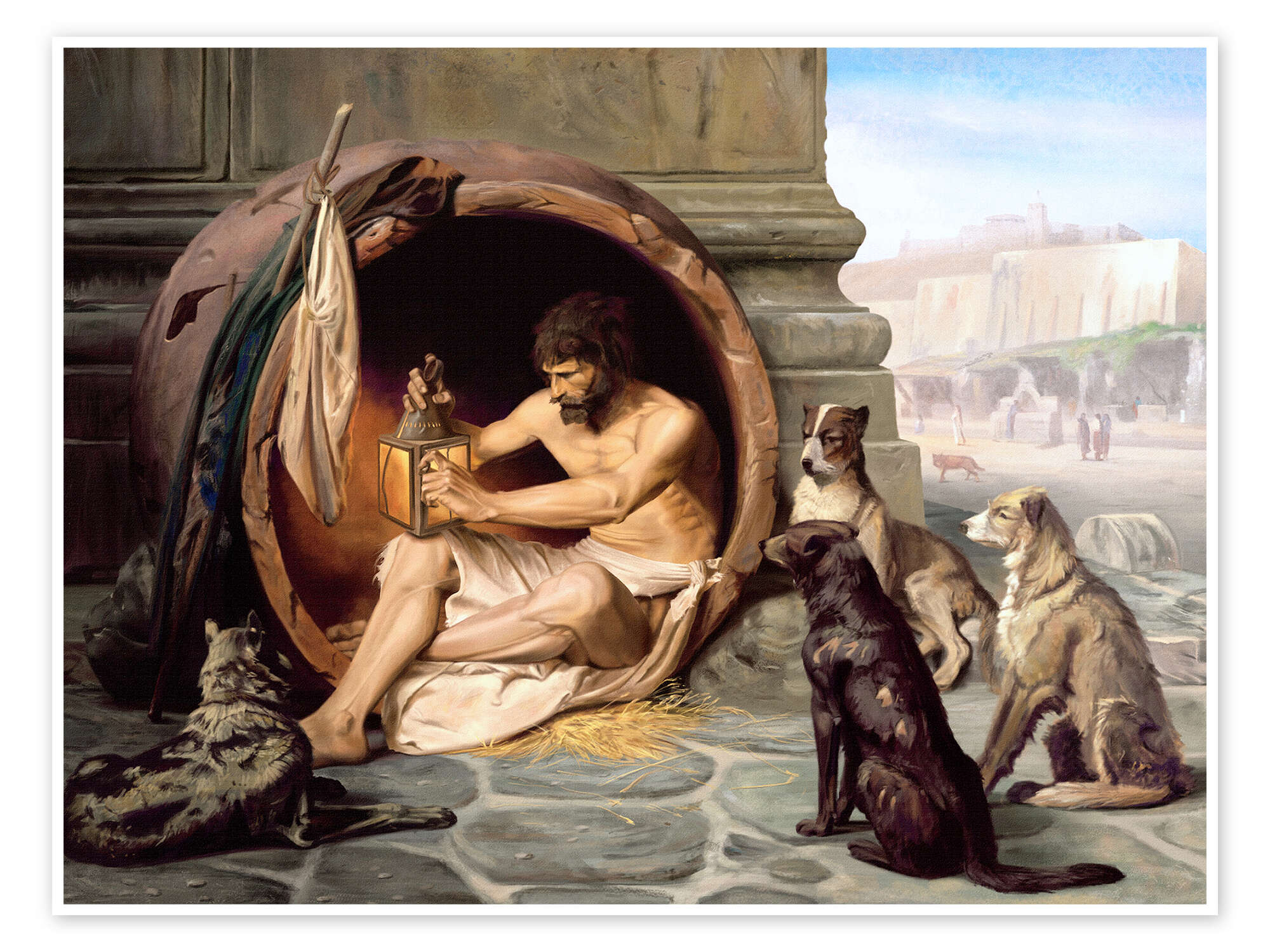
The Cynic philosopher Diogenes of Sinope radicalized the metaphor by inhabiting a jar (a pithos) in the marketplace of Athens. Unlike Plato’s psychological image, Diogenes’ jar was literal. By living inside a clay container, he rejected property, status, and luxury. When he saw a boy drink water from his hands, he threw away his cup—recognizing it as unnecessary.

His life embodied autarky—self-sufficiency. Where Plato described the leaky vessel of excess desire, Diogenes eliminated the need to fill it at all. He minimized desire itself. Happiness was achieved not by accumulation but by subtraction.


Lucretius and the Shattered Vessel

The Epicurean poet Lucretius extended the vessel metaphor into a doctrine of mortality in De Rerum Natura. He argues that when a physical vessel is shattered, its contents scatter. So too, when the body—the vessel of the soul—is broken, the soul dissolves into its first bodies. If the body cannot hold together its animating principle once destroyed, how could the soul survive independently?

Here the jar signifies the physical integrity of the human organism. Once fractured, its contents disperse. The metaphor emphasizes impermanence and the material basis of life.


The Broken Jar in the Gospel of Thomas

Image

Image

Image

Image

Saying 97 of the Gospel of Thomas reads:

“The kingdom of the father is like a certain woman who was carrying a jar full of meal. While she was walking on the road, still some distance from home, the handle of the jar broke and the meal emptied out behind her on the road. She did not realize it; she had noticed no accident. When she reached her house, she set the jar down and found it empty.”

This parable differs from Plato’s in tone and emphasis. There is no conscious indulgence here. The woman is unaware of the loss. The jar breaks silently. The contents are scattered unnoticed. Only upon arrival at the house does the emptiness become known.

The “kingdom” is compared not to fullness but to hidden loss. The meal—the substance of sustenance—has drained away during the journey. The house, which should receive provision, receives nothing.

In Greek philosophical terms, the jar is defective; but here the tragedy lies in ignorance. The woman does not perceive the leakage. The emptiness is discovered only at the end.

The image parallels the Platonic leaky jar, yet transforms it. In Plato, the leakage results from excessive desire. In Thomas, the leakage occurs during ordinary movement. The emphasis falls on awareness: one may be empty without realizing it.


The Gospel of Truth: Broken, Filled, and Perfected Jars

Image

Image

Image

Image

The Gospel of Truth expands the jar metaphor into a dramatic theological vision. It describes people who moved out of dwellings having jars that were not good in certain places. They broke them. The master of the house did not suffer loss; he rejoiced, because bad jars were replaced by full and perfected ones.

When the Word appeared, disturbance erupted among the jars:

“Some had been emptied, others filled; that is, some had been supplied, others poured out, some had been purified, still others broken up.”

Here the jars clearly represent human beings. Their interior condition varies—some empty, some full, some purified, some shattered. The appearance of the Word causes upheaval. The drawn sword with two edges divides and judges. Instability is exposed.

The text personifies “Error” (Greek πλάνη, planē). Error is not a cosmic being but a collective condition—a personification of sin and blindness, embodied historically in corrupt religious authority and spiritual ignorance. When knowledge approaches, Error is emptied. It has nothing inside.

The jars become symbols of inner content. Full jars are anointed. When anointing dissolves, the jar empties, revealing deficiency. But the one who lacks nothing has no seal removed and no emptiness exposed. What is lacking, the perfect Father fills again.

Unlike Plato’s solution—temperance—or Diogenes’—renunciation—the Gospel of Truth presents restoration through knowledge and anointing. The broken jar is not merely a moral failure; it is a state requiring healing and refilling.


Philosophical Parallels and Transformations

Across these traditions, several themes converge:

  1. The Vessel as the Human Condition
    In Plato, the jar represents the structure of desire.
    In Lucretius, it represents bodily integrity.
    In Thomas and the Gospel of Truth, it represents the interior state of persons.

  2. Leakage and Emptiness
    For Socrates, endless pleasure leaks away.
    In Thomas, sustenance drains unnoticed.
    In the Gospel of Truth, some jars are emptied when truth appears.

  3. Breakage as Judgment or Mortality
    In Lucretius, shattering equals dissolution.
    In the Gospel of Truth, breaking may be purgative—removing defective vessels so perfected ones can replace them.

  4. Fullness and Rest
    Plato’s sound jar achieves contentment.
    The Gospel of Truth speaks of jars “made perfect,” filled again by the Father, resting in paradise.


The Sword and the Jar

A striking feature in the Gospel of Truth is the double-edged sword. When the Word appears, disturbance spreads. The jars are shaken. Order collapses. The metaphor suggests that truth destabilizes what is unstable. What is already cracked cannot endure the shock.

In Plato, disorder precedes suffering. In the Gospel of Truth, revelation exposes disorder. The arrival of knowledge does not create emptiness; it reveals it.


Conclusion: From Moral Psychology to Spiritual Restoration

The broken jar moves from Greek philosophy into early Christian metaphor without losing its core meaning. It always signifies containment—the capacity to hold something essential.

For Socrates, that essential thing is moderate pleasure.
For Diogenes, it is self-sufficiency without excess.
For Lucretius, it is the animating principle of life.
For the Gospel of Thomas, it is hidden sustenance lost through unawareness.
For the Gospel of Truth, it is inner fullness disrupted by Error and restored by knowledge.

In every case, the question is the same: what does the vessel contain, and can it hold it?

The answer determines whether the jar leaks endlessly, shatters into dissolution, arrives home empty, or stands full and perfected in rest.


The Broken Jar, the Filled Vessel, and the Overthrow of Error

In Saying 97 of the Gospel of Thomas we read:

“Jesus said, ‘The kingdom of the father is like a certain woman who was carrying a jar full of meal. While she was walking on the road, still some distance from home, the handle of the jar broke and the meal emptied out behind her on the road. She did not realize it; she had noticed no accident. When she reached her house, she set the jar down and found it empty.’”

The image is quiet and devastating. There is no dramatic shattering. The jar does not explode in her hands. Instead, the handle breaks silently. The meal pours out gradually along the road. The woman is unaware. Only when she reaches the house does she discover the loss.

The parable describes hidden depletion. The kingdom is compared not to visible triumph, but to a condition in which something essential has drained away unnoticed. The house stands ready to receive fullness, yet the jar arrives empty. The crisis is not noise but ignorance.

The Gospel of Truth expands this same imagery:

“If indeed these things have happened to each one of us, then we must see to it above all that the house will be holy and silent for the Unity - as in the case of some people who moved out of dwellings having jars that in spots were not good. They would break them, and the master of the house would not suffer loss. Rather, is glad, because in place of the bad jars (there are) full ones which are made perfect. For such is the judgment which has come from above. It has passed judgment on everyone; it is a drawn sword, with two edges, cutting on either side. When the Word appeared, the one that is within the heart of those who utter it - it is not a sound alone, but it became a body - a great disturbance took place among the jars, because some had been emptied, others filled; that is, some had been supplied, others poured out, some had been purified, still others broken up. All the spaces were shaken and disturbed, because they had no order nor stability. Error was upset, not knowing what to do; it was grieved, in mourning, afflicting itself because it knew nothing. When knowledge drew near it - this is the downfall of (error) and all its emanations - error is empty, having nothing inside. That is why Christ was spoken of in their midst, so that those who were disturbed might receive a bringing-back, and he might anoint them with the ointment. This ointment is the mercy of the Father, who will have mercy on them. But those whom he has anointed are the ones who have become perfect. For full jars are the ones that are usually anointed. But when the anointing of one (jar) is dissolved, it is emptied, and the reason for there being a deficiency is the thing by which its ointment goes. For at that time a breath draws it, a thing in the power of that which is with it. But from him who has no deficiency, no seal is removed, nor is anything emptied, but what he lacks, the perfect Father fills again. He is good. He knows his plantings, because it is he who planted them in his paradise. Now his paradise is his place of rest.”

Here jars represent persons. Some are defective “in spots.” They are broken without loss to the master. The breaking is judgment, but also replacement. Bad jars are exchanged for “full ones which are made perfect.” The sword cuts. The Word appears. Disturbance spreads. Emptiness is revealed.

The Hebrew Scriptures provide a long foundation for this vessel imagery. In Jeremiah 18:1–6 the prophet sees the potter shaping clay, and when the vessel is marred, he reworks it according to his will. In Jeremiah 19:1–11 the jar is shattered before the elders as a sign of irrevocable judgment. Lamentations 4:2 laments that the precious sons of Zion are “esteemed as earthen pitchers.” Isaiah 29:16 asks, “Shall the potter be regarded as the clay?” Isaiah 45:9 declares, “Woe to him who strives with his Maker.” Psalm 31:12 confesses, “I am like a broken vessel.”

The jar is never neutral. It symbolizes formed humanity—shaped, fragile, accountable.

Other passages intensify the theme of filling and emptying. In 2 Kings 4:1–7 empty vessels are gathered and miraculously filled with oil until no more jars remain. The abundance stops only when there are no more containers. Fullness depends on available vessels. In 1 Samuel 26:11–12 the jar of water at Saul’s head becomes a sign of vulnerability and mercy. The vessel marks proximity to life and death.

Breaking without loss is also a scriptural pattern. Isaiah 30:14 speaks of a vessel broken so completely that no shard remains to carry fire or water. Psalm 2:9 proclaims, “You shall dash them in pieces like a potter’s vessel.” Judges 7:19–20 describes Gideon’s men breaking jars to reveal light within, a destruction that brings victory. In 2 Kings 13:17–19 striking the arrows determines the extent of triumph, suggesting that incomplete action limits deliverance.

The Gospel of Truth echoes these patterns: jars are broken, yet the master “would not suffer loss.” The destruction of defective vessels serves restoration. The breaking is not annihilation of value but removal of corruption.

Central to the passage is “Error,” Greek πλάνη (planē). It is not a cosmic being but a personification—a collective noun representing sin, blindness, and corrupt leadership. Scripture repeatedly speaks of wandering and deception in collective terms. Isaiah 53:6 states, “All we like sheep have gone astray.” Jeremiah 8:5 asks, “Why have these people turned away in perpetual backsliding?” Hosea 4:6 warns, “My people are destroyed for lack of knowledge.” Isaiah 44:20 describes the deceived: “A deceived heart has turned him aside.” Proverbs 14:12 cautions, “There is a way that seems right to a man, but its end is the way of death.”

Error is emptiness masquerading as fullness. It is a jar that appears intact yet contains nothing of permanence. When knowledge approaches, “error is empty, having nothing inside.” The exposure itself is judgment.

Psalm 119:104 affirms, “Through your precepts I get understanding.” Knowledge overturns wandering. The Gospel of Truth declares that when knowledge draws near, this is “the downfall of (error) and all its emanations.” The collapse of deception causes grief and disturbance because structures built on ignorance cannot endure the sword of discernment.

The anointing imagery intensifies the vessel theme. “Full jars are the ones that are usually anointed.” Oil signifies mercy and completion. Yet “when the anointing of one (jar) is dissolved, it is emptied.” Loss of sealing results in deficiency. Only the one without deficiency retains fullness: “what he lacks, the perfect Father fills again.”

This returns us to Thomas 97. The woman’s jar leaks unnoticed. The Gospel of Truth reveals jars shaken and broken by the Word. In both, the crisis is interior. One empties through ignorance; others are shattered through judgment. In every case, the issue is whether the vessel can hold what it was meant to contain.

The house in Thomas stands as the destination. The Gospel of Truth says the house must be “holy and silent for the Unity.” Rest comes not through denial of fragility but through refilling and reformation. The potter reshapes. The master replaces defective jars. The Father fills deficiency.

Thus jar imagery forms a continuous thread: shaped by a maker, vulnerable to fracture, capable of being filled, subject to judgment, yet also eligible for restoration. Error, as collective wandering and sin, drains vessels from within. Knowledge exposes and overthrows it. The broken jar is not merely ruin; it is revelation. And in that revelation, emptiness is either confirmed—or filled again in the place of rest.

Sunday, 18 January 2026

How to understand nag hammadi scriptures


How to Understand the Nag Hammadi Scriptures

Introduction: Discovery and Significance

In 1945, near the town of Nag Hammadi in Upper Egypt, a collection of thirteen leather-bound codices containing fifty-two tractates was discovered. Written primarily in Coptic and translated from earlier Greek originals, these texts date mainly from the second and third centuries AD. Their contents radically expanded modern knowledge of early Christianity, Jewish mysticism, Egyptian religious thought, and Greco-Roman philosophy.

The Nag Hammadi collection does not represent a single movement, church, or theology. Rather, it preserves the writings of multiple intellectual and spiritual communities that operated within the same cultural world as early Christianity. These texts offer alternative interpretations of creation, revelation, salvation, and knowledge, emphasizing insight (gnosis) rather than obedience to institutional authority.

To understand the Nag Hammadi scriptures properly, one must abandon the assumption that early Christianity was unified, centralized, or doctrinally fixed. The religious environment from which these texts emerged was fluid, competitive, and pluralistic. Teachers, philosophers, and mystics debated cosmology, scripture, ritual, and anthropology in loosely organized circles rather than within rigid institutions.


Not “Lost Gospels” but Independent Traditions

It is misleading to refer to the Nag Hammadi scriptures simply as “Gospels,” as this encourages the mistaken belief that these writings were merely alternative biographies of Jesus excluded from the New Testament. While some texts are titled “Gospel,” the term is used far more broadly than in later ecclesiastical usage.

The communities responsible for these writings did not see themselves as revising or supplementing an already fixed canon. Many of these texts predate the formal establishment of New Testament authority. Moreover, their theological assumptions differ fundamentally from what later became normative Christianity.

At the same time, it would be equally mistaken to detach the Nag Hammadi corpus entirely from early Christian tradition. The majority of texts employ Christian language, figures, and scriptural interpretation. Apostles and biblical characters such as Paul, James, John, Thomas, Philip, Peter, Adam, Seth, Shem, and Melchizedek appear frequently. These writings were intended to supplement biblical material by revealing its hidden or spiritual meaning, not to replace it.

The Nag Hammadi texts reflect Egyptian Christianity, not a foreign or purely anti-Christian movement. Alexandria and Upper Egypt were major intellectual centers where Jewish exegesis, Platonic philosophy, Stoicism, Epicurean thought, Egyptian religious concepts, and mystery cult traditions interacted continuously.


The Religious and Intellectual Environment

Second- and third-century Christian communities functioned primarily as teaching networks. Authority was derived from interpretive skill, philosophical insight, and perceived spiritual illumination rather than from hierarchical office. Teachers competed with one another by offering more coherent cosmologies, deeper scriptural interpretations, or more compelling accounts of salvation.

Jewish traditions provided allegorical readings of Genesis, prophetic literature, and wisdom texts. Middle Platonic metaphysics contributed ideas of emanation, divine intellect, and hierarchical reality. Stoicism influenced ethical instruction and cosmological rationality, while Epicurean philosophy contributed atomic theories of matter and critiques of divine interference. Egyptian religion offered myths of divine descent, resurrection symbolism, and sacred knowledge transmitted through initiation.

The Nag Hammadi texts arose within this shared intellectual space.


Schools, Not Sects

To understand the Nag Hammadi scriptures from a second- and third-century perspective, they must be categorized according to the schools of thought that produced them. These were not rigid denominations but interpretive traditions united by a shared pursuit of gnosis.

The most significant groups represented are:

  • Sethian traditions

  • Valentinian traditions

  • Hermetic traditions

Each held different views on the creator, the structure of reality, and the purpose of the natural world.


1. Sethian Traditions: Myth and Cosmic Critique

The Sethians represent what modern scholarship often calls “classical Gnosticism.” They traced their spiritual lineage to Seth, the third son of Adam, understood as a revealer figure whose descendants preserved divine knowledge.

Cosmology and the Creator

In Sethian mythology, creation is the result of a cosmic rupture originating in Wisdom (Sophia). Through her descent or error, a subordinate creator emerges—commonly named Yaldabaoth—who fashions the natural world in ignorance of the higher divine realm. This creator is not merely mistaken but often portrayed as arrogant and hostile, proclaiming himself the only power.

The natural world is therefore structured by flawed rulers (archons) who attempt to dominate humanity through bodily limitation and deception.

Key Texts

The Apocryphon of John
This is the foundational Sethian text. It reinterprets Genesis as a cosmic tragedy in which humanity contains a higher origin than the creator who formed the body. Salvation comes through remembering one’s origin and receiving revealed knowledge.

The Hypostasis of the Archons
This text elaborates on the nature of the rulers and their failure to control humanity fully. Eve and the serpent are portrayed as instruments of liberation rather than transgression.

The Apocalypse of Adam
Framed as Adam’s revelation to Seth, this work describes the preservation of the “seed” of true humanity amid repeated cosmic catastrophes.


2. Valentinian Traditions: Philosophical Integration

The Valentinians, founded by the teacher Valentinus, represent a more philosophically integrated form of Christian gnosis. They were active participants within broader Christian communities and often attended the same assemblies as non-gnostic believers.

Cosmology and Redemption

Unlike Sethian hostility toward the creator, Valentinian thought portrays the Demiurge as ignorant but not malicious. He is a craftsman operating within limits, eventually to be instructed or reconciled. The natural world is not an evil prison but an incomplete expression of divine fullness.

Humanity is differentiated by capacity for understanding rather than by possession of a divine spark trapped in matter.

Key Texts

The Gospel of Truth
This text presents ignorance as a dream or nightmare. Redemption occurs through awakening to knowledge, not through legal satisfaction or substitutionary sacrifice.

The Gospel of Philip
This work emphasizes sacramental symbolism, interpreting baptism, anointing, and the “bridal chamber” as experiential unions with the divine order.

The Tripartite Tractate
A systematic theological exposition describing emanation, fall, restoration, and the ultimate reintegration of all things.


3. Hermetic Traditions: Egyptian Wisdom

The Hermetic texts in the Nag Hammadi library belong to a Greco-Egyptian wisdom tradition centered on Hermes Trismegistus. These writings are not Christian in origin but were preserved alongside Christian texts due to shared philosophical concerns.

Perspective

Hermetic writings focus on intellectual illumination, cosmic ascent, and the transformation of perception. They lack a conflict between creator and higher deity, emphasizing instead the purification of consciousness.

Key Texts

The Discourse on the Eighth and Ninth
An initiatory dialogue culminating in visionary ascent beyond the planetary spheres.

Asclepius
A reflection on divine presence in the world and the sacred role of Egypt.


Symbolism, Reversal, and Personification

The Nag Hammadi texts employ extensive symbolic language.

  • Personification: Abstract principles such as Wisdom (Sophia), First Thought (Protennoia), and Truth are depicted as divine figures who descend to assist humanity.

  • Biblical Reversal: The serpent in Eden is frequently portrayed as a revealer rather than a deceiver, encouraging humanity to awaken through knowledge.

  • Jesus as Revealer: Jesus is presented primarily as a teacher who communicates secret instruction, enabling recognition of origin and destiny rather than serving as a sacrificial offering.


Additional Interpretive Frameworks

Beyond traditional “Gnostic” classification, the Nag Hammadi scriptures can be approached through several additional lenses:

1. Philosophical Allegory

Many myths function as symbolic representations of psychological, ethical, or metaphysical realities rather than literal cosmology.

2. Mystical Pedagogy

Texts may reflect graded instruction used in teaching circles, with myths functioning as mnemonic or initiatory devices.

3. Scriptural Midrash

Several works operate as radical commentaries on Genesis, Exodus, and prophetic texts, employing Jewish interpretive techniques.

4. Anti-Imperial Critique

Cosmic rulers may reflect political domination, social hierarchy, and imperial authority projected onto mythic frameworks.

5. Egyptian Religious Continuity

Themes of divine descent, hidden names, resurrection symbolism, and sacred knowledge align strongly with Egyptian religious thought.


Related Literature and Comparative Sources

To understand the Nag Hammadi scriptures fully, they must be read alongside other ancient materials:

  1. New Testament Apocrypha and Old Testament Pseudepigrapha

  2. Other Gnostic Texts:

    • Pistis Sophia

    • Books of Jeu

    • Bruce Codex materials

    • Theodotus (Excerpta ex Theodoto)

    • Heracleon’s commentary fragments

    • Ptolemy’s Letter to Flora

  3. Pseudo-Clementine Writings

  4. Clement of Alexandria’s Stromata

  5. Philo of Alexandria

  6. Corpus Hermeticum

  7. The Targums

  8. Early Heresiological Works:

    • Irenaeus

    • Tertullian

    • Hippolytus

    • Augustine


Conclusion

The Nag Hammadi scriptures preserve a world of early religious thought in which revelation was experiential, cosmology was debated, and salvation was understood as awakening rather than acquittal. They do not represent a single theology but a constellation of approaches to knowledge, embodiment, and divine order.

To read them well requires abandoning later doctrinal assumptions and allowing these texts to speak from within their own intellectual and cultural world—a world far richer, stranger, and more diverse than later orthodoxy would allow.


---


## Interpreting the Nag Hammadi Scriptures: Historical Context, Intellectual Traditions, and Methodological Approaches


### Abstract


The discovery of the Nag Hammadi codices in 1945 fundamentally altered modern understanding of early Christianity and related religious movements of the second and third centuries AD. This article examines the Nag Hammadi scriptures within their historical, intellectual, and cultural contexts, arguing that they represent multiple independent yet intersecting traditions rather than a unified “Gnostic” movement or a collection of rejected Christian gospels. By situating these texts within the pluralistic environment of early Christian Egypt and analyzing their major schools of thought—Sethian, Valentinian, and Hermetic—the article demonstrates that the Nag Hammadi writings function as theological, philosophical, and exegetical works intended to supplement existing scriptural traditions. The study further surveys interpretive methodologies appropriate to these texts, including philosophical allegory, Jewish midrash, and comparative religious analysis, and emphasizes the necessity of reading them alongside related non-canonical and patristic sources.


---


### 1. Introduction


The Nag Hammadi library, discovered near Upper Egypt in 1945, consists of thirteen codices containing fifty-two tractates, primarily translated into Coptic from Greek originals. Dating largely to the second and third centuries AD, these texts have reshaped scholarly conceptions of early Christianity, Jewish-Christian exegesis, and Greco-Egyptian religious thought. Prior to their discovery, knowledge of so-called “Gnostic” traditions relied heavily on polemical descriptions preserved in heresiological writings by figures such as Irenaeus, Tertullian, and Hippolytus. The Nag Hammadi texts provide, for the first time, extensive primary sources authored from within these traditions themselves.


This article argues that the Nag Hammadi scriptures should not be approached as marginal or deviant Christian literature, nor as a homogeneous corpus. Rather, they represent a diverse body of texts produced within a competitive and intellectually fluid religious environment. Their interpretation requires careful attention to historical context, philosophical influences, literary genre, and the internal logic of the communities that produced them.


---


### 2. Terminological and Methodological Considerations


The classification of Nag Hammadi writings as “Gnostic gospels” is methodologically problematic. While some texts adopt the literary title “Gospel,” the term is used broadly to denote revelatory discourse rather than biographical narrative. Most tractates differ significantly from the canonical gospels in structure, purpose, and theological emphasis.


Moreover, the assumption that these writings were excluded from a fixed New Testament canon is anachronistic. During the second and third centuries, Christian scripture was not yet formally delimited. The authors of the Nag Hammadi texts did not conceive of themselves as rejecting orthodoxy but as offering superior or more advanced interpretations of revelation.


At the same time, it is equally misleading to detach the Nag Hammadi corpus entirely from Christian tradition. The majority of texts employ Christian figures, themes, and exegetical practices, indicating participation in broader Christian discourse. The appropriate methodological approach is therefore comparative and contextual rather than exclusionary.


---


### 3. Historical and Intellectual Context


The religious environment of second- and third-century Egypt was characterized by pluralism and intellectual exchange. Christian communities operated primarily as teaching networks rather than centralized institutions. Authority was grounded in interpretive competence, perceived spiritual insight, and philosophical coherence rather than ecclesiastical office.


Jewish scriptural interpretation, particularly allegorical readings of Genesis and wisdom literature, played a significant role. Middle Platonic metaphysics contributed concepts of emanation, hierarchical reality, and divine intellect. Stoic ethics, Epicurean natural philosophy, Egyptian religious symbolism, and mystery cult initiation practices coexisted within the same cultural milieu.


The Nag Hammadi texts emerged from this environment and reflect its diversity. They should therefore be read as products of intellectual experimentation rather than theological deviation.


---


### 4. Major Traditions Represented in the Nag Hammadi Corpus


#### 4.1 Sethian Traditions


Sethian texts constitute one of the earliest identifiable traditions within the corpus. These writings trace spiritual lineage to Seth, the third son of Adam, portrayed as a bearer of salvific knowledge. Sethian cosmology typically presents creation as the result of a disruption within the divine realm, often associated with Wisdom (*Sophia*).


The creator of the natural world is depicted as a subordinate and ignorant figure, frequently named Yaldabaoth, who mistakenly claims ultimate authority. Human beings, though formed within this flawed order, possess the capacity to recognize their higher origin through revelation.


Key Sethian texts include *The Apocryphon of John*, which offers a comprehensive reinterpretation of Genesis; *The Hypostasis of the Archons*, which analyzes the nature of cosmic rulers; and *The Apocalypse of Adam*, which presents a revelatory history of humanity through Seth’s lineage.


---


#### 4.2 Valentinian Traditions


Valentinian texts reflect a more philosophically integrated approach to Christian theology. Associated with the teacher Valentinus, these writings demonstrate significant engagement with Middle Platonic metaphysics and were often produced within communities that remained closely connected to broader Christian assemblies.


In Valentinian thought, the creator figure is typically ignorant rather than malevolent, functioning as an intermediary within a larger salvific process. The natural world is not intrinsically evil but incomplete, awaiting restoration through knowledge and instruction.


Representative texts include *The Gospel of Truth*, a homiletic meditation on ignorance and awakening; *The Gospel of Philip*, which offers sacramental interpretations of Christian ritual; and the *Tripartite Tractate*, a systematic theological exposition.


---


#### 4.3 Hermetic Texts


The Nag Hammadi library also contains Hermetic writings associated with the Greco-Egyptian tradition of Hermes Trismegistus. These texts are not Christian in origin but were preserved alongside Christian materials due to shared philosophical concerns, particularly regarding knowledge and transformation.


Hermetic writings emphasize intellectual illumination, cosmic ascent, and the purification of perception. They lack the creator–redeemer conflict found in Sethian myth and instead focus on the harmonization of the human intellect with the divine order.


Notable texts include *The Discourse on the Eighth and Ninth* and fragments of *Asclepius*.


---


### 5. Literary Features and Theological Motifs


Nag Hammadi texts employ extensive symbolism and personification. Abstract concepts such as Wisdom (*Sophia*), First Thought (*Protennoia*), and Truth are depicted as active divine agents. Biblical narratives are frequently inverted, most notably in reinterpretations of the Eden story, where the serpent functions as a revealer rather than a deceiver.


Jesus is commonly portrayed not as a sacrificial figure but as a revealer of hidden knowledge, whose role is to awaken recognition of divine origin rather than to satisfy juridical requirements.


---


### 6. Interpretive Frameworks


Modern scholarship has proposed multiple frameworks for interpreting the Nag Hammadi scriptures:


1. **Philosophical Allegory**, viewing myths as symbolic representations of metaphysical realities

2. **Mystical Pedagogy**, understanding texts as instructional materials for initiatory communities

3. **Jewish Midrashic Exegesis**, recognizing continuity with Second Temple interpretive practices

4. **Sociopolitical Critique**, interpreting cosmic rulers as reflections of imperial authority

5. **Egyptian Religious Continuity**, emphasizing indigenous symbolism and cosmology


These approaches are complementary rather than mutually exclusive.


---


### 7. Comparative Literature


Interpretation of the Nag Hammadi texts benefits from comparison with related materials, including the New Testament apocrypha, Old Testament pseudepigrapha, *Pistis Sophia*, the Bruce Codex writings, Valentinian fragments preserved by Theodotus and Heracleon, the writings of Philo of Alexandria, the Corpus Hermeticum, the Targums, and early heresiological works.


---


### 8. Conclusion


The Nag Hammadi scriptures preserve a spectrum of early religious thought characterized by interpretive creativity, philosophical engagement, and experiential theology. They do not represent a unified alternative canon but a constellation of intellectual traditions operating within early Christianity and its surrounding cultural environment. Academic study of these texts requires methodological rigor, historical sensitivity, and resistance to later doctrinal projections.


---


Wednesday, 12 November 2025

The meaning of heresy

**The Gnostics Were Not Teaching False Doctrines, but Were Sectarians According to the Original Meaning of αἵρεσις**

---

The word *heresy* in its modern sense—implying false doctrine and moral corruption—bears little resemblance to its original meaning in Greek antiquity. The Greek term **αἵρεσις (*hairesis*)** did not mean “false teaching.” It meant **a choice**, **a chosen course**, or **a school of thought.** The transformation of *hairesis* from a neutral word describing a philosophical or religious faction into a weaponized label of condemnation occurred only after the rise of episcopal authority in the second century. Therefore, when early Christian writers called the Gnostics “heretics,” they were not describing men and women who were necessarily false teachers, but rather those who belonged to **a different sect**—a legitimate *hairesis* in the original Greek sense.

---

### 1. The Original Meaning in Classical Greek

The earliest use of **αἵρεσις** in Greek literature reveals that it denoted an act of **choice** or a **course of action deliberately taken.** Derived from the verb **αἱρέω** or **αἱρέομαι**, meaning “to take,” “to choose,” or “to prefer,” the noun developed naturally to refer to any system or school of thought that one chose to follow.

In **Herodotus (Histories 3.80)**, the word describes a decision or selection:

> “Having made their choice (*hairesis*), they took their course of action.”

Here, the word bears no religious or moral meaning; it simply indicates a deliberate decision. Similarly, **Plato**, in *Republic* 617e, employs *hairesis* in the myth of Er to describe the selection of one’s life path:

> “Each soul was required to make its choice (*hairesin*) of life.”

The philosopher **Aristotle**, in *Topics* 101a37, speaks of “the *hairesis* of philosophy”—that is, a philosophical school or persuasion. The Stoics, Epicureans, and Peripatetics each had their own *hairesis*. In **Polybius (Histories 6.56.6)**, the term appears again, describing political factions in the Roman Republic. In none of these examples is *hairesis* negative or heretical. It refers only to a **chosen path, sect, or party**.

In Classical Greek usage, then, *hairesis* was a neutral term describing one’s **adopted discipline or affiliation**—whether philosophical, political, or professional. A man could belong to the *hairesis* of Epicurus just as another might belong to the *hairesis* of Aristotle.

---

### 2. The Hellenistic and Jewish Usage

As Greek culture spread through the Hellenistic world, Jewish writers adopted *hairesis* to describe divisions or schools within Judaism. In this period, the word was used not to denounce, but to **categorize**.

**Josephus**, the first-century Jewish historian, provides a clear example. In *Antiquities* 13.171 and 293, and *Wars* 2.119, he refers to the **Pharisees**, **Sadducees**, and **Essenes** as the three principal *haireseis* of the Jewish people:

> “The Jews have three *haireseis*, the Pharisees, the Sadducees, and the Essenes.”

Josephus does not use the term pejoratively; he treats these sects as legitimate schools within the same religious tradition, much like the philosophical schools among the Greeks. Thus, in Hellenistic Jewish usage, *hairesis* meant **a religious party or sect**, not a deviation from truth.

---

### 3. The Use of αἵρεσις in the New Testament

The New Testament writers inherited this same neutral meaning. In the *Acts of the Apostles*, the term *hairesis* is applied several times to Jewish sects and, later, to the followers of Jesus.

* **Acts 5:17** – “Then the high priest rose up, and all they that were with him, which is the *hairesis* of the Sadducees, were filled with indignation.”
* **Acts 15:5** – “There rose up certain of the *hairesis* of the Pharisees which believed…”
* **Acts 24:5** – Tertullus accuses Paul before Felix, saying: “We have found this man a pestilent fellow, and a mover of sedition among all the Jews throughout the world, and a ringleader of the *hairesis* of the Nazarenes.”
* **Acts 24:14** – Paul responds: “After the way which they call *hairesis*, so worship I the God of my fathers, believing all things which are written in the law and in the prophets.”

Here, Paul directly acknowledges that his movement—the early Christian community—was being called a *hairesis* by the religious establishment. Yet Paul accepts the label without apology, affirming that his worship of the Deity accords with the Scriptures. This passage is crucial: it shows that the first Christians were themselves considered a *sect* within Judaism. The charge of “heresy,” as later understood, did not exist. They were simply a **school** within a larger tradition, no different in structure from the Pharisees or Sadducees.

Even in **1 Corinthians 11:19**, when Paul says, “There must also be *haireseis* among you,” he refers to divisions or factions, not necessarily false beliefs. The context concerns social and communal disorder, not doctrinal corruption.

Thus, within the New Testament itself, *hairesis* never meant “false doctrine.” It always referred to **sects, parties, or divisions**—whether in Judaism or among the followers of Jesus.

---

### 4. The Transformation of Meaning in Early Christianity

The pejorative sense of *hairesis* as “false doctrine” only appeared after the second century, when institutional Christianity began to define **orthodoxy** (right belief) and **heterodoxy** (other belief). As bishops sought to unify doctrine and authority, rival Christian interpretations—such as those of the Gnostics, Marcionites, and Montanists—were branded *heresies.*

Writers like **Irenaeus** (*Adversus Haereses*), **Tertullian**, and **Hippolytus** used the term to condemn alternative theological schools. Yet the irony is clear: the same word once applied neutrally to the *Pharisees*, *Sadducees*, and *Christians* was now used by Christians to stigmatize one another.

The Valentinian, Sethian, and other Gnostic schools were not inherently false; they were *haireseis* in the classical and biblical sense—distinct **sects** that offered their own interpretations of Scripture and cosmology. Like the Stoics and Epicureans, they had their teachers, their systems, and their chosen ways. Their doctrines differed from those of the episcopal hierarchy, but difference does not equal falsehood. The later Church redefined the term to enforce conformity, turning a neutral word into a label of condemnation.

---

### 5. Paul and the Gnostics: A Shared Accusation

Paul’s own experience, as recorded in Acts 24:14, parallels that of the later Gnostics. Both were accused of belonging to a *hairesis*—a sect contrary to the accepted authority. Yet Paul’s defense is telling: he does not deny being part of a *sect*; he denies that his worship is false. He insists that his beliefs align with “all things written in the law and the prophets.” His faith is true, even if others call it a *hairesis*.

In the same way, Gnostic Christians claimed fidelity to the divine revelation but interpreted it differently. They saw themselves not as corrupters of truth but as seekers of deeper understanding. The bishops, like the Pharisees of Paul’s time, used *hairesis* as a tool of exclusion, but the word itself never implied error.

Thus, to call the Gnostics “heretics” in the modern sense is anachronistic. In the language of the New Testament and the Hellenistic world, they were **sectarians**—people who chose a particular way (*hairesis*) of interpreting divine things.

---

### 6. Conclusion

The historical and linguistic evidence demonstrates that **αἵρεσις** originally meant **choice**, **school**, or **sect**, not “false teaching.” From Herodotus to Plato, from Josephus to Paul, the term was consistently used to denote a particular path or group within a broader tradition. The early Christians themselves were called a *hairesis* by the Jewish authorities, just as the later Gnostics were called *haireseis* by the bishops of the emerging Catholic Church.

When the meaning of *hairesis* shifted in the second century, it reflected not a change in truth, but a change in **power**. The dominant ecclesiastical party redefined the word to secure its own authority and suppress rival interpretations. But according to the original Greek sense, the Gnostics were not “heretics” at all; they were **sectarians**, thinkers who chose a distinct *way* of worshiping the Deity, much like Paul and his followers in the first century.

To reclaim the word *hairesis* is to restore historical accuracy and intellectual honesty. The Gnostics, like Paul before them, simply followed a chosen path—a *choice* of understanding the divine mysteries. Whether one accepts their doctrines or not, they stood within the legitimate spectrum of the early Christian *haireseis*, heirs to the same freedom of choice that characterized Greek philosophy and Jewish sectarianism alike.

In truth, the Gnostics were never false teachers; they were **choosers**—those who, like the philosophers of old and the apostle himself, sought truth along a different yet earnest path.


**The Gnostics and the Orthodox: Sectarians United by the Meaning of αἵρεσις**

---

In the history of early Christianity, the term *heresy* has often been used to draw a sharp boundary between “orthodox” belief and “false” teaching. Yet this modern understanding obscures the true meaning of the Greek word **αἵρεσις (*hairesis*)**, which in the first century did not mean *false doctrine* but rather a **sect, school, or chosen way**. The word comes from the verb *αἱρέομαι*, “to choose,” and referred to one’s deliberate alignment with a particular interpretation or community. The Stoics, Epicureans, and Peripatetics were all *haireseis*—distinct schools of thought. Likewise, within Judaism, Josephus used the same word to describe the Pharisees, Sadducees, and Essenes. Even the followers of Jesus were called a *hairesis* in Acts 24:14, where Paul admits before Felix, “After the way which they call *hairesis*, so worship I the God of my fathers.”

Thus, when we examine the so-called “Gnostic” writings, we should not assume they were false or deceptive doctrines. They were **Christian sects**—communities within the wider Christian movement who held different, yet often overlapping, understandings of the same truths. When read carefully, many texts from the *Nag Hammadi Library* affirm the same essential doctrines held by Orthodox Christianity: that Jesus was the Son of God and the Son of Man, that he came in the flesh, died, and rose bodily from the dead. Far from being deniers of the incarnation or the resurrection, these writings preserve a distinctly corporeal faith—one that speaks of *true flesh* and *real resurrection*.

---

### 1. The Lord as Son of God and Son of Man

The **Treatise on the Resurrection** begins with the statement:

> “How did the Lord proclaim things while he existed in flesh and after he had revealed himself as Son of God? He lived in this place where you remain, speaking about the Law of Nature—but I call it ‘Death’. Now the Son of God was Son of Man.”

This passage confesses precisely what Orthodox Christianity professes: that Jesus is both *Son of God* and *Son of Man*. It affirms the union of divine and human nature in the one who revealed himself in flesh. The author contrasts the corruptible world, which he calls “Death,” with the divine life manifested in the Son’s incarnate existence. This is not docetism or illusion; it is a recognition of the Deity’s presence in human form—the same truth confessed in the Nicene and Apostolic traditions.

---

### 2. The Flesh of Jesus

The **Gospel of Thomas** (Saying 28) records Jesus’ own declaration:

> “I took my stand in the midst of the world, and I appeared to them in flesh.”

This simple statement is profoundly orthodox. The writer affirms Jesus’ corporeal presence in the world—the Word made flesh. The *Text of Melchizedek*, another work from the Nag Hammadi collection, defends the same belief with remarkable precision:

> “They will say of him that he is unbegotten, though he has been begotten; that he does not eat, even though he eats; that he does not drink, even though he drinks; that he is uncircumcised, though he has been circumcised; that he is unfleshly, though he has come in the flesh; that he did not come to suffering, though he came to suffering; that he did not rise from the dead, though he arose from the dead.”

This passage denounces those who deny the corporeal nature, death, and resurrection of Christ. It insists that Jesus *was begotten*, *ate and drank*, *was circumcised*, *suffered*, and *rose bodily*. Such statements directly oppose the later docetic movements that denied Christ’s real humanity. They affirm what the apostolic writings declare: “Every spirit that confesses that Jesus Christ is come in the flesh is of God” (1 John 4:2).

---

### 3. The Resurrection of the Flesh

The **Treatise on the Resurrection** continues:

> “If you remember reading in the Gospel that Elijah appeared and Moses with him, do not think the resurrection is an illusion. It is no illusion, but it is truth! Indeed, it is more fitting to say the world is an illusion, rather than the resurrection which has come into being through our Lord the Savior, Jesus Christ.”

Here the author explicitly denies that the resurrection is symbolic or spiritualized. The resurrection is real, more real than the transitory world itself. The same insistence appears in the **Gospel of Philip**:

> “The resurrection is real; it is not an illusion. I condemn those who say the flesh will not rise… It is necessary to arise in this flesh, since everything exists in it.”

The text upholds the resurrection of the same body that now lives and dies. It describes the transformation from mortal to immortal—“spiritual flesh,” as Paul calls it in 1 Corinthians 15:44.

Later in the same gospel we read:

> “[The master] was conceived from what is imperishable, through God. The master rose from the dead, but he did not come into being as he was. Rather, his body was completely perfect. It was of flesh, and this flesh was true flesh. Our flesh is not true flesh but only an image of the true.”

This striking passage parallels Paul’s contrast between corruptible and incorruptible bodies (1 Cor. 15:42–53). The risen Christ’s body is “true flesh”—not illusion or ghost, but perfected corporeality. Such teaching stands in full agreement with the Orthodox belief in the tangible resurrection of Jesus.

---

### 4. The Death and Cross of Christ

The **Gospel of Philip** also recalls Jesus’ cry from the cross:

> “My God, my God, O Lord, why have you abandoned me? He said these words on the cross. But not from that place. He was already gone.”

The text recognizes the crucifixion as a real historical event, while also reflecting on the transcendent identity of the Savior. The **Apocryphon of James** conveys a similar reverence for the cross and death of Christ:

> “Remember my cross and my death and you will live… Truly I say to you, none will be saved unless they believe in my cross. But those who have believed in my cross, theirs is the Kingdom of God.”

Such statements reveal that the authors of these works not only knew of the crucifixion but considered belief in it essential for salvation. This is the same central proclamation of the apostolic gospel: “We preach Christ crucified” (1 Cor. 1:23).

The **Gospel of Truth** likewise affirms that Jesus’ death brought life to many:

> “The compassionate, faithful Jesus was patient in his sufferings until he took that book, since he knew that his death meant life for many… For this reason Jesus appeared. He put on that book. He was nailed to a cross. He affixed the edict of the Father to the cross.”

This passage portrays the crucifixion not as illusion but as divine act—the visible sign of the Father’s purpose, bringing life and revelation to humankind.

---

### 5. The Spiritual Body and the Post-Resurrection Appearance

The **Sophia of Jesus Christ** opens with a scene after the resurrection:

> “After he rose from the dead, his twelve disciples and seven women continued to be his followers… the Savior appeared—not in his previous form, but in the invisible spirit. His likeness resembles a great angel of light… But his resemblance I must not describe. No mortal flesh could endure it, but only pure, perfect flesh, like that which he taught us about on the mountain.”

This depiction matches Paul’s teaching that “flesh and blood cannot inherit the kingdom of God,” but that the mortal puts on immortality (1 Cor. 15:50–54). The resurrected body is still flesh, yet perfected—*pure, perfect flesh* that transcends mortality. The author does not deny the body but exalts it as transformed and incorruptible.

---

### 6. Sectarians, Not Heretics

When one considers these passages, the line between “Gnostic” and “Orthodox” grows remarkably thin. Both affirm Jesus’ divine sonship, incarnation, death, and bodily resurrection. The differences lie mainly in interpretation and cosmology, not in the essential facts of faith. The authors of these texts did not deny the Deity or the resurrection; they sought to understand their deeper meaning.

By the standards of the first century, these believers were simply members of a different *hairesis*—a sect within the diverse landscape of early Christianity. Just as Paul’s movement was called a *hairesis* by the Jews, the Gnostics were labeled *haireseis* by the bishops of the emerging Catholic Church. Yet the original Greek term does not imply error; it denotes a chosen way, a distinct school of thought.

---

### 7. Conclusion

The evidence from the *Nag Hammadi Library* shows that many so-called Gnostic texts affirm the same core beliefs as Orthodox Christianity. They proclaim Jesus as Son of God and Son of Man, confess that he came in the flesh, died on the cross, and rose bodily from the dead. Their theology of resurrection—speaking of “true flesh” and “pure, perfect flesh”—is fully consistent with the apostolic message of transformation from mortality to immortality.

To brand these writings as “heresy” in the modern sense is to misunderstand both the Greek language and the history of early Christianity. In their own time, these communities were not “false teachers” but **sectarians**—followers of a particular *hairesis*, a chosen path within the diverse body of believers. As Paul himself once stood accused of belonging to a *hairesis*, so too did the Gnostics suffer the charge from their contemporaries. But as the Scriptures and the Greek language testify, *hairesis* originally signified not corruption, but choice—an act of seeking and devotion.

Therefore, the Gnostics were not enemies of truth; they were fellow seekers within the same great household of faith, choosing a path toward understanding the mysteries of the Deity. Like Paul before them, they could rightly say, “After the way which they call *hairesis*, so worship I the God of my fathers.”