Saturday, 12 April 2025

GNOSTIC PHILOSOPHY

GNOSTIC PHILOSOPHY


 Title: Exploring the Depths of Gnostic Philosophy: A Journey into Esoteric Wisdom

Introduction:

Gnostic Philosophy, deriving from the Greek term "gnostikón," forms the cornerstone of a profound exploration into knowledge, particularly esoteric mystical knowledge. Functioning as an adjective, "gnostic" links the seeker to the depths of understanding, emphasizing a connection to hidden realms of wisdom. Rooted in the Love of Wisdom, or "philosophia" in Greek, this philosophy encompasses both the esoteric and exoteric, inviting individuals to embark on a transformative journey of self-discovery and enlightenment.

Gnostic: A Crucial Adjective:

At its essence, "gnostic" serves as an adjective, denoting a profound connection to knowledge, especially esoteric mystical knowledge. This term lays the foundation for the exploration of Gnostic Philosophy, providing insight into the philosophy's focus on a specialized and profound understanding of the mysteries of existence.

Philosophy: The Love of Wisdom Explored:

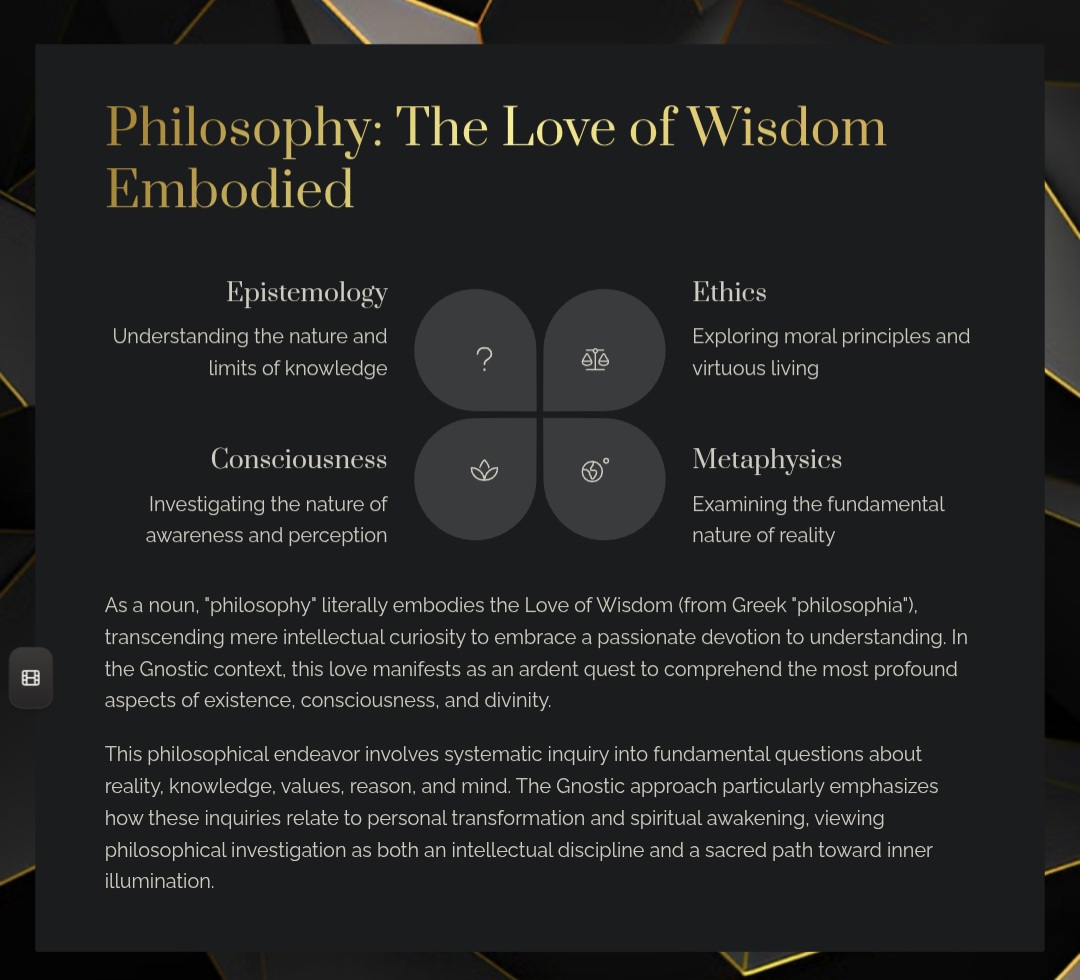
As a noun, "philosophy" embodies the Love of Wisdom, transcending the ordinary and inviting individuals to delve into the intricacies of knowledge, reality, and existence. As an academic discipline, it signifies the study of the fundamental nature of these concepts, forming the intellectual framework upon which Gnostic Philosophy unfolds.

Esoteric and Exoteric Dimensions:

Delving into the adjectives "esoteric" and "exoteric," the former signifies knowledge intended for a select few with specialized knowledge or interest. In contrast, "exoteric" in its formal sense denotes knowledge accessible to the general public. This dual nature encapsulates the inclusivity of Gnostic Philosophy, catering to both those immersed in esoteric pursuits and those seeking a broader understanding.

Mystic: A Transformative Noun:

Within Gnostic Philosophy, the term "mystic" emerges as a noun, representing a person who seeks unity with or absorption into the Deity or the absolute. Through contemplation and self-surrender, the mystic embarks on a journey that transcends mere intellectual understanding, seeking spiritual apprehension of truths beyond conventional comprehension.

Embracing Diversity in Knowledge:

Gnostic Philosophy encourages an open-minded approach to knowledge, emphasizing that wisdom transcends cultural, religious, and philosophical boundaries. The call to listen before judging underscores the importance of diverse sources in making informed decisions. This philosophy promotes a holistic understanding of the human experience, fostering unity amid the multitude of paths to enlightenment.

The Door to Gnosis and Personal Empowerment:

Central to Gnostic Philosophy is the concept that one can lead themselves to the door of gnosis, intuitive knowledge that brings enlightenment. This transformative journey toward self-discovery does not necessitate intermediaries like priests. Instead, Gnostic Philosophy advocates for direct communion with one's inner self, reinforcing the idea that to unlock the profound mysteries of existence, one must first know oneself.

Conclusion:

In conclusion, Gnostic Philosophy unfolds as a rich tapestry, interweaving the adjectives and nouns that define its essence. "Gnostic" serves as the key to understanding, "philosophy" embodies the Love of Wisdom, "esoteric" and "exoteric" capture the dual nature of its teachings, and "mystic" represents the transformative seekers within its fold. The philosophy beckons each individual to step through the door to gnosis, empowering themselves to unravel the profound truths that lie within and fostering a deep connection to esoteric wisdom. In this journey, the call echoes loudly – know thyself, for therein lies the key to unlocking the mysteries of existence.


GNOSTIC
γνωστικών (greek)
[ˈnɒstɪk]

ADJECTIVE
"Relating to knowledge, especially esoteric mystical knowledge."

PHILOSOPHY
φιλοσοφία (greek)
or "philo"+"sophia" which is the Love of Wisdom
[fɪˈlɒsəfi]

NOUN
"the study of the fundamental nature of knowledge, reality, and existence, especially when considered as an academic discipline."

That is my definition of the name : "Gnostic Philosophy".

[The words below will follow these definitions so we all know what I am talking about : not the Urban Dictionary terms.]

ESOTERIC
[ˌɛsəˈtɛrɪkˌiːsəˈtɛrɪk]

ADJECTIVE
"intended for or likely to be understood by only a small number of people with a specialized knowledge or interest."

EXOTERIC
[ˌɛksə(ʊ)ˈtɛrɪk]

ADJECTIVE
formal
"intended for or likely to be understood by the general public."

MYSTIC
[ˈmɪstɪk]

NOUN
"a person who seeks by contemplation and self-surrender to obtain unity with or absorption into the Deity or the absolute, or who believes in the spiritual apprehension of truths that are beyond the intellect."

Knowledge can come from anyone and any faith so remember to listen first before we judge. 

We need more than one source to make an informed decision.

You can lead yourself to the door of gnosis but you must open it.

You do NOT need priests, you need to know yourself


Friday, 11 April 2025

Ode 19: Milk and Breasts of the Father – The Feminine Aspect of the Divine Spirit


Ode 19: Milk and Breasts of the Father – The Feminine Aspect of the Divine Spirit

In this study, we will examine *Ode 19* and its rich symbolism, as it offers a profound depiction of spiritual nourishment, the relationship between the Father, the Son, and the Holy Spirit, and the Church as the Virgin who receives the Word. The symbols of milk, the cup, and the Holy Spirit all interconnect in a deeper theological context, alluding to the Eucharistic meal and the eternal relationship within the divine. The verses of *Ode 19* will be paired with commentary to unpack their meanings in light of esoteric theology and scriptural references.


**"A cup of milk was offered to me, and I drank it in the sweetness of the Lord's kindness."**


The milk is the *Logos*, the divine Word, which sustains and nourishes believers. The cup represents what it contains, and although the cup and thus the milk are identified with the Son, the milk actually comes from the Father allegorically. This imagery points to the understanding that the Son is derived from the Father. The Son is the vessel or instrument through which the divine will and nourishment are made known, yet its origin is the Father, the source of all. This dynamic relationship reflects the deep communion between the divine and humanity.


**"The Son is the cup, and the Father is He who was milked; and the Holy Spirit is She who milked Him."**


In this line, the Holy Spirit is depicted as the feminine principle who milks the Father, underscoring the symbolic role of the Spirit in facilitating the transmission of divine knowledge and wisdom. The Father is milked by the Spirit to produce the nourishing substance (the Logos), which is given to the Son, who in turn offers it to the world. The androgynous nature of the Father, as suggested in scriptures like **John 1:18** (“No one has ever seen God. The only begotten Son, who is in the bosom of the Father, has made Him known”), highlights the inclusive, all-encompassing nature of the divine. The Father’s breasts refer to His generative, nurturing qualities.


**"Because His breasts were full, and it was undesirable that His milk should be ineffectually released."**


This line speaks to the fullness of the divine nature and the necessity for the milk to be properly conveyed to the world. The Father, being complete in Himself, does not withhold His fullness, but it is through the Holy Spirit that the divine essence is brought forth and communicated. The milk is not wasted but given in a purposeful, life-giving manner.


**"The Holy Spirit opened her bosom, and mixed the milk of the two breasts of the Father."**


The Holy Spirit’s role is that of a mediator, mixing the divine milk from the Father’s two breasts. This allegorical mixture of milk—representing the Logos and the Holy Spirit—illustrates the harmonious interaction between the Father’s Word and the Spirit’s power. In this context, the mixture is not just a blending of two elements but a symbol of the unity of the divine will, with the Spirit facilitating the passage of this will into the world.


**"Then She gave the mixture to the generation without their knowing, and those who have received it are in the perfection of the right hand."**


The Holy Spirit gives this mixture to the "generation" (or age), meaning those who are spiritually receptive. Though the recipients may not consciously recognize it, they are nourished by the divine Word and Spirit. The "right hand" is often symbolic of power and authority (as seen in **John 1:10**—"He was in the world, and the world was made through Him, and the world did not know Him"). Those who receive the divine mixture enter into spiritual perfection and are aligned with the divine purpose.


**"The womb of the Virgin took it, and she received conception and gave birth."**


The "Virgin" in this passage is not Mary but rather the Church, as Paul’s letters express. In **2 Corinthians 11:2**, Paul says, “For I am jealous for you with godly jealousy. For I have betrothed you to one husband, that I may present you as a chaste virgin to Christ,” and in **Ephesians 5:27**, it speaks of the Church being presented as a glorious bride without blemish. The Church, as the Virgin, receives the divine milk (the Logos and the Spirit) and gives birth to spiritual life within its members.


**"So the Virgin became a mother with great mercies. And she labored and bore the Son but without pain, because it did not occur without purpose."**


The Virgin, symbolizing the Church, brings forth the Son, but unlike the physical birth of a child, this spiritual birthing happens without pain, signifying that the process is part of a divine plan. The Church gives birth to Christ's presence in the world through her members, laboring for the salvation of souls without the agony of earthly childbirth, as this divine conception is full of mercy and purpose.


**"And she did not require a midwife, because He caused her to give life."**


Unlike physical birth, where a midwife is necessary, the Virgin Church does not need such a helper. The Son (Christ) Himself causes the birth of life, pointing to His divine power and the direct influence He has in the spiritual rebirth of believers. This reference highlights that salvation and spiritual life originate from Christ alone.


**"She brought forth like a strong man with desire, and she bore according to the manifestation, and she acquired according to the Great Power."**


The "strong man" refers to the perfect man of **Ephesians 4:13**, representing the Mystical Body of Christ, the collective body of believers united in Christ. This "strong man" manifests the divine power (the "Great Power" or **El**), which is the manifestation of the Spirit, working through the Church to bring about redemption. This line signifies the strength of the Church, empowered by the divine will, as it bears witness to the truth of Christ.


**"And she loved with redemption, and guarded with kindness, and declared with grandeur."**


The Church, having received the Logos and the Spirit, operates in love, guarding her members with kindness and declaring the greatness of the divine message. The Church’s role is both nurturing and prophetic, as she guides believers in the way of redemption.


**"Hallelujah."**


The ode concludes with a resounding declaration of praise, acknowledging the divine work of redemption, spiritual nourishment, and the active role of the Church in bringing forth Christ into the world.

In conclusion, *Ode 19* presents a profound allegory of the relationship between the Father, the Son, and the Holy Spirit, focusing on the divine processes of nourishment and spiritual birth. The Holy Spirit’s feminine role is seen in her act of mediating the divine milk, which originates from the Father. The Church, as the Virgin, receives and brings forth the Son, not in a literal sense but symbolizing the spiritual birth of Christ in the hearts of believers. This ode does not teach a Trinity but rather emphasizes the distinct roles of the Father, the Son, and the Holy Spirit in the economy of salvation. Through the Logos (the Word) and the Spirit, believers are nourished and brought to spiritual life, highlighting the individual functions of each divine aspect in the process of redemption and spiritual manifestation.

Wednesday, 9 April 2025

What does 666 represent? Revelation 13

What does 666 represent?


**Welcome to Pleroma Pathways apocalyptic and mystic Christianity where we explore esoteric and apocalyptic texts.**

# **The Mystery of 666: The Incomplete Dominion of Fallen Man**

The number *666* is one of the most enigmatic and charged symbols in Scripture. While it appears explicitly only once in the Book of Revelation, its thematic roots span the entirety of biblical history—from Goliath to Solomon to the golden image of Babylon. Its mystery lies not only in numerology but in what it represents: **fallen man, carnal dominion, and a system opposed to divine order**.

## **The Number of a Man**

Revelation 13:18 declares, *“Here is wisdom. Let him that hath understanding count the number of the beast: for it is the number of a man; and his number is Six hundred threescore and six.”*

In Hebrew theology, the number six is deeply symbolic. Man was created on the sixth day (Genesis 1:26-31), and thus the number six represents man in his natural, incomplete state—falling short of seven, the number of divine fullness and spiritual perfection. Paul writes, *“For to be carnally minded is death; but to be spiritually minded is life and peace”* (Romans 8:6). Thus, six is the number of the **carnal mind**, and when tripled—*666*—it becomes the **fullness of imperfection**, the unholy trinity of carnal mind, carnal power, and carnal religion.

## **Old Testament Shadows of 666**

This number reverberates throughout Scripture:

- **Goliath**, the champion of Philistia, stood **six cubits tall**, bore **six pieces of armor**, and wielded a spearhead weighing **600 shekels of iron** (1 Samuel 17:4-7). Goliath represents **military domination and brute force**.
  
- **King Nebuchadnezzar’s golden image** was **60 cubits high**, **6 cubits wide**, and accompanied by **six musical instruments** at its dedication (Daniel 3:1-7). This image demanded universal worship under threat of death, symbolizing **political-religious tyranny**.

- **Solomon**, when he began to turn from divine wisdom toward foreign alliances and opulence, received **666 talents of gold** in a single year (1 Kings 10:14; 2 Chronicles 9:13). This moment reveals the **economic corruption and compromise** that later led to Israel’s division and downfall.

Each of these examples showcases an aspect of the beastly pattern:
1. **Military strength without righteousness (Goliath)**  
2. **Religious idolatry enforced by state power (Babylon)**  
3. **Economic wealth divorced from justice and wisdom (Solomon)**

## **Lateinos and the Roman Mind**

The Greek word *Lateinos*—meaning “Latin man”—has a numerical value of 666 when calculated using Greek numerology. This leads some to equate the Beast with the Roman Empire or the Papacy. While not entirely incorrect historically, this interpretation is deeper than just geography or titles. It represents the **collective human consciousness organized apart from God**.

Rome, in prophetic symbolism, is “iron” (Daniel 2:40), denoting strength without spirit. It is a system that:
- Legalizes authority,
- Replaces spiritual discernment with ritual and hierarchy,
- Elevates image over substance.

Thus, *Lateinos* becomes an archetype—not merely of one man or institution—but of **every government, religion, and culture that resists divine transformation** and enthrones human will.

## **The Beasts and Fallen Man**

Solomon writes: *“Man that is in honor, and understandeth not, is like the beasts that perish”* (Psalm 49:20). And Ecclesiastes reminds us, *“That which befalleth the sons of men befalleth beasts… yea, they have all one breath; so that a man hath no preeminence above a beast”* (Ecclesiastes 3:19).

When man turns from divine understanding, he becomes beast-like. The Beast of Revelation is not just a political empire but **fallen humanity organized against divine order**, fully realized in military, religious, and economic systems that suppress the truth.

## **The Contrast: 666 vs. 144,000**

While *666* symbolizes **man in his incomplete, carnal state**, *144,000* stands for **man redeemed, sealed, and complete**:
- *“And I looked, and, lo, a Lamb stood on the mount Sion, and with him an hundred forty and four thousand, having his Father’s name written in their foreheads.”* (Revelation 14:1)

Here we see a people governed not by empire but by the Lamb. The 144,000 are symbolic of **spiritual governance**—12 (tribes) × 12 (apostolic foundation) × 1000 (divine fullness). They are the restored Ecclesia, the body of Christ, incorruptible and victorious over the beast.

## **Roman Numerals and the Millennial Symbol**

Fascinatingly, the Roman numeral system is built from six letters: I (1), V (5), X (10), L (50), C (100), D (500)—which together total 666. The **seventh** numeral, *M* (1000), is notably absent—symbolizing the **Millennium**, the divine rest and rule of the Messiah.

Thus, *666* represents the closed system of fallen man, while *M*—the seventh and final Roman numeral—heralds the **beginning of divine government** and the **resurrection age**.

## **Conclusion: The Meaning of 666 Today**

*666 is not merely a future threat, nor a label for a past regime. It is the spiritual DNA of every system that exalts man and suppresses the truth of God. It is the carnal kingdom of this world—the Beast—which must give way to the incorruptible kingdom of Christ.*

Those sealed with the name of the Father are not marked by the world’s system but are shaped by love, truth, and incorruptibility. In the final analysis, 666 will fade before the brightness of the One who bears the Name above every name—not a number.

*“And the kingdoms of this world are become the kingdoms of our Lord, and of his Christ; and he shall reign forever and ever.”* (Revelation 11:15)

---


"Here is wisdom. Let him who has understanding calculate the number of the beast, for the number is that of a man; and his number is six hundred and sixty-six." (666)
Is the number ‘666’ mentioned somewhere else in the Old Testament?
Goliath (1 Samuel 17:4-7). His height is six cubits. He had six pieces of armor. His spear head weighed 600 shekels of iron (iron, the metal of Rome, Dan. 2). Goliath's brothers had 6 fingers on each hand and six toes on each foot (2 Sam. 21:20).

It should be noted that the only place the number ‘666’ appears in the Old Testament is with King Solomon when he met the Queen of Sheba after building a house for Yahweh. The number refers to the weight of gold talents that the kings and queens gave him as gifts in one year. "Now the weight of gold that came to Solomon in one year was six hundred and threescore and six talents of gold (2 Chr 9:13, I Kings 10:14);"

Although the number is hidden in a mystery, it appears again in the Bible in the dimensions of the golden image built by King Nebuchadnezzar of Babylon and the number of musicians who played at the celebration. The image was 6 cubits wide and 60 cubits in height. There were also 6 musicians present which gives the number 666 (Dn. 3:1-7). At the time that the musicians played, everyone was required to bow to this golden image. If they did not, the king ordered them to be thrown into the fiery furnace. Three Israelites Shadrach, Meshach, Abednego refused and they were thrown into the furnace (Dn. 3:14-20). For their obedience to the Law of Moses, Elohim delivered them, miraculously saving them unsinged (Dan. 3rd Chapter).
What does the number 6 represent?
In Hebrew theology, the number ‘6’ has special meaning. It represents the number of a man who was created on the 6th day of Moses’ vision. Now ‘6’ is one short of the number ‘7’ which in Hebrew theology represents perfection. Elohim worked 7 days to complete or perfect creation. The three ‘6s’ represent man being incomplete state. The number ‘6’ symbolically represents man in an undeveloped spiritual state which Paul called being carnal minded (Rom. 8:6). 

The number of “the wild beast” is 666 and is called “a man’s number,” indicating that it has to do with imperfect, fallen man, and it seems to symbolize the imperfection of that which is represented by “the wild beast.” The number six being emphasized to a third degree (the six appearing in the position of units, tens, and hundreds) therefore highlights the imperfection and deficiency of that which the beast represents, or pictures
The Beast:
Ec 3:18  I said in my heart, It is because of the sons of men, that God may prove them, and that they may see that they themselves are but as beasts.
Ec 3:19  For that which befalleth the sons of men befalleth beasts; even one thing befalleth them: as the one dieth, so dieth the other; yea, they have all one breath; and man hath no preeminence above the beasts: for all is vanity.

Psalem 49:20  Man that is in honor, and understandeth not, Is like the beasts that perish.

Mankind has observed the characteristics and habits of animals and has applied them in a figurative or symbolic sense to persons, peoples, governments, and organizations. Thus the beast is a symbol of human consciousness organised collectively in opposition to God and his kingdom

—The Barbarian nations are figuratively described as "evil beasts" (Tit. 1:12).

Usually the number 666 is understood has a numerical equivalent of a word or name, both Hebrew or Greek, use the letters of their alphabets as numbers.

"for the number is that of a man":

Mankind was made on the 6th day therefore the number 6 is a man's number

Six is the number of Sin

Sin is symbolized by the number 666. Six is twelve divided. Twelve is the number symbolizing GOVERNMENTAL PERFECTION. (As contrasted to the number seven, which symbolizes SPIRITUAL PERFECTION.) Six--half of twelve. Six--half whole, not whole, un-whole, unholy.

All sin, error, evil, and negativity are the result of lack of true understanding, with or without the accompaniment of malice or violence. Sin and evil are words which refer to ANY HUMAN ATTEMPT TO nullify the DIVINE teachings.

Six, repeated three times, could symbolize repeated attempts to nullify the meaning of 144,000 the number symbolizing spiritual wholeness or rightness and perfect completion

And so the number of the man of sin -- 666 -- will give way to the number of the man of righteousness -- the 144,000 on Mount Zion, who have the name of the Lamb and of his Father (in contrast to the name of the Beast: Rev 13:17) written on their foreheads (Rev 14:1)!

Here is the simplest "explanation" of the 666: there are six Roman numerals that, taken in various combinations, account for all the smaller numbers. They are I (= 1), V (= 5), X (= 10), L (= 50), C (= 100), and D (= 500), Thus the SIX common Roman numerals have a total value of 600 (500 + 100), 60 (50 + 10), and 6 (5 + 1). These are all the numerals involved in the Roman system, at the lower level, until the number 1,000 is reached (which is denoted by "M" -- for "mille", or thousand). This is itself is significant: the lesser numbers, in all their possible combinations, represent all men, or all mankind (Roman, at least!) -- until we come to the "M" (the SEVENTH numeral) -- which, obviously, represents the Millennium! When the Millennium begins, all the numbers of "man" (totaling 666) will cease!
The Papacy
Revelation 13:18. Here is wisdom. He who has understanding must calculate the number of the beast, [the papacy]: for it is the number [standing or value] of a man. The Man of Sin, the Papacy. — Rev. 19:20; 2 Thes. 2:3.; and his number is 666.

From the second century A.D. onwards, the interpretation "LATEINOS" has been given, because the numerical values of the letters add to 666. This identification was given by Irenaeus, the disciple of Polycarp (born A.D. 70) who was contemporary with the apostle John

The official name or title of the popes is "Vicar of the Son of God" -- 'Vicarius Filii Dei'
V
I
C
A
R
I
U
S
F
I
L
I
I
D
E
I
5
1
100
0
0
1
5
0
0
1
50
1
1
500
0
1
=
666


The Hebrew word for this power is 'ROMIITH' -- the Hebrew value being:
R
O
M
I
I
TH
  
200
6
40
10
10
400
=
666


The official signature of the Pope is "DUX CLERI" which means "High" or "Chief Priest." Being Latin this adds to:
D
U
X
C
L
E
R
I
  
500
5
10
100
50
0
0
1
=
666


[666—is the total value of the pope’s crown inscribed with this title translated means Vicar of the Son of God and by accepting such a one as an earthly head, it would constitute one as a part of the anti-Christ].

The mark of the best is the number of a man that is the man of sin so who is the man of sin?

The distinctive marks of the man of sin, identified in 2 Thessalonians  2:
The Apostasy
abandonment of truth.2:3
The Man Of Sin an individual apostate.2:3
The Man Of Sin a religious organisation continuing from Paul’s time to Christ’s return.2:3 to 2:8
Exalts Self Above All That Is Called Godclaim to be vicar and vice-regent of both God and Christ.2:4
Coming After The Working of Satan disguising Apostacy under forms of Christian religion.2:9
With All Power, Signs and Lying wondersclaiming power of priesthood, mediatorship, secular and spiritual government, and miraculous signs and healings.2:9
Have PleasureIn Unrighteousness - profligate, licentious and immoral.2:12
  • Antichrist is the Greek word “antichristos” transferred directly, and untranslated, into English.
  • Antichrist has a meaning, translatable into English, which is “One instead of Christ”
  • Antichrist is therefore someone who claims to be in Christ’s place.
  • Antichrist is identical in meaning to the Latin term: “Vicarius Christi “Vicar of Christ
  • Vicar of Christ is one of many evidences which identify the papacy and Roman Catholicism with Antichrist.
  • At the close of the council of Rome in AD 495, the assembled bishops shouted in honour of the pope “We see thou art the Vicar of Christ”!
  • In assuming the title Vicar of Christ the papacy has identified itself as the Antichrist.

Thus, every time the Pope of Rome officially signs a document, he writes the Latin equivalent of the number 666.

The number 666 has been attributed to many different persons at different times, since John was given the Revelation. Many believe it was a warning from John. The number 666 has most often been attributed to the Emperor Nero--who was the first to persecute Christians.

The number 6 in scripture represents Mankind (created on the 6th day); as such, it does not refer to any one person or thing.

[The Hebrew, Greek, and Latin languages use letters to represent a numerical value. Over the past few years, with the advent of computers, many scholars are attempting to decipher "The Bible Code." ed.]


Lateinos 666: The Pagan Roman Empire and the Papacy as the Beast

 **Lateinos 666: The Pagan Roman Empire and the Papacy as the Beast**  


**Revelation 13:18 – The Number of the Beast**  


Revelation 13:18 states:  


*"Here is wisdom. Let him that hath understanding count the number of the beast: for it is the number of a man; and his number is Six hundred threescore and six."* (KJV)  


The earliest interpretation of the number 666 as *Lateinos* comes from Irenaeus (*Against Heresies*, Book V, Chapter 30). Irenaeus suggested that *Lateinos* (ΛΑΤΕΙΝΟΣ) adds up to 666:  


- L (30), A (1), T (300), E (5), I (10), N (50), O (70), S (200) = 666  


Irenaeus associated this with the Latin-speaking Roman Empire, identifying it as the kingdom that would be tied to the Antichrist. Later Protestant scholars took this interpretation and applied it to the papacy, seeing a direct link between the pagan Roman Empire and the ecclesiastical power of the Roman Church.  


**The Pagan Roman Empire as the Dragon – Revelation 12:3-4**  


Revelation 12:3-4 describes the Dragon:  


*"And there appeared another wonder in heaven; and behold a great red dragon, having seven heads and ten horns, and seven crowns upon his heads. And his tail drew the third part of the stars of heaven, and did cast them to the earth: and the dragon stood before the woman which was ready to be delivered, for to devour her child as soon as it was born."*  


The Dragon in this passage represents the pagan Roman Empire. Historically, the Roman Empire persecuted early Christians, as seen in the martyrdoms under Nero, Domitian, and Diocletian. The seven heads and ten horns align with the structure of Rome, later reflected in the division of its territory.  


**The Dragon Gives Power to the Papacy – Revelation 13:2**  


Revelation 13:2 describes the transfer of power:  


*"And the beast which I saw was like unto a leopard, and his feet were as the feet of a bear, and his mouth as the mouth of a lion: and the dragon gave him his power, and his seat, and great authority."*  


This verse reflects the historical reality that the pagan Roman Empire gave its authority to the papacy. The transition was not to the Holy Roman Empire but to the Bishop of Rome, who gradually gained supremacy. The collapse of the Western Roman Empire in 476 AD left a power vacuum. Over time, the popes took on the role of rulers, exercising both spiritual and temporal power.  


Even the Byzantine Empire, though an Eastern continuation of Rome, recognized the growing influence of the papacy. Emperor Justinian (527-565 AD) legally recognized the pope as "head of all the holy churches," further solidifying papal authority. This corresponds with the Beast receiving power from the Dragon.  


**The Papacy as the Beast – The Holy Roman Empire**  


The papacy, through its political and religious control, became the Beast of Revelation 13. The Holy Roman Empire, established in 800 AD under Charlemagne, was a direct result of papal influence. This empire was not a continuation of the pagan Roman Empire but an entity that existed due to papal coronation and authority. The Protestant Reformation reaffirmed this identification, with reformers like Martin Luther, John Calvin, and others calling the papacy the Antichrist.  


**2 Thessalonians 2:3-4 – The Man of Sin**  


Paul warned about the rise of a great deceiver:  


*"Let no man deceive you by any means: for that day shall not come, except there come a falling away first, and that man of sin be revealed, the son of perdition; Who opposeth and exalteth himself above all that is called God, or that is worshipped; so that he as God sitteth in the temple of God, shewing himself that he is God."* (2 Thessalonians 2:3-4)  


The pope, claiming authority over all Christians and being addressed as *Vicar of Christ*, fits this description. The papacy exalted itself above kings and claimed divine authority, fulfilling Paul's prophecy.  


**2 Thessalonians 2:9-10 – Deception and False Miracles**  


Paul continues:  


*"Even him, whose coming is after the working of Satan with all power and signs and lying wonders, And with all deceivableness of unrighteousness in them that perish; because they received not the love of the truth, that they might be saved."* (2 Thessalonians 2:9-10)  


The papacy, through its false doctrines, indulgences, and corruption, deceived many. The Roman Church's claims of miracles and authority over salvation align with this warning.  


**Revelation 19:20 – The End of the Beast**  


Revelation 19:20 foretells the Beast’s judgment:  


*"And the beast was taken, and with him the false prophet that wrought miracles before him, with which he deceived them that had received the mark of the beast, and them that worshipped his image. These both were cast alive into a lake of fire burning with brimstone."*  


The Protestant interpretation sees this as the eventual downfall of the papacy. Many reformers believed the papacy’s power would end before Christ’s return, leading to the restoration of true Christianity.  


** Transition of power to the papacy**  


There was no transition from the pagan Roman Empire to the Holy Roman Empire. Instead, power passed from the pagan Roman emperors to the papacy, with the popes assuming control over Rome and Europe. This can be seen from the decrees of Justinian and Phocas, both of whom legislated in support of the Papacy. The former was the period 529-533, when Justinian proclaimed the supremacy of the Pope of Rome over all other bishops. The latter was the period 606-610 when Phocas endorsed the proclamation of Justinian. The Holy Roman Empire only formed later under the papacy’s influence in 800 AD.  


**Conclusion**  


The traditional Protestant interpretation, rooted in Irenaeus’ identification of *Lateinos*, shows that the number 666 originally pointed to the Latin-speaking Roman Empire. Over time, as the Roman Empire decayed, this identity shifted to the papacy, which took on the power and authority of the Dragon.  


This interpretation does not look to a future eschatological figure but recognizes the papacy as the fulfillment of the prophecies concerning the Beast, the Antichrist, and the Man of Sin.

Who Are the Quartodecimans?

Who are the Quartodecimans?


**Who Are the Quartodecimans?**


Welcome to Pleroma Pathways apocalyptic and mystic Christianity where we explore esoteric and apocalyptic texts. This post explores the historical tradition of the Quartodecimans—early Christians who observed the Passover on the 14th day of Nisan, commemorating the death of Jesus Christ in continuity with the apostolic tradition.


The term *Quartodeciman* comes from the Latin *quarta decima*, meaning “fourteenth,” based on Leviticus 23:5, which says: “In the first month, on the fourteenth day of the month at twilight, is Yahweh’s Passover.” These early believers chose to remember the Messiah's death on the day he was crucified, in harmony with the biblical calendar, irrespective of the day of the week.


It is important to clarify that this tradition does not mean Quartodecimans only celebrated the Eucharist once per year. In fact, *Acts 2:42, 44–46* shows that “they devoted themselves to the apostles’ teaching and fellowship, to the breaking of bread and the prayers…day by day…breaking bread in their homes.” This indicates a regular—likely weekly—gathering, as was the custom in the early church. Likewise, *Acts 20:7* notes that “on the first day of the week… the disciples came together to break bread,” reinforcing the idea that Sunday gatherings were common.


However, the Quartodecimans gave special reverence to the 14th of Nisan, the same day Jesus observed his final meal and offered his body and blood as a covenant. According to *Studia Patristica, Volume V (1962), p. 8*: “As regards the day for observing the Pascha, the usage of the Quartodeciman churches of Asia was continuous with that of the Jerusalem church.”


The tradition created tension between churches in Asia Minor and Rome. Around 155 C.E., Polycarp of Smyrna visited Bishop Anicetus of Rome to discuss differences. Eusebius records: “Neither could Anicetus persuade Polycarp not to observe what he had always observed with John the disciple of our Lord…nor yet did Polycarp persuade Anicetus to observe it” (*Ecclesiastical History* 5.24). Polycarp stood on the authority of the apostles; Anicetus appealed to Roman tradition.


Later, Polycrates of Ephesus defended the practice boldly: “We keep the day without tampering with it, neither adding, nor subtracting…These all observed the fourteenth day for the Pascha according to the Gospel, in no way deviating therefrom…We must obey God rather than men” (*Eusebius*, 5.24). Yet Pope Victor sought uniformity and attempted to excommunicate dissenters. Irenaeus of Lyons urged peace (*Eusebius*, 5.23–25).


By the third century, Quartodecimanism began to wane. The Council of Arles in 314 C.E. and the Council of Nicaea in 325 C.E. pushed for conformity to the Roman custom, rejecting the Jewish calendar. K.J. Hefele, in *A History of the Christian Councils* (Vol. 1, p. 322), noted the rationale: “It was declared…unworthy for this…to follow the custom of the Jews…whose minds were blinded.” *Studia Patristica, Volume IV (1961), p. 412* adds: “To be in such a position was viewed as a ‘humiliating subjection’ to the Synagogue.”


This was blatant anti-Semitism. Ironically, Jesus was a Jew and gave new meaning to the Passover. Despite being labeled Judaizers and heretics, many Quartodecimans endured. The Council of Antioch (341 C.E.) excommunicated them, but they survived into the fifth century.


*Epistula Apostolorum* (ch. 15) speaks of an annual vigil “until the cock crows” on Passover night, celebrating “the remembrance which is for me and the agapê.” This shows an annual memorial of Jesus’ death paired with a fellowship meal. Yet weekly gatherings for the Eucharist continued. *The Didache* (ch. 14) confirms this weekly pattern: “Every Lord's day gather yourselves together, and break bread…that your sacrifice may be pure.”


The *Gospel of Philip* also reflects this dual structure. Valentinians participated in both weekly celebrations and an annual remembrance. They interpreted the elements symbolically: the “flesh” as the Logos and the “blood” as the Holy Spirit.


In conclusion, Quartodecimans maintained the apostolic command to remember the Lord’s death on the 14th of Nisan, while also participating in regular gatherings to break bread. Their witness defied imperial pressure, preserved apostolic tradition, and resisted theological innovation rooted in antisemitic bias. Their testimony remains a powerful example of fidelity to the command: “Do this in remembrance of me” (Luke 22:19).


We will begin this study with a reading from the Epistula Apostolorum or the Letter (Epistle) of the Apostles

this is how I will do it after going to the Father, and you, remember my death. When the Passover happens, (Epistula Apostolorum chapter 15)

A Quartodeciman, from Quartodecimani (‘fourteenther’) Quartodecimanism (from the Vulgate Latin where quarta decima refers to the ‘fourteenth’ day in Leviticus 23:5,) refers to the custom of some early Christians celebrating Passover beginning with the eve of the 14th day of Nisan

This post is about the historical date of the Passover

Note this post does not support the false teaching of Jehovah's Witnesses who claim that the breaking of bread, the weekly celebratory or communal meal should be done once a year:

“And they devoted themselves to the apostles’ teaching and fellowship, to the breaking of bread and the prayers. And all who believed were together and had all things in common. And they were selling their possessions and belongings and distributing the proceeds to all, as any had need. And day by day, attending the temple together and breaking bread in their homes, they received their food with glad and generous hearts” (Acts 2:42,44-46). 

There's no indication that Quartodecimans restricted their celebration of the Eucharist to only the 14th of Nisan; in fact, the evidence suggests they likely had weekly celebrations, as was common in the early church. 

The term "Quartodecimans" refers to those Christian communities in the early Church which commemorating Christ's death on the 14th of Nisan (die quarta decima ), the day of the Jewish Passover (Ex 12.6) regardless of the day of the week.  

Some scholars recognized that these “Fourteenthers” were following the original apostolic pattern. One historian said: “As regards the day for observing the Pascha, the usage of the Quartodeciman churches of Asia was continuous with that of the Jerusalem church. In the 2nd century these churches at their Pascha on the 14th of Nisan commemorated the redemption effected by the death of Christ.”—Studia Patristica, Volume V, 1962, page 8.

While many in Asia Minor followed the apostolic practice, the churches in and around Rome changed to the practice of commemorating Christ's always on the Sunday following first Full Moon following the vernal equinox, calling it "the day of the resurrection of our Saviour". About the year 155 C.E., Polycarp of Smyrna, a representative of the Asian Churches, visited Rome to discuss this and other problems. Unhappily, no agreement was reached on this matter.

Irenaeus of Lyons wrote in a letter: “Neither could Anicetus [of Rome] persuade Polycarp not to observe what he had always observed with John the disciple of our Lord and the other apostles with whom he consorted; nor yet did Polycarp persuade Anicetus to observe it, for he said that he ought to hold to the custom of the elders before him.” (Eusebius, Book 5, chapter 24) Note that Polycarp reportedly based his stand on the authority of the apostles, whereas Anicetus appealed to the custom of previous elders in Rome.

however, reaching agreement. Pope victor (189–198) sought unity through a series of synods held in both East and West; all accepted the Roman practice except the Asiatic bishops.

Replying on behalf of those in Asia Minor, Polycrates of Ephesus refused to bow to this pressure. He said: “We keep the day without tampering with it, neither adding, nor subtracting.” He then listed many authorities, including the apostle John. “These all,” he maintained, “observed the fourteenth day for the Pascha according to the Gospel, in no way deviating therefrom.” Polycrates added: “I for my part, brethren, . . . am not affrighted by threats. For those better than I have said, We must obey God rather than men.”—Eusebius, Book 5, chapter 24.

When Victor attempted coercion by excommunication, St. irenaeus of lyons intervened to restore peace (eusebius, Ecclesiastical History 5.23–25). During the third century Quartodecimanism waned; it persisted in some Asiatic communities down to the fifth century.

In 314 C.E. the Council of Arles (France) tried to force the Roman arrangement and suppress any alternative. The remaining Quartodecimans held out. In order to settle this and other matters that were dividing the professed Christians in his empire, in 325 C.E. the pagan emperor Constantine called an ecumenical synod, the Council of Nicaea. It issued a decree that instructed all in Asia Minor to conform to the Roman usage.

It is interesting to note one of the principal arguments advanced for abandoning the observing of the Memorial of Christ’s death according to the date on the Jewish calendar. A History of the Christian Councils, by K. J. Hefele, states: “It was declared to be particularly unworthy for this, the holiest of all festivals, to follow the custom (the calculation) of the Jews, who had soiled their hands with the most fearful of crimes, and whose minds were blinded.” (Volume 1, page 322) To be in such a position was viewed as a “‘humiliating subjection’ to the Synagogue which irked the Church,” says J. Juster, quoted in Studia Patristica, Volume IV, 1961, page 412.

Anti-Semitism! Those who celebrated the Memorial of Jesus’ death on the same day that he died were viewed as Judaizers. It was forgotten that Jesus himself was a Jew and that he had given the day its meaning by then offering his life in behalf of mankind. From then on, the Quartodecimans were censured as heretics and schismatics and were persecuted. The Council of Antioch in 341 C.E. decreed that they were to be excommunicated. Nevertheless, there were still many of them in 400 C.E., and they persisted in small numbers long thereafter.


This does not mean that they only celebrated the Eucharist annually at this time, but that they observed Pascha on Passover rather than on Sunday as was the practice of many other Christians. Quartodecimans defended their Passover tradition against internecine efforts to eradicate it for at least a few hundred years beginning with the inception of Christianity.

It is uncertain whether Jewish Christian sects such as the Ebionites or Elcesaites could also be deemed Quartodecimans, but they probably observed the Passover in addition to other Jewish festivals, in connection with Jesus. 


Acts 20:7 ¶  And upon the first [day] of the week, when the disciples came together to break bread, Paul preached unto them, ready to depart on the morrow; and continued his speech until midnight.

And upon the first day of the week" — Some suggest that this was the "first sabbath" after Passover (v. 6), and that therefore the brethren only met once a year for communion on that day. But Paul had tarried at Philippi for the eight days of unleavened bread, and a further week in Troas after five days at sea (v. 6), indicating that this was the usual regular time for the weekly gathering of disciples.

On this first day of the week believers receive strength and encouragement through the word of exhortation; they are comforted by the fraternization that results from fellowship with brethren and sisters. Spiritual self discipline is invaluable, and is practised when unwavering devotion is given to the invariant keeping of this ordinance. And the grand example of the first Church is being imitated; for "they continued steadfastly in the apostles' doctrine and fellowship, and in breaking of bread, and in prayers" (Acts 2:42).

this is how I will do it after going to the Father, and you, remember my death. When the Passover happens, there is one of you who will be put into prison because of my name and and he will be in a state of grief and concern that you were keeping the Passover while he was in prison and not with you. For he will grieve that he was not keeping the Passover with you. For I will send my power in the likeness of Gabriel the angel. The gates of the prison will open. He will come to you and will keep a vigil (lit. a measure of watch) with you and stay with you until the cock crows. When you complete the remembrance which is for me  and the agapê, he will once again be put into prison as a witness until he comes forth and preaches the things I said to you." We said to him, "Lord, is it not necessary once again that we take the cup and drink ?" He said to us, "Yes, it is necessary until the day when I come together with those who have been killed for my sake."(Epistula Apostolorum chapter 15)

chapter 15 of the Epistula Apostolorum speaks suddenly and unexpectedly of the memorial of the death of Jesus which the apostles are to celebrate every Passover night (until the cock crows) as a Memorial consisting of the Eucharist and a fellowship meal called agape

The Didache, written shortly after the close of the first century, speaks of Christians coming together each Lord’s day and breaking bread (9:1-12; 14:1)

The Didache Chapter 14. Christian Assembly on the Lord's Day. But every Lord's day gather yourselves together, and break bread, and give thanksgiving after having confessed your transgressions, that your sacrifice may be pure. But let no one who is at odds with his fellow come together with you, until they be reconciled, that your sacrifice may not be profaned. For this is that which was spoken by the Lord: "In every place and time offer to me a pure sacrifice; for I am a great King, says the Lord, and my name is wonderful among the nations."


For the Valentinians celebrate the breaking of bread or Eucharist this is is confirmed by the Gospel of Philip. The Gospel of Philip in particular shows that Valentinians understood the flesh and the blood of the Savior to be symbolic thus, for instance, the “flesh” is the Logos and the “blood” is the Holy Spirit.

The Lord's Day once a week (bread prepared on a weekly basis for a celebratory or communal meal)

The Lord's Supper feast annually (feast annually in remembrance of Jesus and his Last Passover Supper.)