Tuesday, 8 April 2025

The Twelve Apostles as a type of the Twelve Aeons Matthew 10:1-4


The Twelve Apostles as a type of the Dodecad
or
The Twelve Apostles as a type of the Twelve Aeons

Matthew 10:1 And he called unto him his twelve disciples, and gave them authority over unclean spirits, to cast them out, and to heal all manner of disease and all manner of sickness. 
10:2 Now the names of the twelve apostles are these: The first, Simon, who is called Peter, and Andrew his brother; James the son of Zebedee, and John his brother; 
10:3 Philip, and Bartholomew; Thomas, and Matthew the publican; James the son of Alphaeus, and Thaddaeus;
10:4 Simon the Cananaean, and Judas Iscariot, who also betrayed him.

There are four lists of the apostles -- in Matthew 10, Mark 3, Luke 6 and Acts 1. The order of names is not the same, but each list is divisible into three quaternions. In each of these groups the order varies, but the names are the same. Thus, Peter and Andrew, James and John are always together. Next come Philip, Bartholomew, Matthew and Thomas, whilst the last group is James the son of Alphaeus, Simon Zelotes, Judas of James, also called Lebbaeus and Thaddaeus, and, always last, Judas Iscariot, replaced in Acts.1 by Matthias.

apostles--Those sent forth (emanations); messengers; ambassadors; active spiritual thoughts (aspects of the divine mind). Jesus conferred this title on the Twelve whom He sent forth to teach and to heal.

The Twelve
Twelve. The patriarch Jacob had 12 sons, who became the foundations of the 12 tribes of Israel. Their offspring were organized by God under the Law covenant as God’s nation. Twelve therefore seems to represent a complete, balanced, divinely constituted arrangement. (Ge 35:22; 49:28) Jesus chose 12 apostles, who form the secondary foundations of the New Jerusalem, built upon Jesus Christ. (Mt 10:2-4; Re 21:14) There are 12 tribes of “the sons of [spiritual] Israel,” each tribe consisting of 12,000 members.—Re 7:4-8.

Joshua had taken 12 stones out of Jordan, as a token of Israel's dedication to turn the Land of Promise into God's Kingdom. Jesus ("Joshua") now selects 12 men (the first, Peter, a "stone"), baptized in Jordan, to become foundation stones of a new Jerusalem (Rev 21:14). 

New Jerusalem (Rev. 21) Twelve gates, twelve angels, twelve foundations.
Measurement of New Jerusalem, 12,000 furlongs.

Twelve is the number of orderly government and spiritual fulfillment.


Understanding Times and Seasons 
"In Genesis 1:14-15 and 22:17, the stars and sands symbolize the divine plan for humanity, where true believers are viewed as living symbols of time and seasons. Just as the celestial bodies mark days, years, and seasons, believers embody these spiritual milestones, representing the passage of time in God's design. Time, in this context, is not measured by material motion but by spiritual motion, symbolized through the actions and faith of God's people. Each believer plays a role in this divine cycle, serving as markers of spiritual epochs, with their lives illuminating the path toward divine fulfillment.

Time itself is a creation of God, where the sun, moon, and stars reflect the spiritual roles believers play. The sun represents God, the moon symbolizes wisdom, and the stars are the believers who reflect divine light. Each believer’s actions serve as markers of spiritual time, akin to the hours, days, and seasons that punctuate the passage of life. In this framework, believers are seen as "human watches," marking time in the spiritual realm, where their lives represent phases of God's redemptive plan, guiding humanity toward the fulfillment of God's eternal purpose.

Then, in this aeon, which is the psychic one, the man will come into being who knows the great Power. He will receive (me) and he will know me. He will drink from the milk of the mother, in fact. He will speak in parables; he will proclaim the aeon that is to come, just as he spoke in the first aeon of the flesh, as Noah. Now concerning his words, which he uttered, he spoke in all of them, in seventy-two tongues. And he opened the gates of the heavens with his words. And he put to shame the ruler of Hades; he raised the dead, and he destroyed his dominion. (The Concept of Our Great Power)

Just as the present aeon, though a unity, is divided by units of time and units of time are divided into years and years are divided into seasons and seasons into months, and months into days, and days into hours, and hours into moments, so too the aeon of the Truth, since it is a unity and multiplicity, receives honor in the small and the great names according to the power of each to grasp it - by way of analogy - like a spring which is what it is, yet flows into streams and lakes and canals and branches, or like a root spread out beneath trees and branches with its fruit, or like a human body, which is partitioned in an indivisible way into members of members, primary members and secondary, great and small (The Tripartite Tractate)

Therefore our aeon came to be as the type of Immortal Man. Time came to be as the type of First Begetter, his son. The year came to be as the type of Savior. The twelve months came to be as the type of the twelve powers. The three hundred and sixty days of the year came to be as the three hundred and sixty powers who appeared from Savior. Their hours and moments came to be as the type of the angels who came from them (the powers), who are without number (Eugnostos the Blessed)

A treatise on TIME appears in Secrets of Enoch LXV, Lost Books of the Bible. It speaks on the "rolled up" effect of God's "TIMES" (children). He wrote "When all creation visible and invisible as the Lord created it shall end, then every man goes to the great judgment (as we have described it in the "GOOD NEWS") ... then shall all time perish and the years (men shall rise to heaven at death), and thenceforward there shall be neither months, nor days, nor hours, they will be stuck together and will not be counted. There will be one aeon and all the righteous who shall escape the Lord's Great Judgment shall be collected in the great aeon, for the righteous the great eon will begin and they will live eternally", Secrets LXV:5,6. 


In another text, Philo speaks of "aeon" as being in the life of God what "time" is in the life of Man. Time is measured by material motion, but aeon by spiritual motion. Spiritual motion can only be conceived of, by us men, as "Thought". It is God's Thought, and God's Thought is a Thought, Plan, or Design, of Redemption for Man, expressed in human beings who are, as Philo says, "measures of aeon." In this context, the heroes of Israel are incarnate thoughts of God, and his series of illustrations represents spiritual lives that are phases of God's foreordained redemptive Purpose.
   

Philo views "aeon" as a spiritual counterpart to "time" in the human realm. While time is defined by material motion, aeon is driven by spiritual motion, which Philo connects to God's Thought or Plan of Redemption. This Thought is revealed through the lives of biblical figures like Abraham, Isaac, and Jacob, who represent the progressive phases of God's redemptive purpose, expressed through faith, joy, and righteousness. Philo refers to these figures as "measures of aeon," representing distinct stages in the unfolding of divine salvation. For him, aeon is not infinite time, but a gracious and continuous unfolding of God's will, beyond the constraints of time and space.

In Philo's framework, believers symbolize the spiritual aeons, marking the progression of God's redemptive work. The passage likens the twelve months of the year to the twelve powers of God, with believers representing the time aeons, similar to how the sun, moon, and stars mark time in the heavens. Time itself is a creation of God, and believers, through their lives and actions, serve as markers of spiritual epochs in God's plan. Just as the sun symbolizes God and the moon represents wisdom, believers, as stars, embody the divine purpose in the material world. Thus, time and aeons are intertwined with spiritual concepts of redemption, with believers actively participating in the realization of God's eternal design..


The Twelve Apostles Are a Type of the Aeons
From the writings of Irenaeus of Lyons we learn that some Gnostic Sects understood the Twelve Apostles as a type of the aeons:

He chose the apostles with this view, that by means of them He might show forth the Aeons who are in the Pleroma (Irenaeus of Lyons)

Jesus saw the twelve Apostles as a figure of the twelve faculties of the Divine Mind which expanded from the Deity

Now it is to the twelve apostles that you shall go, for they are elect spirits, and they will greet you." (The Coptic Apocalypse of Paul)

The apostles, as emissaries or messengers, sent forth by Jesus to teach and heal, representing active spiritual thoughts or aspects of the divine mind "for they are elect spirits". 

First the aeons are aspects or attributes of the Father which emanate from the mind of the Father. The aeons are also separate spiritual beings which emanate from the Father's substance 

Altogether there are 30 aeons collectively called the Triacontad the last group of emanations is called the Dodecad meaning Twelve

According to the Gnostic interpretation of the New Testament, Jesus chose the twelve apostles to represent the twelve Aeons, which are aspects or attributes of the Father that emanate from his mind. The Aeons are also seen as separate spiritual beings that emanate from the Father's substance. 

The group of thirty Aeons is collectively called the Triacontad, and the final group of twelve Aeons is called the Dodecad.

In Gnosticism, the aeons are viewed as emanations or attributes of the ultimate divine being, often referred to as the Father or the Monad (The One). These aeons exist within the Pleroma, a term used to describe the fullness or completeness of the divine realm. The aeons are seen as spiritual beings that emanate from the Father's substance and collectively they represent the fullness of the divine qualities or aspects. The last group of emanations is known as the Dodecad, which represents the twelve primary aspects of the divine mind. In this context, the twelve apostles can be seen as representing these twelve aspects of the divine mind, which Jesus used to reveal or manifest the fullness of the divine to humanity.

Colossians 2:9 For in Christ all the fullness of the Deity dwells in bodily form.

Acts 2:1 When the Day of Pentecost had fully come, they were all with one accord in one place. 2 And suddenly there came a sound from heaven, as of a rushing mighty wind, and it filled the whole house where they were sitting. 3 Then there appeared to them divided tongues, as of fire, and one sat upon each of them. 4 And they were all filled with the Holy Spirit and began to speak with other tongues, as the Spirit gave them utterance.

Jesus came full of the Aeons this fullness of the aeons was poured out upon all those of the Church by the Spirit on the day of Pentecost

Christ the Verifier who stood as the sonship in their midst. this Christ bore twelve aspects which were manifest in the twelve apostles (The Untitled Text in the Bruce Codex)

Then Thomas said to him: "Lord, Savior, how many are the aeons of those who surpass the heavens?" The perfect Savior said: "I praise you (pl.) because you ask about the great aeons, for your roots are in the infinities. Now when those whom I have discussed earlier were revealed, he provided ....
"Now when those whom I have discussed earlier were revealed, Self-begetter Father very soon created twelve aeons for retinue for the twelve angels. All these are perfect and good. (The Sophia of Jesus Christ cp. Rev 4:4,6,7)

For this cause have I chosen you verily from the beginning through the First Mystery. Rejoice then and exult, for when I set out for the world, |11. I brought from the beginning with me twelve powers, as I have told you from the beginning, which I have taken from the twelve saviours of the Treasury of the Light, according to the command of the First Mystery. These then I cast into the womb of your mothers, when I came into the world, that is those which are in your bodies to-day. For these powers have been given unto you before the whole world, because ye are they who will save the whole world, and that ye may be able to endure the threat of the rulers of the world and the pains of the world and its dangers and all its persecutions, which the rulers of the height will bring upon you (Pistis Sophia chapter 7)

The Christ, has twelve powers of spiritual perception or mental ideas emanations from the Divine Mind these twelve powers or attributes are represented in the history of Jesus by the Twelve Apostles. So each of us has spiritual perception or attributes to make manifest, to bring out, and to use in the attainment of his ideals.

In order to command our powers and to bring them into unity of action, we must know what they are and their respective places on the staff of Being

The twelve apostles function as counterparts of the aeons they make up the body of truth or duodecad
The Dodecad
The Dodecad is group of twelve aeons they are the emanations of Anthropos and Ecclesia 

The Names of the aeons of the Dodecad are: 

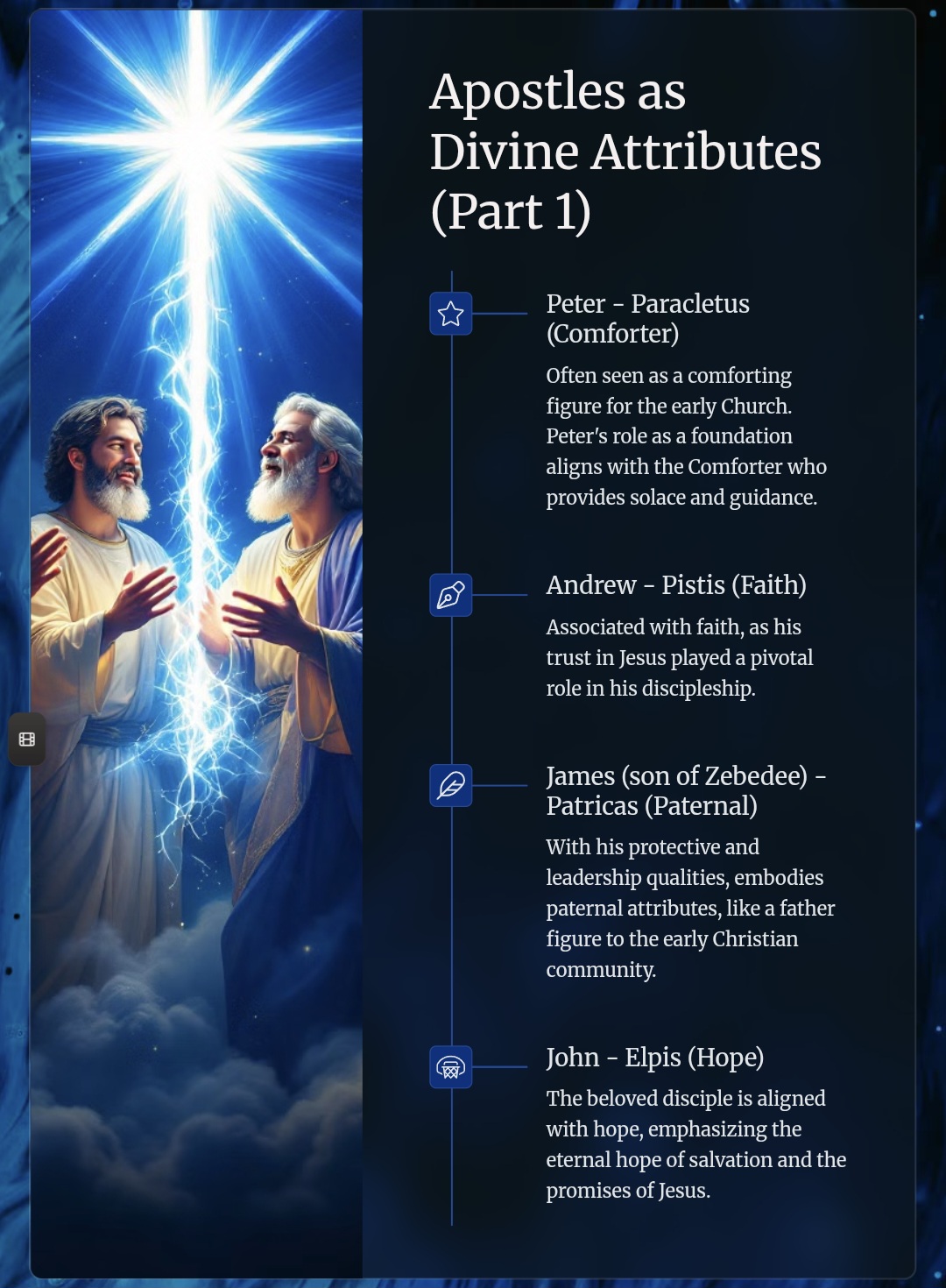
  • the twelve apostles are seen as symbolic of the twelve Aeons of the Dodecad. Here is a breakdown of how each apostle may be associated with an Aeon:

    1. Paracletus (Comforter) - This attribute could be associated with the Apostle Peter, who is often seen as a representative of the divine Comforter, providing support and guidance to believers.

    2. Pistis (Faith) - The attribute of faith can be linked to the Apostle Andrew, who displayed faith and trust in the teachings of Jesus.

    3. Patricas (Paternal) - This attribute, representing fatherhood and protection, could be associated with the Apostle James (son of Zebedee), who was one of the prominent disciples and had a close relationship with Jesus.

    4. Elpis (Hope) - The attribute of hope can be aligned with the Apostle John, who emphasized the hope and expectation of eternal life through Jesus' teachings.

    5. Metricos (Maternal) - This attribute, symbolizing motherhood and nurturing, could be associated with the Apostle Philip, who is said to have cared for and nurtured the early Christian community.

    6. Agape (Love) - The attribute of love can be linked to the Apostle Bartholomew, who demonstrated selfless love and devotion in his discipleship.

    7. Ainos (Praise) - The attribute of praise can be aligned with the Apostle Thomas, who is often remembered for his expression of praise and devotion to Jesus.

    8. Synesis (Intelligence) - This attribute, representing intelligence and understanding, could be associated with the Apostle Matthew, who was known for his background as a tax collector and his ability to comprehend and articulate Jesus' teachings.

    9. Ecclesiasticus (Son of Ecclesia) - This attribute, symbolizing community and belonging, could be linked to the Apostle James (son of Alphaeus), who was part of the close-knit group of disciples forming the early Christian community.

    10. Macariotes (Blessedness) - The attribute of blessedness can be aligned with the Apostle Thaddaeus, who is believed to have experienced the joy and blessedness of being a follower of Jesus.

    11. Theletus (Perfect) - This attribute, representing perfection, could be associated with the Apostle Simon the Zealot, who dedicated himself to the pursuit of righteousness and perfection in his discipleship.

    12. Sophia (Wisdom) - The attribute of wisdom can be linked to the Apostle Judas Iscariot, who, despite his unfortunate betrayal, may be seen as representing the potential for growth and redemption through the pursuit of wisdom.


In the Dodecad, the masculine aeons’ names describe the functions of the aeons of the Ogdoad (especially Mind); the female aeons’ names describe virtues in a partially recognizable sequence (Faith, Hope, Love: 1 Corinthians 13.13).

The dodecad are forces and energies of the psychical universe or the material universe. They are the product of Anthropos and Ecclesia and are related to our states of being. The genders pairs refer to “form” and “substance,” so the Aeons of the Dodecad describe tangible actions and reactions

According to Irenaeus, the Valentinians say that the production of the Duodecad of aeons corresponds to the election of the twelve apostles. The twelfth emanation, the suffering Sophia, corresponds with Judas the twelfth apostle

Irenaeus writes that they think that Sophia's suffering points to Judas' apostasy because both were associated with the number twelve. He reiterates this by saying that the Valentinians relate the suffering Sophia to the betrayal of Judas. Thus her suffering was her error, when she did what was forbidden. It is Sophia's betrayal that results in her suffering which the Valentinians said corresponded to Judas' betrayal of Jesus

It is Sophia's betrayal that results in her suffering which the Valentinians said corresponded to Judas' betrayal of Jesus

Judas was replaced by Matthias this corresponds to the restoration of Sophia

The twelve sons of Jacob and the twelve tribes also signal the Dodecad (Against Heresies 1.18.4). So too the twelve stones on the breastplate and the twelve bells.[Genesis 35.22–26, 49.28; Exodus 28.21, 36.21. (Justin Martyr Dialogue with Trypho 42.1) 

The concept of the Twelve Aeons, also known as the Dodecad, is a central component of Gnostic cosmology. According to this belief system, the Aeons represent emanations of the divine and are arranged in pairs of male and female. Together, they form a system of twelve interconnected and complementary powers that emanate from the divine source.

The Twelve Apostles of Christianity are often seen as symbolic of the Twelve Aeons. Each of the apostles represents an aspect of the divine, and together they embody the fullness of God's power and wisdom.


.

Geographical inaccuracy in the The Sophia of Jesus Christ


Geographical inaccuracy in the The Sophia of Jesus Christ


**Welcome to Pleroma Pathways apocalyptic and mystic Christianity where we explore esoteric and apocalyptic texts.**

**Geographical Accuracy in *The Sophia of Jesus Christ*: Are There Two Mountains of Olives?**

In the Nag Hammadi text *The Sophia of Jesus Christ*, there is a fascinating and much-debated reference to a mountain called "Of the Olives" located in **Galilee**, which has raised questions about its geographical accuracy. The passage reads:

> “After he rose from the dead, his twelve disciples and seven women continued to be his followers, and went to Galilee onto the mountain called ‘Divination and Joy.’ When they gathered together and were perplexed about the underlying reality of the universe and the plan, and the holy providence, and the power of the authorities, and about everything the Saviour is doing with them in the secret of the holy plan, the Saviour appeared—not in his previous form, but in the invisible spirit. And his likeness resembles a great angel of light. But his resemblance I must not describe. No mortal flesh could endure it, but only pure, perfect flesh, like that which he taught us about on the mountain called ‘Of the Olives’ in Galilee.” (*The Sophia of Jesus Christ*)

Critics of the text have proposed that this reference to “the mountain called ‘Of the Olives’ in Galilee” is a geographical inaccuracy. Traditionally, the Mount of Olives is located in **Judea**, just east of Jerusalem, and it is well-known for its biblical significance. However, this assumption fails to account for the broader geographical and agricultural realities of ancient Israel and especially of the region of Galilee.

To begin with, *Matthew 28:9-10* provides us with Jesus’ own instruction to his disciples:

> “Rejoice!… Do not be afraid. Go and tell My brethren to go to Galilee, and there they will see Me.” (Matthew 28:9-10)

Later, we read:

> “Then the eleven disciples went away into Galilee, to the mountain which Jesus had appointed for them.” (Matthew 28:16)

Clearly, Jesus intended for his post-resurrection appearances to occur **in Galilee**—not just Jerusalem. Galilee was not only the region of Jesus’ early ministry but also the setting for his final revelations to the disciples.

We also find that at some point after the Jerusalem appearance, Jesus met with seven disciples at the **Sea of Tiberias** (another name for the Sea of Galilee):

> “After these things Jesus showed Himself again to the disciples at the Sea of Tiberias…” (John 21:1)

This meeting in John 21 is consistent with the idea that the resurrected Jesus spent time with his disciples in Galilee, affirming the idea of *mountains in Galilee* being spiritually significant during that period.

So what of this mountain “called ‘Of the Olives’ in Galilee”? While the Mount of Olives near Jerusalem is well known, there is no reason to assume it is the *only* mountain historically associated with olive trees. In fact, Galilee is abundant with olive groves. The olive tree (*Olea europaea*) thrives throughout the Mediterranean, including:

- The mountain slopes of Galilee
- Samaria
- The central highlands of Israel

This is supported by various biblical references such as:

> “When you beat your olive trees, you shall not go over the boughs again; it shall be for the stranger, the fatherless, and the widow.” (Deuteronomy 24:20)

> “You shall have olive trees throughout all your territory, but you shall not anoint yourself with the oil; for your olives shall drop off.” (Deuteronomy 28:40)

The Galilee region has long been known for its **olives**, **wine**, and **pomegranates**. One such mountain of significance in Galilee is **Mount Tabor**, a monadnock rising prominently from the surrounding landscape, distinct from the Nazareth ridge nearby. Mount Tabor is:

- Located in Lower Galilee
- Known for its surrounding olive groves and vineyards
- Historically associated with visions and divine encounters

It is entirely possible that a mountain near or on Mount Tabor could have been locally referred to as a “mountain of olives,” especially by a Galilean community. This would explain the reference in *The Sophia of Jesus Christ* to “the mountain called ‘Of the Olives’ in Galilee.”

Furthermore, ancient place-names were not always fixed or formalized in the way we assume today. Communities often used descriptive or symbolic names based on physical features or spiritual significance. A mountain covered in olive trees in Galilee could naturally be called the "mountain of the olives" or “Mount of Olives” without referencing the Judean mountain east of Jerusalem.

It is worth noting the mystical and symbolic quality of the *The Sophia of Jesus Christ* as a Gnostic text. The reference to mountains, olive trees, and divine teaching is loaded with spiritual meaning. Mountains often symbolize ascension, divine encounter, and spiritual revelation. Olive trees symbolize peace, anointing, and divine provision. That this teaching occurred on a mountain "called ‘Of the Olives’ in Galilee" carries not just literal but mystical resonance in keeping with the Gnostic tradition of spiritual ascent and hidden wisdom.

Finally, the existence of multiple olive-covered mountains in Israel is not merely probable—it is geologically and agriculturally certain. Galilee is full of such places. One only needs to visit the slopes around Mount Tabor or the hills of Upper Galilee to see the groves stretching across the terrain.

**Conclusion:**

There is no geographical error in *The Sophia of Jesus Christ*. Rather, it reflects a localized Galilean setting where olive-covered hills and mountains were—and still are—common. The reference to a “mountain called ‘Of the Olives’ in Galilee” is plausible both historically and agriculturally. Far from being an error, this mention enriches our understanding of how early Christian mystics localized divine encounters in familiar and sacred spaces, allowing for spiritual continuity between Jesus' ministry in Galilee and his post-resurrection revelations. Thus, we may affirm: **there are indeed two—or even more—Mountains of Olives.**

Monday, 7 April 2025

The Aeonian Realm

The Aeonian Realm


**The Aeonian Realm in the Bible: Aeonian Realm for Them and Us to Inhabit Immediately Here and Now**

Welcome to *Pleroma Pathways* apocalyptic and mystic Christianity, where we explore esoteric and apocalyptic texts. In this document, we will delve into the concept of the Aeonian Realm as described in the Bible. For believers, this realm represents a divine dimension that is not confined to future hope but can be experienced here and now. By examining the term *aionios*—the Greek word meaning "aeonian" or "eternal"—we will discover its deeper significance in both spiritual and corporeal contexts, bringing clarity to its relevance for the faithful in the present age.

**The Aeonian God**

The first and most profound aspect of the Aeonian Realm is God Himself. The Bible introduces God as the "Aeonian God," emphasizing His eternal and unchanging nature. In Romans 16:26, Paul refers to God as the "Aeonian God," highlighting His timeless existence: "the only wise God, through Jesus Christ, be glory forever." Similarly, in the Old Testament, Genesis 21:33 declares, "Abraham called on the name of YHWH, the Aeonian God." This title reflects God's existence beyond time and space, a Deity who was, is, and always will be. He transcends our natural understanding of time, dwelling outside the constraints of physical existence.

Isaiah 57:15 speaks of God inhabiting "eternity" or more precisely, the *aeon*, which refers not just to a measure of time but to the fullness of divine presence. The Hebrew word *olam* is translated as "aeon" in the Greek, signifying the realm of spiritual motion or divine thought. God’s eternal nature allows His will and presence to permeate all of creation instantly, unbound by time or space. As we understand it, God's divine realm of *aeon* is an active, timeless force that transcends human concepts of temporal limitations.

**Aeonian Dwellings**

The Bible speaks of aeonian dwellings, places prepared by God for His faithful. These are not physical mansions made of brick and mortar but spiritual, invisible realms where believers may dwell in the presence of God, both now and forever. In Luke 16:9, it is written: "And I say to you, make friends for yourselves by unrighteous mammon, that when you fail, they may receive you into everlasting (aeonian) habitations." Similarly, 2 Corinthians 5:1 provides further insight: "For we know that if the earthly tent we live in is destroyed, we have a building from God, an eternal (aeonian) house in heaven, not built by human hands." These dwellings are described not as physical structures but as spiritual abodes—spaces in God's presence for those who are part of His divine kingdom.

Jesus affirms this concept in John 14:3, where He assures His followers: "And if I go and prepare a place for you, I will come again and receive you to Myself; that where I am, there you may be also." This place is not in a far-off, distant heaven but is intended for immediate experience, showing that the Kingdom of God, represented by the aeonian realm, is accessible now. This connection is not bound by physical locations but by the spiritual presence of God, which believers can experience today.

**The Nature of the Aeonian Realm**

The *aeonian realm* is not confined to an afterlife or a distant time. It represents God's divine purpose, unfolding in the present and the future. As the Apostle Paul writes in 2 Corinthians 4:18, "So we fix our eyes not on what is seen, but on what is unseen. For what is seen is temporary, but what is unseen is aeonian." This verse reinforces that the true nature of the divine realm—the aeonian—is invisible and transcendent. It reflects the divine kingdom which is not dependent on earthly time or space but is present and eternal in the heart of believers.

Paul also teaches that by faith, believers can comprehend the divine aeonian order, which is the revelation of God's will throughout creation. Hebrews 11:3 explains: "By faith we understand that the ages (aeons) were prepared by the word of God, so that what is seen was not made out of what was visible." This passage asserts that the aeons, the spiritual dimensions through which God interacts with His creation, are manifestations of His divine thought. These aeons are not eternal in themselves but are created by God's will to reveal His eternal purpose.

**The Union of Believers in the Aeonian Realm**

The union of believers is another vital aspect of the aeonian realm. In Ephesians 2:18, it is written, "For through Him we both have access to the Father by one Spirit." Believers, united in the spiritual man, partake in this divine realm, making them one with the body of Christ. This unity is not bound by physical space or time but is a spiritual connection that transcends earthly limitations. As Paul says in 1 Corinthians 5:3, even though he was "absent in the body," he was "present in spirit." This demonstrates that the aeonian realm is not confined by our earthly understanding of time and distance.

Furthermore, Hebrews 12:23 speaks of the Church being connected with "the spirits of just men made perfect," showing that believers in the aeonian realm are united with saints from all ages, both living and dead. This spiritual unity reflects the eternal nature of the aeonian realm, where believers are all one in Christ, a mystical body connected beyond time and space.

**The Aeonian Realm for Today**

The aeonian realm is not a distant future but a present reality for those who walk in the spirit. It is a realm where God's will is immediate, present, and actively shaping the lives of believers. The resurrection from the dead, as described in Daniel 12:2, represents the ultimate realization of this realm—a divine restoration that affects all believers, both living and dead, to partake in the fullness of God's presence. As believers align their hearts and minds with God’s aeonian thought, they partake in the unfolding of God's timeless, spiritual realm here and now.

In conclusion, the aeonian realm is not a distant promise but a present reality that believers are called to inhabit. It is a realm of divine thought, spiritual unity, and timeless purpose, made accessible through Jesus Christ. As we fix our eyes not on the visible but on the invisible, we enter into this aeonian reality, experiencing the eternal presence of God in our lives today and in the age to come.


They will receive you into aeonian dwellings (Luke 16: 9). We have a building from God, an aeonian house in heaven, not built by human hands (2 Cor 5: 1). I am going to prepare a place for you, so that you also may be where I am (John 14: 3). The natural mind thinks about living in a physical house made of brick or stone. Solomon even built a physical house of stone where God could live. Jesus did not go to prepare a mansion in the sky for his followers to enjoy after they died. Rather he prepared an invisible, spiritual place for them and us to inhabit immediately here and now.

Heb 9:14 How much rather shall the blood of the Christ, who through an age-abiding spirit offered himself unspotted unto God, purify our conscience from dead works, to the rendering of divine-service, unto a Living God?

Here Paul uses the words Aeonian Spirit, to make it clear that he is referring to the supernatural, heavenly, invisible Spirit that proceeds from God, rather than its earthly shadow the wind.

Spirit develops the organism of all creatures, and preserves it from disorganization. It is what pathologists term the vis medicatrix natwras; and physiologists, " the vital principle." When the spirit and breath of the Creator are withdrawn from a man or a sparrow, there remain no healing power and vitality in their several bodies; and the immediate tendency in them is to corruption and dust. Hence, all creatures in the air, earth, and seas, are spirit-farms. The types or patterns, after which they were created were all in the mind of Deity before they were created; and when they were formed, the formation was out of spirit-matter and by spirit according to pattern. Every creature is therefore a spirit in this sense; but not necessarily immortal because a spirit. The immortality of a spirit depends upon the constitution of the matter or substance of the peculiar form. A spirit form of a flesh and blood organization is essentially mortal and corruptible; for death and corruption are peculiar to that material constitution.

His spirit withdrawn, and the cohesive affinity of their substance departed, and its gaseous elements entered into new combinations, destructive of the forms, termed man, cattle, fowl, and so forth. Hence the Deity is styled by Moses in Numb, xxvii. 16, " YAHWEH, Elohim of the spirits of all flesh " : that is, the spirit self-styled HE SIIALL BE, is the powers of all flesh-emanations of his power. The spirit-power of the lion is the power of Jehovah; and so of all other creatures. Hence the facility with which he can open and shut their fierce and voracious mouths, as in the case of Daniel and his persecutors. This universal diffusion of spirit places all created things in telegraphic communication with the will of the Deity. What he wills needs not batteries and wires for transmission.

The spiritual union of the members of the Church, living and the dead. They are all part of a single "mystical body of Christ", with Jesus as the head

The natural man cannot possibly understand the love of Christ, but the Spirit " in the inner man" can fully comprehend it (Eph. 3:16-19). This failure of the natural man to understand the things of the spirit is the basic reason for all division between genuine brethren. Time and again we are reminded of the fact that our fellowship with each other is due to the fact that we both have the spiritual man inside us (Eph. 2:18; 4:3,4; Phil. 1:27;2:1).

Our spiritual man is not limited by the bonds of space. Thus Paul was bodily absent from Corinth, " but present in spirit" (1 Cor. 5:3), i.e. his spiritual man was present with them. It was the same with Colosse: " I be absent in the flesh, yet am I with you in the spirit" (Col. 2:5). When our spiritual man groans, Christ groans too in Heaven, an infinite distance away (Rom. 8:23 cp. 26). There is no time barrier, either. Thus our spiritual man is in close fellowship with " the spirits of just men made perfect" , having died many years ago (Heb. 12:23). This is the glorious unity of the Spirit; we are not just connected with all living saints, wherever they may be, but with the spiritual characters of all true saints throughout history.

Whosoever believeth that Jesus is the Christ is born of God" (1 Jn. 5:1). Our spiritual man is what is born of God. All true believers are here spoken of as if they are their spiritual man. All true believers in Christ therefore have a spiritual man within them, which we must seek out, even imagine at times, and with which we should fellowship

The Pleroma in the Odes of Solomon

The Use of Pleroma in The Odes of Solomon


**The Pleroma in the Odes of Solomon**  
*Welcome to Pleroma Pathways apocalyptic and mystic Christianity where we explore esoteric and apocalyptic texts.*

The Odes of Solomon, a collection of early Christian hymns composed in Syriac, offer rich and mystical language that often resonates with the concept of the *Pleroma*. In Valentinian thought, the *Pleroma* is the fullness of divine attributes manifesting corporally through Aeons, and the Odes express this idea through the use of Syriac terms for “fullness,” “perfection,” and “completion.” This essay explores the manifold dimensions of the Pleroma in the Odes, from its theological, redemptive, and spatial meanings to its embodiment in gnosis and divine nature.

**The Pleroma and the Divine Nature**

At the heart of the Odes is the affirmation of the divine fullness and incorruptibility of God. Ode 7:7 declares, “The Father of knowledge is the Word of knowledge. For He it is who is incorrupt, the perfection of the worlds and their Father.” This parallel of “perfection” with “incorruptibility” identifies God as the Pleroma—the unbounded fullness of all being. Similarly, in Ode 7:13, we read that God has widened and lengthened His way “and brought it to complete perfection,” showing the unfolding of divine intention through gnosis. Ode 17:7 affirms this again: “He who knew and exalted me, is the Most High in all His perfection.”

In Ode 16:17, this perfection is participatory: “And by their portion one from another they complete the beauty of God.” The divine beauty is completed or made manifest through unity and sharing among the faithful—a corporate dimension of the Pleroma.

**The Pleroma and Gnosis**

Knowledge (*gnosis*) is central to the understanding of divine fullness in the Odes. The Word (*Logos*) of knowledge is not just divine speech but also a transmission of divine essence. Ode 23:4 exhorts: “Walk in the knowledge of the Lord, and you will know the grace of the Lord generously; both for His exultation and for the perfection of His knowledge.” The Syriac term rendered “perfection of His knowledge” can also be translated as “Pleroma of His gnosis,” tying divine knowledge directly to divine fullness.

Ode 7:13 also says, “For towards knowledge He has set His way... and brought it to complete perfection,” linking the divine path to the gnosis of God, a gnosis that occupies and fills the Pleroma. Thus, the Pleroma is not only the nature of God but also the medium through which gnosis is imparted.

**The Pleroma as a Spatial Reality**

The Pleroma is not merely abstract; it has a spatial dimension. Ode 26:7 says, “Even from the crest of the summits and unto their extremity is His perfection.” The divine perfection—God’s fullness—spans from height to extremity, suggesting a metaphysical geography. Ode 36:2 deepens this idea: “And made me stand on my feet in the height of the Lord, before His perfection and His glory.” Here, the worshipper stands *in* the height, *before* the Pleroma, echoing Philo’s notion that God is “a place” who contains all but is contained by nothing (De Somniis I, xi, 63-64). The Pleroma thus becomes both a state and a place: the divine space of glory and fullness.

**The Pleroma and Redemption**

The fullness of God is not static but redemptive. Ode 9:4 proclaims, “For in the will of the Lord is your life, and His purpose is eternal life, and your perfection is incorruptible.” The Syriac term here translated “your perfection” has rich meaning—implying consecration, maturity, and wholeness. As scholars note, it also reflects the Hebrew *Thummim*, used in the priestly context (Deut. 33:8). This incorruptible perfection is parallel to eternal life, and is received from the one who “filleth all in all” (Eph. 1:23).

Ode 19:5 continues the theme using maternal imagery: “Then She gave the mixture to the generation without their knowing, and those who have received it are in the perfection of the right hand.” Just as divine milk nourishes the newborn, the Pleroma nourishes and redeems the generation without their full comprehension, conveying consecration and restoration.

**The Pleroma and Fruitfulness**

The Pleroma is also expressed in imagery of fruitfulness and completion. Ode 1 begins, “Your fruits are full and complete; they are full of Your salvation.” Ode 11:23 adds, “There is nothing in [Paradise] which is barren, but everything is filled with fruit.” This fullness of fruit aligns with the Pleroma as generative and sustaining. It also recalls Gnostic imagery: “the joint fruit of the Pleroma,” and Sophia, “mother of all living creatures,” who brings forth life from the fullness. The Odes, while not explicitly naming Sophia, allude to a feminine principle of divine nurture—especially in Ode 19:3, “Because His breasts were full,” and Ode 11:2, “He uncovered my inward being towards Him, and filled me with His love.”

**The Pleroma as Union with the Divine**

Finally, the Pleroma is imparted to the Believer. Ode 36:6 states, “And He anointed me with His perfection; and I became one of those who are near Him.” To be near God is to be immersed in His Pleroma. In this divine fullness, the worshipper is transformed, not merely in understanding but in essence. The believer partakes of the divine nature (cf. 2 Peter 1:4) and stands within the Pleroma of the Most High.

**Conclusion**

In the Odes of Solomon, the *Pleroma* is not merely a metaphysical concept but a lived reality. It is the incorruptible perfection of God, the fullness of divine knowledge, the spatial realm of glory, the redemptive essence imparted through divine nurture, and the goal of the Believer’s journey. The Odes articulate a theology of fullness—God as the one who fills all things with Himself, who anoints the faithful with His own perfection, and whose knowledge is the path to eternal life.


The Father of knowledge (gnosis) is the Word (logos) of knowledge (gnosis).
He who created wisdom is wiser than His works.
And He who created me when yet I was not knew what I would do when I came into being.
On account of this He was gracious to me in His abundant grace, and allowed me to ask from Him and to benefit from His sacrifice.
For He it is who is incorrupt, the perfection (Pleroma) of the aeons and their Father.


A few places where the the equivalent of Pleroma occurs (in Syriac) in a somewhat theological sense.


Ode 1 Your fruits are full and complete; they are full of Your salvation....
Ode 6:10 For it spread over the surface of all the earth, and it filled everything.
Ode 7:7 The Father of knowledge is the Word of knowledge.
For He it is who is incorrupt, the perfection of the ages and their Father.
13 Because He it is that is incorrupt, the fullness of the ages and the Father of them. 
Ode 7:13 For towards knowledge He has set His way, he has widened it and lengthened it and brought it to complete perfection.
Ode 9:4 For in the will of the Lord is your life, and His purpose is eternal life, and your perfection is incorruptible.
Ode 11:23 Indeed, there is much room in Your Paradise. And there is nothing in it which is barren, but everything is filled with fruit.
Ode 17:7 And He who knew and exalted me, is the Most High in all His perfection.
18 You are my God, falsehood and death are not in Your mouth; only perfection is Your will.
Ode 19:3 Because His breasts were full, and it was undesirable that His milk should be ineffectually released.
19:5 Then She gave the mixture to the generation without their knowing, and those who have received it are in the perfection of the right hand.
Ode 23:4 Walk in the knowledge of the Lord, and you will know the grace of the Lord generously; both for His exultation and for the perfection of His knowledge.
Ode 23:21 And the letter became a large volume, which was entirely written by the finger of God.

Ode 26:7 Even from the crest of the summits and unto their extremity is His perfection.
Ode 36:2 And made me stand on my feet in the height of the Lord, before His perfection and His glory, while I was praising Him by the composition of His songs. 
Ode 36:6 And He anointed me with His perfection; and I became one of those who are near Him.

Ode 3 speaks of the “members of the Lord” as if referring to something like the gnostic Pleroma


The Pleroma has consecration and redemtion

Ode 9:4 For in the will of the Lord is your life, and His purpose is eternal life, and your perfection is incorruptible.

For in the good-pleasure of the Lord your life exists, and His thought is the life that is for ever; and incorruptible is-verily your fullness-of-perfection. 


imperishable is your Pleroma/fullness  here perfection is parallel to etenal life 

Your fullness-of-perfection: The Odes of Solomon sometimes uses the words 
Perfection, fullness, complete with the idea of consecration.Hence the Syr. here rendered "fullness-of-perfection" (which is a form of Heb. "full") means (Thes. 2128, and comp. 4210) (i) "complete," (2) "perfection," (3) "consecration."


The thought of a full and perfect redemption of mankind in the course of which humanity is developed "to a full-grown Man" (comp. Eph. 4:13) while still remaining a babe. This full-grown humanity, or "fullness of perfection," he cannot attain except by receiving it from the "fullness of perfection" of Him who (Eph 1:23) "filleth all in all." 

the totality the completion the perfection and fulfilment of the whole body the total number of persons in connection with the angels and the church of divine perfection the totality of aeons whole of the divine sphere or Pleroma   

In the second of these senses it represents (Deut. 33:8 (Syr.)) "Thummim," or " Perfection." 

Ode 6:10 For it spread over the surface of all the earth, and it filled everything.

In Hebrew thought, God filled all things by His Presence, His Spirit, His glory and His Wisdom*^ philo, who bridges the gap between Hebraic and Hellenistic thought, speaks frequently of the omnipresence of God, or His filling all things by means of His Spirit, or the Logos, or Wisdom, or His Providence, or His Powers 3. Philo, Legum Allegoria, III, ii, 4; De Gigantibus, vi. 27-28; De Specialibus Legibus, I, iii, 18; De Vita Mo'sTs, II, xliii, "S38; and many other places*


Ode 36:6 And He anointed me with His perfection; and I became one of those who are near Him.

Here the Messiah is given the fullness of the Most High 


Ode 19:3 Because His breasts were full, and it was undesirable that His milk should be ineffectually released.

Ode 19 Then She gave the mixture to the generation without their knowing, and those who have received it are in the perfection of the right hand.

The metaphor may seem crude to our occidental minds, but such language as "the Divine Word, the milk of the Father,"  

in their choice of the word to convey the thought of "the fullness of God," "the fullness in Christ," and the fullness imparted to believers.

again notice the link  perfection,  consecration.and redemption


Ode 1 Your fruits are full and complete; they are full of Your salvation....

Ode 11:23 Indeed, there is much room in Your Paradise. And there is nothing in it which is barren, but everything is filled with fruit.

your fruits full of your salvation

"the joint fruit of the Pleroma," and "Sophia, mother of all living creatures," and " the Jerusalem that is... Sophia whose spouse is the joint fruit of the Pleroma


The Pleroma and Gnosis

7:7 The Father of knowledge is the Word of knowledge.
For He it is who is incorrupt, the perfection of the ages and their Father.

13 Because He it is that is incorrupt, the fullness of the ages and the of them.

7:13 For towards knowledge He has set His way, he has widened it and lengthened it and brought it to complete perfection.


Ode 23:4 Walk in the knowledge of the Lord, and you will know the grace of the Lord generously; both for His exultation and for the perfection of His knowledge.

Ode 23:21 And the letter became a large volume, which was entirely written by the finger of God.

Ode 11:2 For the Most High circumcised me by His Holy Spirit, then He uncovered my inward being towards Him, and filled me with His love.

Ode 12:1 He has filled me with words of truth, that I may proclaim Him.

To fill of a person's inner life


The Pleroma as a place

the father of knowlage is called the pleroma of the aeons and their father 
towards gnosis he laid out his way and brought it over the whole pleroma


Ode 7:13 For towards knowledge He has set His way, he has widened it and lengthened it and brought it to complete perfection.


towards gnosis he laid out his way and brought it over the whole pleroma this brings out the spatial character of this fullness

Ode 23:4 Walk in the knowledge of the Lord, and you will know the grace of the Lord generously; both for His exultation and for the perfection of His knowledge.

The walk of life of a person's inner life. the terms way walk and complete perfection perfection of His knowledge or pleroma  are connetied 

The expression the perfection of His knowledge or the pleroma of his gnosis means Yahweh's own knowledge and also the pleroma of the Most High 

Ode 26:7 Even from the crest of the summits and unto their extremity is His perfection. 

Ode 26:7 And from the top of the hills to their utmost bound is His perfection. 

Compare Ps 112:5 LXX 5  (112:5) Who is as the Lord our God? who dwells in the high places,

the summits or hills literally the heights of the Most High define the space of his pleroma 


Ode 36:2 And made me stand on my feet in the height of the Lord, before His perfection and His glory, while I was praising Him by the composition of His songs. 

the pleroma in its divine fullness of being and fullness of essence with spatial dimension

we often find in Philo's writings some form of that familiar phrase, "containing all things but not contained

"There is a third signification (of place), in keeping with which God Himself is called a place, by reason of His containing all things and being contained by nothing whatever, and being a place for all to flee into, and because He is Himself the space which holds Him; for He is that which He Himself has occupied, and nought encloses Him but Himself. I, mark you, am not a place but in a place and each thing likewise that exists; for that which is contained is different from that which contains it, and the Deity, being contained by nothing, is of necessity Itself Its own place.  Philo, De Somniis, I, xi, 63-64. Likewise, see De Migrations AbraEami, xxxii, 181-182; xxxv, 192>; De ConTusione Lingu'arum, xxvii, 136; and Legum Allegoria, I, xiv, 44.


The Pleroma as the nature of God


Ode 16:17 And by their portion one from another they complete the beauty of God.

Ode 17:7 And He who knew and exalted me, is the Most High in all His perfection.


18 You are my God, falsehood and death are not in Your mouth; only perfection is Your will.

the basic idea behind Pleroma, as used of God, was doubtless the concept of a Deity who was all-perfect, who was limited by nothing, "who contained all things but was not contained,"'