The Holy Hebdomad Isaiah 11:2–3


Let's commence our exploration with a passage from The Gospel of the Egyptians:
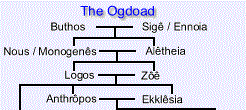
"The perfect hebdomad, shrouded in hidden mysteries, attains fulfillment. Upon receiving glory, it expands into eleven ogdoads."
Originating from Late Latin, "hebdomada" signifies the number seven or a group of seven, particularly denoting a period of seven days or a week, including the seventh day or Sabbath. This term derives from Ancient Greek "hebdomás," which denotes a group of seven, especially referencing seven days or seven years, composed of "heptá" meaning seven, and the suffix "-ás," forming abstract number-related nouns. Notably, cognates of this term exist in French, Portuguese, and Spanish, signifying a weekly periodical or events occurring on a weekly basis.
In the Orthodox Church, a hebdomadary holds a distinct role akin to that of the Roman Catholic Church. This individual, appointed for a week's duration, assumes responsibility for singing the chapter Mass and guiding the recitation of the breviary within a church or monastery setting. Within Roman Catholic chapters or convents, a hebdomadary similarly fulfills the duty of leading the chapter Mass and overseeing the recitation of the canonical hours, embodying a temporary appointment for the week.
Biblical Usage
The term "hebdomad" originates from the Ancient Greek ἑβδομάς (hebdomás) and is comparable to the Latin hebdomas.
In various biblical passages, the term appears with variations denoting periods of sevens:
- Exodus 34:22 references "εβδομάδων" as a period of sevens.
- Leviticus 23:15 mentions "εβδομάδας," signifying periods of seven.
- Leviticus 23:16 uses "εβδομάδος" to denote a period of seven.
- Leviticus 25:8 discusses "εβδομάδες," representing periods of seven.
- Numbers 28:26 refers to "εβδομάδων" as four periods of sevens.
- Daniel 9:24-27 includes several instances of "εβδομάδες," indicating periods of seven.
For instance, Leviticus 25:8 reads: "'And you must count for yourself seven sabbaths of years, seven times seven years, and the days of the seven sabbaths of years must amount to forty-nine years for you."
In the Greek text, it appears as follows: "Καὶ ἐξαριθμήσεις σεαυτῷ ἑπτὰ ἀναπαύσεις αὐτῶν, ἑπτὰ ἔτη ἑπτάκις, καὶ ἔσονταί σοι ἑπτά ἑβδομάδες ἐτῶν ἐννέα καὶ τεσσαράκοντα ἔτη."
The term "sabbaths of years" translates from the Greek "hebdomadeseton," meaning "weeks of years." This usage is comparable to other instances in the book of Daniel, highlighting the consistent biblical usage of the term "hebdomad" to signify periods of seven.
The number seven originates from the Hebrew word "SAVAH," denoting ceasing, resting, or celebration. Derived from the verb "shavath," meaning rest or cease, the Hebrew expression "yohm hash·shab·bath´" signifies the Sabbath, a day of rest on the seventh day.
Throughout biblical narratives, God establishes the significance of the number seven, illustrating rest and completion. The Sabbath, observed on the seventh day, symbolizes rest and cessation from labor (Exodus 20:10; Leviticus 25:2, 6, 8).
In Hebrew, the term for "week" (shavua`) signifies a sevenfold unit or period, echoing the concept of seven. Similarly, the Greek word "sabbaton" derives from the Hebrew word for Sabbath (shabbath´), reinforcing the association with rest and cessation.
Luke 18:12 references fasting "twice in the week," utilizing the Greek word "sabbaton," encompassing both the Sabbath day and other days of the week, akin to the notion of a seven-day period.
The Jewish Sabbath, observed from sundown Friday to sundown Saturday, is named after the planet Saturn, reflecting the Roman designation of Saturday as "Sāturni diēs" ("Saturn's Day").
The mystical significance of the number seven is pervasive, rooted in ancient astronomy and religious beliefs. It symbolizes the seven planetary spheres and the rulership of the heavenly realms. In pre-Christian religions, the concept of seven rulers or archontes, often associated with archangels, signifies cosmic order and divine governance.
In modern Greek, the seven-day week is referred to as an "hebdomada," highlighting the enduring influence of the number seven in religious and cultural contexts.
"Hebdomas" connotes the kingdom of the "Seven," representing the authority of the seven archangels, as delineated in the First Book of Enoch. Thus, the number seven holds profound significance across various traditions, embodying themes of rest, completion, and celestial order.
The term "hebdomad," originating from the Greek for "group of seven," denotes the seventh planetary sphere or seventh heaven, believed to be the realm of the archons or rulers in Gnostic cosmology. The chief archon, or Demiurge, is sometimes associated with the hebdomad, although occasionally linked with the Ogdoad, another grouping of seven.
In Proverbs 9:1, the mention of "Wisdom" constructing her house with seven pillars is interpreted by Valentinians as a reference to the planetary heavens, where Sophia, the embodiment of divine wisdom, resides. According to Valentinian beliefs, Sophia's abode is positioned above the hebdomad within the Ogdoad, a higher spiritual realm.
The passage from the Extracts from the Works of Theodotus further elaborates on the concept, portraying Wisdom as the architect of creation. Through the agency of a divine figure, symbolizing the image of the Father, Wisdom brings forth both heavenly and earthly realms. This imagery underscores the role of Wisdom in shaping the cosmos and establishing order within the divine hierarchy.
Overall, the notion of the hebdomad as the dwelling place of archons and the celestial abode of Wisdom reflects Gnostic cosmological beliefs, highlighting the interconnectedness of spiritual principles and celestial spheres within their theological framework.
The concept of the Hebdomad encompasses both the seven archangels and the seven heavens, reflecting a symbolic and spiritual understanding deeply rooted in ancient texts.
In the Book of Tobit from the Old Testament Apocrypha, Raphael identifies himself as one of the seven angels who stand in the glorious presence of the Lord, emphasizing the existence of seven archangels alongside Michael and Gabriel.
Similarly, the Book of Enoch lists seven holy angels who watch over various aspects of creation, including Uriel, Raphael, Raguel, Michael, Saraqael, Gabriel, and Ramael, further reinforcing the idea of a divine septet.
The significance of the seven pillars is often interpreted as representing the seven virtues, as outlined in Isaiah 11:2–3. These virtues, including wisdom, understanding, counsel, might, knowledge, godliness, and the fear of Yahweh, are associated with the Seven Spirits of God mentioned in the Book of Revelation.
In Isaiah 11:2–3, the Spirit of God is described as resting upon the Messiah, imbuing him with the seven virtues. This connection between the virtues and the natural world is further explored by early Christian theologians like Irenaeus, who utilized number symbolism to elucidate spiritual truths.
According to Irenaeus, the virtues symbolize the seven heavens, drawing a parallel between the divine order and the structure of creation. This interpretation aligns with the biblical narrative, where Moses is instructed to fashion a seven-branched lampstand, reflecting the heavenly model revealed to him on the mountain.
Overall, the concept of the Hebdomad encapsulates the interconnectedness of celestial beings, virtues, and heavenly realms, serving as a symbolic framework to understand divine order and spiritual truths.
In his work "The Proof of Apostolic Preaching," Irenaeus delves into the interconnectedness of scripture, the natural world, and divine symbolism. Drawing from Isaiah 11:2–3, Irenaeus, like the Valentinians, employs number symbolism to elucidate spiritual truths, particularly focusing on the manifestation of seven virtues upon the Messiah.
According to Isaiah 11:2–3, the Spirit of God will rest upon the Messiah, imbuing him with seven virtues: wisdom, understanding, counsel, might, knowledge, godliness, and the fear of Yahweh. Irenaeus interprets these virtues as referring to the seven heavens, reflecting a divine order mirrored in creation.
Irenaeus explains that the seven heavens encompass the world, serving as dwelling places for powers, angels, and archangels who perform service to God. The Spirit of God, manifold in its indwelling, is symbolically represented in seven forms of service as described by Isaiah, resting upon the Son of God, or the Word, in his incarnation as a human.
Each heaven, according to Irenaeus, corresponds to a specific virtue: wisdom, understanding, counsel, might, knowledge, godliness, and the fear of Yahweh. The first heaven, being the highest, represents wisdom, while subsequent heavens symbolize understanding, counsel, might, knowledge, godliness, and the fear of Yahweh respectively.
The imagery of the seven-branched lampstand, as described in Exodus 25:40, serves as a pattern for understanding the relationship between the heavens and the virtues. Moses, in obedience to the divine command, fashioned the lampstand according to the pattern revealed to him on the mountain, signifying the heavenly order.
This connection between the seven-branched lampstand and the heavens underscores the divine blueprint for creation, with the lampstand serving as a symbolic representation of the heavenly realms. The continual shining of the lampstand in the holy place mirrors the perpetual presence of the virtues within the celestial spheres.
In essence, Irenaeus's exploration of Isaiah 11:2–3 and the symbolism of the seven virtues reveals a profound understanding of divine order and spiritual truth. Through the alignment of scripture, nature, and symbolism, Irenaeus illuminates the interconnectedness of the natural and spiritual realms, offering insight into the divine plan for creation.
We will begin this study with a reading from The Gospel of the Egyptians
And thus the perfect hebdomad, which exists in hidden mysteries, became complete. When she receives the glory, she becomes eleven ogdoads. (The Gospel of the Egyptians)
From Late Latin hebdomada (“number seven; group of seven; seven days”), hebdomas (“number seven; a period of seven days a WEEK; seventh day or Sabbath), from Ancient Greek ἑβδομάς (hebdomás, “group of seven, especially seven days or seven years”), from ἑπτά (heptá, “seven”) + -ᾰ́ς (-ás, suffix forming abstract nouns of number from numerals). The word is cognate with French hebdomadaire, hebdo (“weekly periodical”), hebdomadairement (“weekly”), Portuguese hebdomadário (“weekly periodical”), Spanish hebdomadario (“weekly; weekly periodical; hebdomadary”).
In Orthodox Church
The word hebdomadary in the Roman Catholic Church is a member of a church or monastery appointed for one week to sing the chapter Mass and lead in the recitation of the breviary.a member of a Roman Catholic chapter or convent appointed for the week to sing the chapter mass and lead the recitation of the canonical hours
Biblical Use
From Ancient Greek ἑβδομάς (hebdomás). Compare Latin hebdomas.
εβδομάδες G1439.1 - Apostolic Bible Polyglot Concordance, Strongs-AB Number G1439.1
Exodus 34:22 εβδομάδων - of a period of sevens
Leviticus 23:15 εβδομάδας - [2periods of seven
Leviticus 23:16 εβδομάδος - period of seven
Leviticus 25:8 εβδομάδες - periods of seven
Numbers 28:26 εβδομάδων - 4period of sevens],
Deuteronomy 16:9 εβδομάδας - [2periods of seven
Deuteronomy 16:9 εβδομάδας - periods of seven.
Deuteronomy 16:10 εβδομάδων - of the period of sevens
Deuteronomy 16:16 εβδομάδων - period of sevens,
2 Chronicles 8:13 εβδομάδων - period of sevens,
Daniel 9:24 εβδομάδες - periods of seven
Daniel 9:25 εβδομάδες - [2periods of seven
Daniel 9:25 εβδομάδες - [2periods of seven
Daniel 9:26 εβδομάδας - [2periods of seven
Daniel 9:27 εβδομάς - [2period of sevens
Daniel 9:27 εβδομάδος - period of seven
Daniel 10:2 εβδομάδας - periods of seven
Daniel 10:3 εβδομάδων - period of sevens
Leviticus 25:8 Καὶ ἐξαριθμήσεις σεαυτῷ ἑπτὰ ἀναπαύσεις αὐτῶν, ἑπτὰ ἔτη ἑπτάκις, καὶ ἔσονταί σοι ἑπτά ἑβδομάδες ἐτῶν ἐννέα καὶ τεσσαράκοντα ἔτη.
“Sabbaths of.” Heb., shabbethoth´; Lat., ebdomades, “weeks.”
“Sabbaths of years.” Greek, hebdomadeseton´, “weeks of years.” Compare Da 9:24 ftn, “Weeks.”
Seven
Seven comes from the Hebrew "SAVAH" meaning to cease (47x), rest (11x), away (3x), fail (2x), celebrate (1x), miscellaneous (7x).
The Hebrew expression yohm hash·shab·bath´ is drawn from the verb shavath´, meaning “rest, cease.” (Ge 2:2; 8:22)
God set the pattern for the whole Sabbath arrangement, from the seven-day week to the Jubilee year that followed the seven-times-seven–year cycle. (Ex 20:10; Le 25:2, 6, 8)
The sabbath is on the seventh day it is a day of rest therefore seven symbolizes rest
The Hebrew word for “week” (shavua`) literally refers to a sevenfold unit or period. The Greek word sabbaton, in turn, is derived from the Hebrew word for Sabbath (shabbath´).
Luke 18:12 I fast twice in the week <4521>, I give tithes of all that I possess.
4521. σάββατον sabbaton sabbaton; of Hebrew origin [07676]; the Sabbath (i.e. Shabbath), or day of weekly repose from secular avocations (also the observance or institution itself); by extension, a se’nnight, i.e. the interval between two Sabbaths; likewise the plural in all the above applications: — sabbath (day), week.
AV-sabbath day 37, sabbath 22, week 9; 68
The word translated week here in Luke 18:12 refers to other days in the week as well the Sabbath day (its like saying seven days, a week).
The Jewish Sabbath is from from sundown Friday to sundown Saturday. Saturday is named after the planet Saturn.
The Jewish Sabbath is from from sundown Friday to sundown Saturday. Saturday is named after the planet Saturn.
Seven is so universally used as a mystical number that its basis must be in some fundamental arrangement of the natural world.
Seven indicates the number of days in a week, the number of planetary spheres (sun, moon, Mercury, Venus, Mars, Jupiter, Saturn) in ancient astronomy, and so the number of kings stationed over the spheres of heaven in the Secret Book of John. The seventh or hebdomad refers to the realm of the planetary spheres, over which the Demiurge is stationed.
Because there were seven planets in the sky (the sun, moon, Mercury, Venus, Mars, Jupiter, and Saturn),[1] it was commonly agreed that there were seven of these beings ruling as a hebdomad who were called “archontes” (principalities or rulers).[2]
[1.] This dependence upon the number seven is quite common in pre-Christian religion. The Jews, for example, believed that these seven planets were ruled by seven archangels: Michael, Gabriel, Raphael, Uriel, Selaphiel, Jegudiel, and Barachiel. (Each of which corresponded to the seven days of the week, respectively.)
[2.] In modern Greek, the seven-day week is called an hebdomada.
Hebdomas; The kingdom of the "Seven", referring to the seven Archangels. The seven archangels are name in the First Book of Enoch
hebdomad: (Greek, “group of seven”) The seventh planetary sphere or seventh heaven, lair of the archons. The chief archon or Demiurge is sometimes considered to reside in the hebdomad and sometimes in the Ogdoad. Hebdomad can also refer to a grouping of seven beings (for instance, archons) in Gnostic texts.
Isaiah 11:2 2 and the Spirit of God shall rest upon him, the spirit of wisdom and understanding, the spirit of counsel and strength, the spirit of knowledge and godliness shall fill him;
Revelation 4:5: And out of the throne proceeded lightnings and thunderings and voices: and there were seven lamps of fire burning before the throne, which are the seven Spirits of God.
Because there were seven planets in the sky (the sun, moon, Mercury, Venus, Mars, Jupiter, and Saturn),[1] it was commonly agreed that there were seven of these beings ruling as a hebdomad who were called “archontes” (principalities or rulers).[2]
[1.] This dependence upon the number seven is quite common in pre-Christian religion. The Jews, for example, believed that these seven planets were ruled by seven archangels: Michael, Gabriel, Raphael, Uriel, Selaphiel, Jegudiel, and Barachiel. (Each of which corresponded to the seven days of the week, respectively.)
[2.] In modern Greek, the seven-day week is called an hebdomada.
Hebdomas; The kingdom of the "Seven", referring to the seven Archangels. The seven archangels are name in the First Book of Enoch
Seven Hevens and Seven Archangels
(Proverbs 9:1): Wisdom has built her house, She has carved out her seven pillars;
The seven pillars which wisdom built a house are understood by valentinians to refer to the planetary heavens, the habitation of the Sophia herself was placed above the Hebdomad in the Ogdoad (Extracts from the Works of Theodotus. 8, 47):
47 Now the Saviour became the first universal creator. “But Wisdom,” the second, “built a house for herself and hewed out seven pillars” and first of all she put forth a god, the image of the Father, and through him she made heaven and earth, that is “heavenly things, and the earthly” – the things on the right hand and on the left. (Extracts from the Works of Theodotus)
The seven pillars which wisdom built a house are understood by valentinians to refer to the planetary heavens, the habitation of the Sophia herself was placed above the Hebdomad in the Ogdoad (Extracts from the Works of Theodotus. 8, 47):
47 Now the Saviour became the first universal creator. “But Wisdom,” the second, “built a house for herself and hewed out seven pillars” and first of all she put forth a god, the image of the Father, and through him she made heaven and earth, that is “heavenly things, and the earthly” – the things on the right hand and on the left. (Extracts from the Works of Theodotus)
The Hebdomad is used of the seven seven archangels and the seven heavens
The idea of seven archangels is most explicitly stated in the old testament Apocrypha, Book of Tobit when Raphael reveals himself, declaring: "I am Raphael, one of the seven angels who stand in the glorious presence of the Lord, ready to serve him." (Tobit 12:15) The other two archangels mentioned by name in the Bible are Michael and Gabriel.
The Book of Enoch (also known as 1 Enoch)
8:4 And as men perished, they cried, and their cry went up to heaven to the holy angels who watch.
20:1 And these are the names of the holy angels who watch.
20:2 Uriel, one of the holy angels, who presides over clamour and terror.
20:3 Raphael, one of the holy angels, who is over the spirits of men.
20:4 Raguel, one of the holy angels who takes vengeance on the world of the luminaries.
20:5 Michael, one of the holy angels, who, is set over the best part of mankind and over chaos.
20:6 Saraqael, one of the holy angels, who is set over the spirits, who sin in the spirit.
20:7 Gabriel, one of the holy angels, who is over the Garden of Eden and the serpents and the Cherubs.
20:8 Ramael, one of the holy angels, whom God set over those who rise.
The idea of seven archangels is most explicitly stated in the old testament Apocrypha, Book of Tobit when Raphael reveals himself, declaring: "I am Raphael, one of the seven angels who stand in the glorious presence of the Lord, ready to serve him." (Tobit 12:15) The other two archangels mentioned by name in the Bible are Michael and Gabriel.
The Book of Enoch (also known as 1 Enoch)
8:4 And as men perished, they cried, and their cry went up to heaven to the holy angels who watch.
20:1 And these are the names of the holy angels who watch.
20:2 Uriel, one of the holy angels, who presides over clamour and terror.
20:3 Raphael, one of the holy angels, who is over the spirits of men.
20:4 Raguel, one of the holy angels who takes vengeance on the world of the luminaries.
20:5 Michael, one of the holy angels, who, is set over the best part of mankind and over chaos.
20:6 Saraqael, one of the holy angels, who is set over the spirits, who sin in the spirit.
20:7 Gabriel, one of the holy angels, who is over the Garden of Eden and the serpents and the Cherubs.
20:8 Ramael, one of the holy angels, whom God set over those who rise.
The seven pillars are normally interpreted as seven virtues. The seven virtues are understood to be the seven spirits of Isaiah 11:2–3 wisdom, understanding, counsel, might, knowledge, godliness, and the fear of Yahweh, here are represented the seven Spirits, which are before the throne of God. The reference to the lamb in Revelation 5:6 relates it to the Seven Spirits which first appear in Revelation 1:4 and are associated with Jesus who holds them along with seven stars
The seven Spirits of God are mentioned four times in the Book of Revelation, and in the Book of Isaiah it names each Spirit.
Isaiah 11:2 2 and the Spirit of God shall rest upon him, the spirit of wisdom and understanding, the spirit of counsel and strength, the spirit of knowledge and godliness shall fill him;
3 the spirit of the fear of God. He shall not judge according to appearance, nor reprove according to report:
Revelation 4:5: And out of the throne proceeded lightnings and thunderings and voices: and there were seven lamps of fire burning before the throne, which are the seven Spirits of God.
In discussing Isaiah 11.2–3 (“And the Spirit of God will rest upon him, a Spirit of wisdom and understanding …”), Irenaeus, like the Valentinians, uses number symbolism to connect the Scripture and the natural world. According to this verse there are seven virtues that come upon the Messiah: wisdom, understanding, counsel, might, knowledge, godliness, and the fear of Yahweh.
Irenaeus explains that the virtues refer to the seven heavens, the model Moses used for the seven-branched lampstand, in obedience to the command to fashion things as a type of what was revealed to him on the mountain (Exodus 25.40).
Irenaeus The Proof of Apostolic Preaching
9. Now this world is encompassed by seven heavens, [87] in which dwell powers and angels and and angels and archangels, doing service to God, the Almighty and Maker of all things: not as though He was in need, but that they may not be idle and unprofitable and ineffectual.
9. Now this world is encompassed by seven heavens, [87] in which dwell powers and angels and and angels and archangels, doing service to God, the Almighty and Maker of all things: not as though He was in need, but that they may not be idle and unprofitable and ineffectual.
88] Wherefore also the Spirit of God is manifold in its indwelling, [89] and in seven forms of service [90] is He reckoned by the prophet Isaiah, as resting on the Son of God, that is the Word, in His coming as man.
The Spirit of God, he says, shall rest upon him, the Spirit of wisdom and of understanding, the Spirit of counsel and of might, (the Spirit of knowledge) [91] and of godliness; the Spirit of the fear of God shall fill him.
Now the heaven which is first from above, [92] and encompasses the rest, is (that of) wisdom; and the second from it, of understanding; and the third, of counsel; and the fourth, reckoned from above, (is that) of might; and the fifth, of knowledge; and the sixth, of godliness; and the seventh, this firmament of ours, is full of the fear of that Spirit which gives light to the heavens. For, as the pattern (of this), Moses received the seven-branched lampstand, [93] that shined continually in the holy place; for as a pattern of the heavens he received this service, according to that which the Word spake unto him: Thou shalt make (it) according to all the pattern of the things which thou hast seen in the mount. (The Proof of Apostolic Preaching, 9)
The number seven as it pertains to heavens was mentioned by Clement of Alexandria and Origen, who probably were relayed the idea from first century Jewish mysticism (Bereshith Rabba, 19, fol. 19, col. 3 contains a later Jewish presentation of the idea, but being that the seventh heaven contains the Shekinah [Sophia] glory of God, the Jewish mysticism was ironically Gnostic in nature–the Quran also contains a similar reference in Surah 67).
The word Hebdomad occurs also in the Clementine Homilies. The mystery of the Hebdomad there unfolded (Hom. xvii. 10) is an independent exposition of the six days' work of creation, and the seventh day's rest; illustrated by the six directions, into which infinite space extends, viz. up, down, right, left, backward, forward, together with the central point considered as making a seventh.
Pseudo-Clementine Literature/The Clementine Homilies/Homily XVII/Chapter 10
Chapter X.—The Nature and Shape of God.
“This is the mystery of the hebdomad. For He Himself is the rest of the whole who grants Himself as a rest ( “Rest,” of course, points to the number seven the Sabbath Day.) to those who imitate His greatness within their little measure. For He is alone, sometimes comprehensible, sometimes incomprehensible, sometimes limitable, sometimes illimitable, having extensions which proceed from Him into infinity. For thus He is comprehensible and incomprehensible, near and far, being here and there, as being the only existent one, and as giving a share of that mind (the ogdoad) which is infinite on every hand, in consequence of which souls breathe and possess life; and if they be separated from the body and be found with a longing for Him, they are borne along into His bosom, as in the winter time the mists of the mountains, attracted by the rays of the sun, are borne along immortal to it. What affection ought therefore to arise within us if we gaze with our mind on His beautiful shape! But otherwise it is absurd to speak of beauty. For beauty cannot exist apart from shape; nor can one be attracted to the love of God, nor even deem that he can see Him, if God has no form. (Clementine Homilies Chapter 10)
- The Untitled Text in the Bruce Codex also describes the Pleroma as ‘the body’ of the monad, which is like the mother-city “This is the manner in which they are all within the monad : there are twelve monads making a crown upon its head ; each one makes twelve. And there are ten decads surrounding its shoulders. And there are nine enneads surrounding its belly. And there are seven hebdomads at its feet, and each one makes a hebdomad. And to the veil which surrounds it like a tower, there are twelve gates. There are twelve myriad powers at each gate, and they are called archangels and also angels. This is the mother-city of the only-begotten one.” (Untitled Text in the Bruce Codex)
The hebdomad symbolizes rest, but it is surpassed by the ogdoad, wherein is the promise of gnostic perfection.
Clement of Alexandria says that those who reach the highest levels of perfection have not remained in the hebdomad of rest, but have advanced into the inheritance of the benefit of the ogdoad (ὀγδοαδικῆς εὐεργεσιάς).
The material world is a shadowy, flawed version of the Pleroma, the two worlds sometimes being referred to as the Hebdomad (from hebdomas, meaning ‘seven’, a reference to the seven spheres of the material and Ogdoad (from ogdoas, meaning ‘eight’, referring to the eighth heaven), respectively.
The hebdomad symbolizes rest, but it is surpassed by the ogdoad, wherein is the promise of gnostic perfection.
Clement of Alexandria says that those who reach the highest levels of perfection have not remained in the hebdomad of rest, but have advanced into the inheritance of the benefit of the ogdoad (ὀγδοαδικῆς εὐεργεσιάς).
The material world is a shadowy, flawed version of the Pleroma, the two worlds sometimes being referred to as the Hebdomad (from hebdomas, meaning ‘seven’, a reference to the seven spheres of the material and Ogdoad (from ogdoas, meaning ‘eight’, referring to the eighth heaven), respectively.
Summary
In modern Greek, the seven-day week is called an hebdomada
The Hebdomad is used of the seven archangels and the seven heavens
The Hebdomad refers to seven spirits of virtues
The Hebdomad refers the seven spirits of God
The Hebdomad symbolizes rest
The Hebdomad is a copy of the Pleroma