Wednesday, 18 September 2019

The head of prophecy was cut off with John The Apocryphon of James

The head of prophecy was cut off with John The Apocryphon of James

Introduction

The early Christian texts, including the canonical Gospels and certain apocryphal writings, offer profound insights into the nature of prophecy, the human soul, and the spiritual journey. In this document, we will explore the historical background of Luke 9:7-9, Matthew 14:1-12, and Mark 6:14-29, as well as the teachings found in the Apocryphon of James and the Gospel of Mary. These texts provide a unique perspective on the relationship between prophecy, the human soul, and the mind, shedding light on the mysteries of faith and spirituality in the early Christian context.

Historical Background

Luke 9:7-9, Matthew 14:1-12, and Mark 6:14-29 are passages that center around the beheading of John the Baptist. These events took place during the time of Jesus and were recorded in the synoptic Gospels. John the Baptist was a significant figure in the New Testament, known for his role as a precursor to Jesus and his bold proclamation of repentance and baptism.

In these passages, the ruler Herod Antipas, who had previously arrested John, was tormented by the idea that John had risen from the dead and was performing miraculous deeds through Jesus. The passages highlight the fear and superstition surrounding these events, leading to the conclusion that John's death was a significant turning point in the narrative of Jesus' ministry.

The Apocryphon of James

The Apocryphon of James: Then I asked him, "Lord, how shall we be able to prophesy to those who request us to prophesy to them? For there are many who ask us, and look to us to hear an oracle from us."

The Lord answered and said, "Do you not know that the head of prophecy was cut off with John?"

But I said, "Lord, can it be possible to remove the head of prophecy?"

The Lord said to me, "When you come to know what 'head' means, and that prophecy issues from the head, (then) understand the meaning of 'Its head was removed.' At first I spoke to you in parables, and you did not understand; now I speak to you openly, and you (still) do not perceive. Yet, it was you who served me as a parable in parables, and as that which is open in the (words) that are open.

The Apocryphon of James is an ancient Gnostic text that provides insights into the nature of prophecy. In the dialogue between James and the Lord, James seeks guidance on how to prophesy effectively. The Lord's response, "Do you not know that the head of prophecy was cut off with John?" is enigmatic but carries profound meaning.

The "head of prophecy" signifies the source and origin of prophetic knowledge. The Lord's statement implies that with the arrival of John the Baptist, a transitional phase in spiritual revelation occurred. John, as the forerunner of Christ, represented a crucial point in the unfolding of divine wisdom. The removal of John's head symbolizes the cessation of a particular form of prophecy, as John had fulfilled his role by preparing the way for Jesus.

The Lord's subsequent explanation suggests that true prophecy emanates from a deeper source – the mind, which serves as an intermediary between the soul (outward senses or the body) and the spirit (emotions or the heart). The mind, in this context, represents the intellectual and spiritual receptivity of the individual.

This teaching invites the reader to contemplate the nature of spiritual revelation and the evolving role of prophecy within the context of the early Christian community. It suggests that the focus should shift from external prophecies to inner, transformative experiences of the mind and spirit.

The Gospel of Mary

10) I said to Him, Lord, how does he who sees the vision see it, through the soul  or through the spirit?
11) The Savior answered and said, He does not see through the soul nor through the spirit, but the mind that is between the two that is what sees the vision

The Gospel of Mary introduces a dialogue where the disciples inquire about the nature of visions and how they are perceived. The response provided by the Savior is highly symbolic and aligns with the broader Gnostic understanding of human composition.

The Savior's answer that one does not see visions through the soul or spirit but through the mind that resides between them emphasizes the integral role of the mind in spiritual perception. In this context, the soul represents the physical, sensory aspect of human existence, while the spirit denotes the emotional and heartfelt aspects.

This teaching reinforces the idea that true spiritual vision requires a harmonious balance between sensory perception and emotional engagement, facilitated by the discerning and receptive nature of the mind. It underlines the Gnostic belief in the significance of transcending the limitations of the physical world to attain spiritual enlightenment.

II. Understanding the Terminology

Before delving into the interconnected themes across these texts, it is crucial to clarify the terminology used, particularly the concepts of the soul, spirit, and mind.

A. Body, Soul, and SpiritIn early Christian thought, humans were often seen as composed of body, soul, and spirit. The body represented the physical vessel, the soul as the seat of outward senses or the body itself, and the spirit as the seat of emotions or the heart. This trichotomy was a way to understand the complexity of the human experience and the interaction between the physical and spiritual aspects of life.

B. The Head as the Mind

The texts highlight the concept that "prophecy issues from the head," with the head symbolizing the mind. In this context, the mind represents the intellectual and cognitive aspect of human existence. It is through the mind that one perceives and interprets prophecies and visions.

III. The Deeper Meaning

A. Prophecy and the End of Prophecy

The Lord's response in the Apocryphon of James, "the head of prophecy was cut off with John," suggests a profound spiritual insight. It implies that the path to prophecy, or spiritual revelation, is no longer reliant on external sources or prophetic figures, as John the Baptist once represented. Instead, the guidance is to look within, to the "mind that is between the two."

B. The Mind as the Visionary Gateway

The Gospel of Mary further elucidates the nature of visionary experiences. The Savior's response, "He does not see through the soul nor through the spirit, but the mind that is between the two," emphasizes that the visionary experiences are accessed through the harmonious interaction of the soul and spirit within the mind.

IV. Implications for Early Christianity

The interconnected teachings in these texts hold significance for early Christianity. They point to a shift from an era where prophecy was sought externally, through figures like John the Baptist, to a more introspective and mystical approach. The emphasis on the "mind that is between the two" suggests that individuals have the capacity to access spiritual insights and visions through their own inner contemplation.

Conclusion

The early Christian texts, when examined in conjunction with Gnostic teachings, offer a nuanced perspective on the nature of prophecy, the human soul, and the mind's role in perceiving spiritual visions. The removal of the "head of prophecy" with John the Baptist's mission signifies a shift in the way spiritual revelation is understood. It suggests a move from external prophecies to an inner, transformative experience facilitated by the receptive and discerning nature of the mind.

The teachings in the Gospel of Mary emphasize the importance of a harmonious union of the body, soul, and spirit in the pursuit of spiritual vision and enlightenment. The mind, located between the soul and spirit, is central to this process, serving as the vehicle for the perception of divine truths.

In summary, these ancient texts provide valuable insights into the mystical dimensions of early Christian thought, encouraging a deeper understanding of the interplay between the components of the human self and the evolving nature of prophecy and spiritual revelation in the Christian tradition.


historical background: Luke 9:7–9; Matthew 14:1–12; Mark 6:14–29 

Gospel of Thomas (52) His students said to him, Twenty-four prophets have spoken in Israel and they all spoke of you. He said to them, You have disregarded the living one among you and have spoken of the dead.

This saying in the Gospel of Thomas it is not really a prophecy, it first confirms the Old Testament prophets all speaking about Jesus this show us that the writer of the text believed that the OT prophets prognosticated information about Jesus. next Jesus himself declares his own prophetic status   


The Apocryphon of James: Then I asked him, "Lord, how shall we be able to prophesy to those who request us to prophesy to them? For there are many who ask us, and look to us to hear an oracle from us."

The Lord answered and said, "Do you not know that the head of prophecy was cut off with John?"

But I said, "Lord, can it be possible to remove the head of prophecy?"

The Lord said to me, "When you come to know what 'head' means, and that prophecy issues from the head, (then) understand the meaning of 'Its head was removed.' At first I spoke to you in parables, and you did not understand; now I speak to you openly, and you (still) do not perceive. Yet, it was you who served me as a parable in parables, and as that which is open in the (words) that are open.

Gospel of Mary 

10) I said to Him, Lord, how does he who sees the vision see it, through the soul  or through the spirit?
11) The Savior answered and said, He does not see through the soul nor through the spirit, but the mind that is between the two that is what sees the vision

Here the words soul and spirit refer to natural human faculties

Man is made up of a body, soul and spirit

1Th 5:23  And the very God of peace sanctify you wholly; and [I pray God] your whole spirit and soul and body be preserved blameless unto the coming of our Lord Jesus Christ.

Heb 4:12  For the word of God [is] quick, and powerful, and sharper than any twoedged sword, piercing even to the dividing asunder of soul and spirit, and of the joints and marrow, and [is] a discerner of the thoughts and intents of the heart.

Sometimes the word soul and spirit and be translated mind, heart,

brain seat of consciousness
Mind = the intellect
soul = seat of the outward senses or the body 
spirit = seat of emotions or the heart 

therefore the head is the mind and the mind is thinking produced by the brain

 that prophecy issues from the head, and the mind that is between the two (spirit emotions or the heart and soul seat of the outward senses or the body) that is what sees the vision

  Jesus is saying to them that Christ has already come why does there need to be a prophecy I’ve shown you the path to Christhood there needs not to be prophecies anymore


The gospel of Thomas Saying 11

The gospel of Thomas Saying 11


Jesus said: This heaven will pass away, and the one above it will pass away; and those who are dead are not alive, and those who are living will not die. In the days when you ate of what is dead, you made of it what is living. When you come to be light, what will you do? On the day when you were one, you became two. But when you have become two, what will you do?

In the Gospel of Thomas, a collection of sayings attributed to Jesus, there lies a profound exhortation that resonates with the spiritual truths found within the Bible. Jesus proclaims, "This heaven will pass away, and the one above it will pass away; and those who are dead are not alive, and those who are living will not die" (Gospel of Thomas, Saying 11). This declaration echoes the prophecy of Isaiah, stating, "And all the host of heaven shall be dissolved, and the heavens shall be rolled together as a scroll" (Isaiah 34:4).

Central to this saying is the notion that the dead are not alive, a concept deeply embedded in the fabric of the one true faith as delineated in the Bible. Contrary to the beliefs of many other religious traditions, the Bible teaches that death is not a gateway to eternal life in heaven but rather a state of unconsciousness. This truth is reiterated throughout both the Gospel of Thomas and the Scriptures (e.g., Ecclesiastes 9:5, Psalms 115:17, 146:3-4).

Sayings 15, 51, 52, 59, along with biblical references such as Ecclesiastes 9:5, 10 and Psalms 115:3-4, underscore the theme of the unconsciousness of the dead. They emphasize that death is a state of non-being, where individuals are unaware of the affairs of the living world. This aligns with the biblical notion that in death, there is no consciousness or knowledge (Ecclesiastes 9:5) and that the dead do not praise the Lord (Psalms 115:17).

Furthermore, Saying 87 and 112, along with the reference to Genesis, highlight the interconnectedness of the body, flesh, and soul. This echoes the biblical concept that humanity is comprised of both physical and spiritual elements, and these aspects are intricately linked. The unity of body, flesh, and soul underscores the holistic nature of human existence, emphasizing the importance of both physical and spiritual well-being.

The interpretation of these sayings goes beyond a mere understanding of physical death; they also speak to spiritual death—the separation from God due to sin. Those who remain spiritually dead, unenlightened by the truth, face not only physical death but also spiritual death, symbolized by a second death after judgment. In contrast, those who are spiritually alive in Christ experience eternal life, marked by a profound union with God.

The Gospel of Thomas, much like the Bible, emphasizes the transformative power of truth and the significance of spiritual awakening. Through faith in Christ and adherence to His teachings, believers transition from spiritual death to life, from darkness into the everlasting light of God's presence.

In essence, these additional sayings reinforce the central themes of spiritual consciousness, interconnectedness of body and soul, and the transformative power of truth found within the Gospel of Thomas. They complement the broader narrative of Jesus's teachings, inviting believers to contemplate the nature of life, death, and eternity in light of divine truth.

In light of these additional sayings, the concept of eating dead and living things takes on a broader spiritual significance. It encompasses not only physical nourishment but also spiritual sustenance, highlighting the importance of feeding the soul with divine truth rather than relying solely on worldly pleasures. Just as the body requires sustenance for physical life, the soul requires spiritual nourishment for eternal life.

Therefore, the admonition to eat dead and living things in the Gospel of Thomas goes beyond mere dietary practices; it serves as a metaphor for embracing spiritual truths and rejecting spiritual death. By partaking of the living bread—the teachings of Christ—and rejecting the dead works of the flesh, believers find true fulfillment and eternal life in Him.

Moreover, Jesus's words in Saying 11 align with the biblical teaching that the spiritually dead will face a second death after judgment, while those alive in Christ will attain everlasting life. The distinction between the dead and the living is not merely physical but spiritual, highlighting the importance of being spiritually alive through faith in Christ.

The imagery of eating dead and living things in the saying symbolizes the consumption of spiritual nourishment. The dead represent adherence to the Law of Moses, which fails to impart eternal life, while the living symbolize partaking of Christ's flesh and blood through belief in His testimony as revealed in the Scriptures (John 6:54, Revelation 22:14). Thus, truth nourishes life, leading believers from darkness into the light of Christ.

"When you are in the Light, what will you become?" Jesus's question invites contemplation on the transformative power of light, equating it with moral enlightenment and unity with God. As believers walk in the light, they become united with God, transitioning from a state of oneness to a divine partnership, symbolized by the union of man and woman in marriage (Genesis 2:24).

This transition from oneness to twoness signifies both unity with God and the potential for division. Through faith in Christ, believers become united with God, yet this unity also distinguishes them from the world, making them "two" in their spiritual journey.

Ultimately, the saying challenges believers to ponder their spiritual state and trajectory. Will they remain spiritually dead, adhering to temporal laws and doctrines, or will they embrace the life-giving truth of Christ, transitioning from darkness into the eternal light?

In conclusion, the Gospel of Thomas, like the Bible, illuminates profound spiritual truths concerning life, death, and light. Through reflection on Jesus's teachings, believers are invited to transcend mere existence and embrace the abundant life found in Him. As they walk in the light, they become united with God, shining as beacons of truth and righteousness in a world enveloped by darkness.


This saying is an exhortation of Isaiah 34:4  And all the host of heaven shall be dissolved, and the heavens shall be rolled together as a scroll: and all their host shall fall down, as the leaf falleth off from the vine, and as a falling fig from the fig tree. Cp. Isaiah 13:13

“The dead are not alive” here we have one of the spiritual truth of the one true faith found only in the Bible the dead are not alive and the kingdom is not in the sky cp. Saying 3, every other bible based faith and religion teaches we go to heaven when we die or that only some go to heaven to rule with Christ. If death is not death than what the Bible says about death is a lie. 

However it is not only the bible that teaches that the dead are unconscious and know nothing and this is summed in the words of Jesus here in saying 11 "The dead are not alive." compare sayings 59, 60. 

So like the Bible and the true believers of the Bible, the Gospel of Thomas does not teach that we go to heaven to rule with Christ or that the soul live on after death. The GTh teaches that the dead are unconscious and know nothing so The dead are not alive Cp. Saying 15, 51, 52, 59, Ecc 9:5, 10 Ps 115: 146:3, 4. And the body, the flesh, and the soul are equivalent in value or interdependent Saying 87, 112 Gen 

This also has another meaning it is also about spiritual death those who have not been made alive by the word of truth. The spiritually dead will die a second death after the judgment. However those who are alive in Christ will have indefinitely lasting life.

The eating of dead and living things are not a doctrine of vegetarianism for the dead things are dead animals compare saying 60 87 111 112 which are killed and than eaten to sports life thus making the dead thing living. The dead and living things are also rational principles cp. 13 61 108 111 this is the same in the bible it is spiritual meat Ps 73:24. Thus, the dead principle would be the Law of Moses, which does not bring everlasting life only a long life in this life if they live by it. Now the living principle is the bread that is the flesh of Christ and if we do not eat the flesh of the son of man and drink his blood we have no life in us. But we only eat and drink his flesh and blood by believing the written testimony of the Logos concerning Jesus, set forth in the Bible and become the subject of repentance and remission of sins in the name of Christ Jesus, eats his flesh and drinks his blood. Cp. Rev 22:14 Jn 6:54. Truth eats life no one nourished by truth will die. This is the meaning of eating living things which bring us out of darkness and into the light.


“When you are in the Light, what will you become?” Jesus is the light of the world and also God is light, and we are told in the Bible add that we are to become like Jesus is now and Jesus now is consubstantial with God so we are to become consubstantial with God and God is Light so we shall become light first moral light (which denotes the knowledge of the truth i.e. a light to the nations) second when we shall shine like the brightness of the expanse and those who lead many to righteousness, like the starts forever.

On the day when you come into the light you became two. When you are two, what will you become? Two can be a figure both of unity and of division. Man and woman form the basic family unit (Gen 1:27 2:20,24) we become two when we are united with God we are two because God is with us and we are walking with him we are walking in the light and we are no longer one but two.


11) Jesus said, "This heaven [the errant Christo-pagan system of worship] will pass away, and the one above it [errant Judaism] will pass away. The dead [those who are "of" the two heavens named] are not alive [have not found the Life, the resurrection (“Christ in you”)], and the living [those who have “Christ in them”] will not die. In the days when you consumed [put your faith and trust in false teachings of men] what is dead [the lower/outward (fleshly) forms], you made it what is alive [a falsehood has no life of its own, one must give it life by believing and accepting it as true]. When you come to dwell in the light [come to learn the truth about all of these things], what will you do [great question but I am guessing it is best answered by; “choose this day whom you will serve”]? On the day [you sinned] when you were one [still in harmony with the spirit (for most of us, this is lost pretty early in life!)] you became two [you were separated from the Father (duality of mind) eating only from the tree of knowledge, the lower form]. But when you become two, what will you do [try like crazy to recover that lost unity]?" 

The Holy Hebdomad Isaiah 11:2–3

The Holy Hebdomad Isaiah 11:2–3


Let's commence our exploration with a passage from The Gospel of the Egyptians:

"The perfect hebdomad, shrouded in hidden mysteries, attains fulfillment. Upon receiving glory, it expands into eleven ogdoads."

Originating from Late Latin, "hebdomada" signifies the number seven or a group of seven, particularly denoting a period of seven days or a week, including the seventh day or Sabbath. This term derives from Ancient Greek "hebdomás," which denotes a group of seven, especially referencing seven days or seven years, composed of "heptá" meaning seven, and the suffix "-ás," forming abstract number-related nouns. Notably, cognates of this term exist in French, Portuguese, and Spanish, signifying a weekly periodical or events occurring on a weekly basis.

In the Orthodox Church, a hebdomadary holds a distinct role akin to that of the Roman Catholic Church. This individual, appointed for a week's duration, assumes responsibility for singing the chapter Mass and guiding the recitation of the breviary within a church or monastery setting. Within Roman Catholic chapters or convents, a hebdomadary similarly fulfills the duty of leading the chapter Mass and overseeing the recitation of the canonical hours, embodying a temporary appointment for the week.

Biblical Usage

The term "hebdomad" originates from the Ancient Greek ἑβδομάς (hebdomás) and is comparable to the Latin hebdomas.

In various biblical passages, the term appears with variations denoting periods of sevens:

- Exodus 34:22 references "εβδομάδων" as a period of sevens.
- Leviticus 23:15 mentions "εβδομάδας," signifying periods of seven.
- Leviticus 23:16 uses "εβδομάδος" to denote a period of seven.
- Leviticus 25:8 discusses "εβδομάδες," representing periods of seven.
- Numbers 28:26 refers to "εβδομάδων" as four periods of sevens.
- Daniel 9:24-27 includes several instances of "εβδομάδες," indicating periods of seven.

For instance, Leviticus 25:8 reads: "'And you must count for yourself seven sabbaths of years, seven times seven years, and the days of the seven sabbaths of years must amount to forty-nine years for you."

In the Greek text, it appears as follows: "Καὶ ἐξαριθμήσεις σεαυτῷ ἑπτὰ ἀναπαύσεις αὐτῶν, ἑπτὰ ἔτη ἑπτάκις, καὶ ἔσονταί σοι ἑπτά ἑβδομάδες ἐτῶν ἐννέα καὶ τεσσαράκοντα ἔτη."

The term "sabbaths of years" translates from the Greek "hebdomadeseton," meaning "weeks of years." This usage is comparable to other instances in the book of Daniel, highlighting the consistent biblical usage of the term "hebdomad" to signify periods of seven.

The number seven originates from the Hebrew word "SAVAH," denoting ceasing, resting, or celebration. Derived from the verb "shavath," meaning rest or cease, the Hebrew expression "yohm hash·shab·bath´" signifies the Sabbath, a day of rest on the seventh day.

Throughout biblical narratives, God establishes the significance of the number seven, illustrating rest and completion. The Sabbath, observed on the seventh day, symbolizes rest and cessation from labor (Exodus 20:10; Leviticus 25:2, 6, 8).

In Hebrew, the term for "week" (shavua`) signifies a sevenfold unit or period, echoing the concept of seven. Similarly, the Greek word "sabbaton" derives from the Hebrew word for Sabbath (shabbath´), reinforcing the association with rest and cessation.

Luke 18:12 references fasting "twice in the week," utilizing the Greek word "sabbaton," encompassing both the Sabbath day and other days of the week, akin to the notion of a seven-day period.

The Jewish Sabbath, observed from sundown Friday to sundown Saturday, is named after the planet Saturn, reflecting the Roman designation of Saturday as "Sāturni diēs" ("Saturn's Day").

The mystical significance of the number seven is pervasive, rooted in ancient astronomy and religious beliefs. It symbolizes the seven planetary spheres and the rulership of the heavenly realms. In pre-Christian religions, the concept of seven rulers or archontes, often associated with archangels, signifies cosmic order and divine governance.

In modern Greek, the seven-day week is referred to as an "hebdomada," highlighting the enduring influence of the number seven in religious and cultural contexts.

"Hebdomas" connotes the kingdom of the "Seven," representing the authority of the seven archangels, as delineated in the First Book of Enoch. Thus, the number seven holds profound significance across various traditions, embodying themes of rest, completion, and celestial order.

The term "hebdomad," originating from the Greek for "group of seven," denotes the seventh planetary sphere or seventh heaven, believed to be the realm of the archons or rulers in Gnostic cosmology. The chief archon, or Demiurge, is sometimes associated with the hebdomad, although occasionally linked with the Ogdoad, another grouping of seven.

In Proverbs 9:1, the mention of "Wisdom" constructing her house with seven pillars is interpreted by Valentinians as a reference to the planetary heavens, where Sophia, the embodiment of divine wisdom, resides. According to Valentinian beliefs, Sophia's abode is positioned above the hebdomad within the Ogdoad, a higher spiritual realm.

The passage from the Extracts from the Works of Theodotus further elaborates on the concept, portraying Wisdom as the architect of creation. Through the agency of a divine figure, symbolizing the image of the Father, Wisdom brings forth both heavenly and earthly realms. This imagery underscores the role of Wisdom in shaping the cosmos and establishing order within the divine hierarchy.

Overall, the notion of the hebdomad as the dwelling place of archons and the celestial abode of Wisdom reflects Gnostic cosmological beliefs, highlighting the interconnectedness of spiritual principles and celestial spheres within their theological framework.

The concept of the Hebdomad encompasses both the seven archangels and the seven heavens, reflecting a symbolic and spiritual understanding deeply rooted in ancient texts.

In the Book of Tobit from the Old Testament Apocrypha, Raphael identifies himself as one of the seven angels who stand in the glorious presence of the Lord, emphasizing the existence of seven archangels alongside Michael and Gabriel.

Similarly, the Book of Enoch lists seven holy angels who watch over various aspects of creation, including Uriel, Raphael, Raguel, Michael, Saraqael, Gabriel, and Ramael, further reinforcing the idea of a divine septet.

The significance of the seven pillars is often interpreted as representing the seven virtues, as outlined in Isaiah 11:2–3. These virtues, including wisdom, understanding, counsel, might, knowledge, godliness, and the fear of Yahweh, are associated with the Seven Spirits of God mentioned in the Book of Revelation.

In Isaiah 11:2–3, the Spirit of God is described as resting upon the Messiah, imbuing him with the seven virtues. This connection between the virtues and the natural world is further explored by early Christian theologians like Irenaeus, who utilized number symbolism to elucidate spiritual truths.

According to Irenaeus, the virtues symbolize the seven heavens, drawing a parallel between the divine order and the structure of creation. This interpretation aligns with the biblical narrative, where Moses is instructed to fashion a seven-branched lampstand, reflecting the heavenly model revealed to him on the mountain.

Overall, the concept of the Hebdomad encapsulates the interconnectedness of celestial beings, virtues, and heavenly realms, serving as a symbolic framework to understand divine order and spiritual truths.

In his work "The Proof of Apostolic Preaching," Irenaeus delves into the interconnectedness of scripture, the natural world, and divine symbolism. Drawing from Isaiah 11:2–3, Irenaeus, like the Valentinians, employs number symbolism to elucidate spiritual truths, particularly focusing on the manifestation of seven virtues upon the Messiah.

According to Isaiah 11:2–3, the Spirit of God will rest upon the Messiah, imbuing him with seven virtues: wisdom, understanding, counsel, might, knowledge, godliness, and the fear of Yahweh. Irenaeus interprets these virtues as referring to the seven heavens, reflecting a divine order mirrored in creation.

Irenaeus explains that the seven heavens encompass the world, serving as dwelling places for powers, angels, and archangels who perform service to God. The Spirit of God, manifold in its indwelling, is symbolically represented in seven forms of service as described by Isaiah, resting upon the Son of God, or the Word, in his incarnation as a human.

Each heaven, according to Irenaeus, corresponds to a specific virtue: wisdom, understanding, counsel, might, knowledge, godliness, and the fear of Yahweh. The first heaven, being the highest, represents wisdom, while subsequent heavens symbolize understanding, counsel, might, knowledge, godliness, and the fear of Yahweh respectively.

The imagery of the seven-branched lampstand, as described in Exodus 25:40, serves as a pattern for understanding the relationship between the heavens and the virtues. Moses, in obedience to the divine command, fashioned the lampstand according to the pattern revealed to him on the mountain, signifying the heavenly order.

This connection between the seven-branched lampstand and the heavens underscores the divine blueprint for creation, with the lampstand serving as a symbolic representation of the heavenly realms. The continual shining of the lampstand in the holy place mirrors the perpetual presence of the virtues within the celestial spheres.

In essence, Irenaeus's exploration of Isaiah 11:2–3 and the symbolism of the seven virtues reveals a profound understanding of divine order and spiritual truth. Through the alignment of scripture, nature, and symbolism, Irenaeus illuminates the interconnectedness of the natural and spiritual realms, offering insight into the divine plan for creation.


We will begin this study with a reading from The Gospel of the Egyptians


And thus the perfect hebdomad, which exists in hidden mysteries, became complete. When she receives the glory, she becomes eleven ogdoads. (The Gospel of the Egyptians)


From Late Latin hebdomada (“number seven; group of seven; seven days”), hebdomas (“number seven; a period of seven days a WEEK; seventh day or Sabbath), from Ancient Greek ἑβδομάς (hebdomás, “group of seven, especially seven days or seven years”), from ἑπτά (heptá, “seven”) + -ᾰ́ς (-ás, suffix forming abstract nouns of number from numerals). The word is cognate with French hebdomadaire, hebdo (“weekly periodical”), hebdomadairement (“weekly”), Portuguese hebdomadário (“weekly periodical”), Spanish hebdomadario (“weekly; weekly periodical; hebdomadary”).


In Orthodox Church
The word hebdomadary in the Roman Catholic Church is a member of a church or monastery appointed for one week to sing the chapter Mass and lead in the recitation of the breviary.

a member of a Roman Catholic chapter or convent appointed for the week to sing the chapter mass and lead the recitation of the canonical hours


Biblical Use

From Ancient Greek ἑβδομάς (hebdomás). Compare Latin hebdomas.


εβδομάδες G1439.1 - Apostolic Bible Polyglot Concordance, Strongs-AB Number G1439.1


Exodus 34:22 εβδομάδων - of a period of sevens 
Leviticus 23:15 εβδομάδας - [2periods of seven 
Leviticus 23:16 εβδομάδος - period of seven 
Leviticus 25:8 εβδομάδες - periods of seven 
Numbers 28:26 εβδομάδων - 4period of sevens], 
Deuteronomy 16:9 εβδομάδας - [2periods of seven 
Deuteronomy 16:9 εβδομάδας - periods of seven. 
Deuteronomy 16:10 εβδομάδων - of the period of sevens 
Deuteronomy 16:16 εβδομάδων - period of sevens, 
2 Chronicles 8:13 εβδομάδων - period of sevens, 
Daniel 9:24 εβδομάδες - periods of seven 
Daniel 9:25 εβδομάδες - [2periods of seven 
Daniel 9:26 εβδομάδας - [2periods of seven 
Daniel 9:27 εβδομάς - [2period of sevens 
Daniel 9:27 εβδομάδος - period of seven 
Daniel 10:2 εβδομάδας - periods of seven 
Daniel 10:3 εβδομάδων - period of sevens

Leviticus 25:8 “‘And you must count for yourself seven sabbaths of years, seven times seven years, and the days of the seven sabbaths of years* must amount to forty-nine years for you.

Leviticus 25:8 Καὶ ἐξαριθμήσεις σεαυτῷ ἑπτὰ ἀναπαύσεις αὐτῶν, ἑπτὰ ἔτη ἑπτάκις, καὶ ἔσονταί σοι ἑπτά ἑβδομάδες ἐτῶν ἐννέα καὶ τεσσαράκοντα ἔτη. 


“Sabbaths of.” Heb., shabbethoth´; Lat., ebdomades, “weeks.”


“Sabbaths of years.” Greek, hebdomadeseton´, “weeks of years.” Compare Da 9:24 ftn, “Weeks.”
Seven
Seven comes from the Hebrew "SAVAH" meaning to cease (47x), rest (11x), away (3x), fail (2x), celebrate (1x), miscellaneous (7x).

The Hebrew expression yohm hash·shab·bath´ is drawn from the verb shavath´, meaning “rest, cease.” (Ge 2:2; 8:22)


God set the pattern for the whole Sabbath arrangement, from the seven-day week to the Jubilee year that followed the seven-times-seven–year cycle. (Ex 20:10; Le 25:2, 6, 8)


The sabbath is on the seventh day it is a day of rest therefore seven symbolizes rest


The Hebrew word for “week” (shavua`) literally refers to a sevenfold unit or period. The Greek word sabbaton, in turn, is derived from the Hebrew word for Sabbath (shabbath´).


Luke 18:12  I fast twice in the week <4521>, I give tithes of all that I possess.


4521. σάββατον sabbaton sabbaton; of Hebrew origin [07676]; the Sabbath (i.e. Shabbath), or day of weekly repose from secular avocations (also the observance or institution itself); by extension, a se’nnight, i.e. the interval between two Sabbaths; likewise the plural in all the above applications: —  sabbath (day), week. 

AV-sabbath day 37, sabbath 22, week 9; 68

The word translated week here in Luke 18:12 refers to other days in the week as well the Sabbath day (its like saying seven days, a week).   

The Jewish Sabbath is from from sundown Friday to sundown Saturday. Saturday is named after the planet Saturn.


The Romans named Saturday Sāturni diēs ("Saturn's Day") no later than the 2nd century for the planet Saturn, which controlled the first hour of that day, according to Vettius Valens

Seven is so universally used as a mystical number that its basis must be in some fundamental arrangement of the natural world.

Seven indicates the number of days in a week, the number of planetary spheres (sun, moon, Mercury, Venus, Mars, Jupiter, Saturn) in ancient astronomy, and so the number of kings stationed over the spheres of heaven in the Secret Book of John. The seventh or hebdomad refers to the realm of the planetary spheres, over which the Demiurge is stationed.

Because there were seven planets in the sky (the sun, moon, Mercury, Venus, Mars, Jupiter, and Saturn),[1] it was commonly agreed that there were seven of these beings ruling as a hebdomad who were called “archontes” (principalities or rulers).[2]


[1.] This dependence upon the number seven is quite common in pre-Christian religion. The Jews, for example, believed that these seven planets were ruled by seven archangels: Michael, Gabriel, Raphael, Uriel, Selaphiel, Jegudiel, and Barachiel. (Each of which corresponded to the seven days of the week, respectively.)


[2.] In modern Greek, the seven-day week is called an hebdomada.


Hebdomas; The kingdom of the "Seven", referring to the seven Archangels. The seven archangels are name in the First Book of Enoch


Seven Hevens and Seven Archangels

hebdomad: (Greek, “group of seven”) The seventh planetary sphere or seventh heaven, lair of the archons. The chief archon or Demiurge is sometimes considered to reside in the hebdomad and sometimes in the Ogdoad. Hebdomad can also refer to a grouping of seven beings (for instance, archons) in Gnostic texts.

(Proverbs 9:1): Wisdom has built her house, She has carved out her seven pillars;

The seven pillars which wisdom built a house are understood by valentinians to refer to the planetary heavens, the habitation of the Sophia herself was placed above the Hebdomad in the Ogdoad (Extracts from the Works of Theodotus. 8, 47):

47 Now the Saviour became the first universal creator. “But Wisdom,” the second, “built a house for herself and hewed out seven pillars” and first of all she put forth a god, the image of the Father, and through him she made heaven and earth, that is “heavenly things, and the earthly” – the things on the right hand and on the left. (Extracts from the Works of Theodotus)


The Hebdomad is used of the seven seven archangels and the seven heavens

The idea of seven archangels is most explicitly stated in the old testament Apocrypha, Book of Tobit when Raphael reveals himself, declaring: "I am Raphael, one of the seven angels who stand in the glorious presence of the Lord, ready to serve him." (Tobit 12:15) The other two archangels mentioned by name in the Bible are Michael and Gabriel.

The Book of Enoch (also known as 1 Enoch)

8:4 And as men perished, they cried, and their cry went up to heaven to the holy angels who watch.

20:1 And these are the names of the holy angels who watch.
20:2 Uriel, one of the holy angels, who presides over clamour and terror.
20:3 Raphael, one of the holy angels, who is over the spirits of men.
20:4 Raguel, one of the holy angels who takes vengeance on the world of the luminaries.
20:5 Michael, one of the holy angels, who, is set over the best part of mankind and over chaos.
20:6 Saraqael, one of the holy angels, who is set over the spirits, who sin in the spirit.
20:7 Gabriel, one of the holy angels, who is over the Garden of Eden and the serpents and the Cherubs.
20:8 Ramael, one of the holy angels, whom God set over those who rise.

The seven pillars are normally interpreted as seven virtues. The seven virtues are understood to be the seven spirits of Isaiah 11:2–3 wisdom, understanding, counsel, might, knowledge, godliness, and the fear of Yahweh, here are represented the seven Spirits, which are before the throne of God. The reference to the lamb in Revelation 5:6 relates it to the Seven Spirits which first appear in Revelation 1:4 and are associated with Jesus who holds them along with seven stars

The seven Spirits of God  are mentioned four times in the Book of Revelation, and in the Book of Isaiah it names each Spirit.

Isaiah 11:2 
2  and the Spirit of God shall rest upon him, the spirit of wisdom and understanding, the spirit of counsel and strength, the spirit of knowledge and godliness shall fill him;
3  the spirit of the fear of God. He shall not judge according to appearance, nor reprove according to report:

Revelation 4:5: And out of the throne proceeded lightnings and thunderings and voices: and there were seven lamps of fire burning before the throne, which are the seven Spirits of God.

In discussing Isaiah 11.2–3 (“And the Spirit of God will rest upon him, a Spirit of wisdom and understanding …”), Irenaeus, like the Valentinians, uses number symbolism to connect the Scripture and the natural world. According to this verse there are seven virtues that come upon the Messiah: wisdom, understanding, counsel, might, knowledge, godliness, and the fear of Yahweh. 

Irenaeus explains that the virtues refer to the seven heavens, the model Moses used for the seven-branched lampstand, in obedience to the command to fashion things as a type of what was revealed to him on the mountain (Exodus 25.40).

Irenaeus The Proof of Apostolic Preaching

9. Now this world is encompassed by seven heavens, [87] in which dwell powers and angels and and angels and archangels, doing service to God, the Almighty and Maker of all things: not as though He was in need, but that they may not be idle and unprofitable and ineffectual. 

88] Wherefore also the Spirit of God is manifold in its indwelling, [89] and in seven forms of service [90] is He reckoned by the prophet Isaiah, as resting on the Son of God, that is the Word, in His coming as man. 

The Spirit of God, he says, shall rest upon him, the Spirit of wisdom and of understanding, the Spirit of counsel and of might, (the Spirit of knowledge) [91] and of godliness; the Spirit of the fear of God shall fill him.

 Now the heaven which is first from above, [92] and encompasses the rest, is (that of) wisdom; and the second from it, of understanding; and the third, of counsel; and the fourth, reckoned from above, (is that) of might; and the fifth, of knowledge; and the sixth, of godliness; and the seventh, this firmament of ours, is full of the fear of that Spirit which gives light to the heavens. For, as the pattern (of this), Moses received the seven-branched lampstand, [93] that shined continually in the holy place; for as a pattern of the heavens he received this service, according to that which the Word spake unto him: Thou shalt make (it) according to all the pattern of the things which thou hast seen in the mount. (The Proof of Apostolic Preaching, 9)

The number seven as it pertains to heavens was mentioned by Clement of Alexandria and Origen, who probably were relayed the idea from first century Jewish mysticism (Bereshith Rabba, 19, fol. 19, col. 3 contains a later Jewish presentation of the idea, but being that the seventh heaven contains the Shekinah [Sophia] glory of God, the Jewish mysticism was ironically Gnostic in nature–the Quran also contains a similar reference in Surah 67).

The word Hebdomad occurs also in the Clementine Homilies. The mystery of the Hebdomad there unfolded (Hom. xvii. 10) is an independent exposition of the six days' work of creation, and the seventh day's rest; illustrated by the six directions, into which infinite space extends, viz. up, down, right, left, backward, forward, together with the central point considered as making a seventh.


Pseudo-Clementine Literature/The Clementine Homilies/Homily XVII/Chapter 10

Chapter X.—The Nature and Shape of God.

“This is the mystery of the hebdomad. For He Himself is the rest of the whole who grants Himself as a rest ( “Rest,” of course, points to the number seven the Sabbath Day.) to those who imitate His greatness within their little measure. For He is alone, sometimes comprehensible, sometimes incomprehensible, sometimes limitable, sometimes illimitable, having extensions which proceed from Him into infinity. For thus He is comprehensible and incomprehensible, near and far, being here and there, as being the only existent one, and as giving a share of that mind (the ogdoad) which is infinite on every hand, in consequence of which souls breathe and possess life
and if they be separated from the body and be found with a longing for Him, they are borne along into His bosom, as in the winter time the mists of the mountains, attracted by the rays of the sun, are borne along immortal to it. What affection ought therefore to arise within us if we gaze with our mind on His beautiful shape! But otherwise it is absurd to speak of beauty. For beauty cannot exist apart from shape; nor can one be attracted to the love of God, nor even deem that he can see Him, if God has no form. (Clementine Homilies Chapter 10)


- The Untitled Text in the Bruce Codex also describes the Pleroma as ‘the body’ of the monad, which is like the mother-city “This is the manner in which they are all within the monad : there are twelve monads making a crown upon its head ; each one makes twelve. And there are ten decads surrounding its shoulders. And there are nine enneads surrounding its belly. And there are seven hebdomads at its feet, and each one makes a hebdomad. And to the veil which surrounds it like a tower, there are twelve gates. There are twelve myriad powers at each gate, and they are called archangels and also angels. This is the mother-city of the only-begotten one.” (Untitled Text in the Bruce Codex)


The hebdomad symbolizes rest, but it is surpassed by the ogdoad, wherein is the promise of gnostic perfection.

Clement of Alexandria says that those who reach the highest levels of perfection have not remained in the hebdomad of rest, but have advanced into the inheritance of the benefit of the ogdoad (ὀγδοαδικῆς εὐεργεσιάς).

The material world is a shadowy, flawed version of the Pleroma, the two worlds sometimes being referred to as the Hebdomad (from hebdomas, meaning ‘seven’, a reference to the seven spheres of the material and Ogdoad (from ogdoas, meaning ‘eight’, referring to the eighth heaven), respectively.

Summary
In modern Greek, the seven-day week is called an hebdomada
The Hebdomad is used of the seven archangels and the seven heavens
The Hebdomad refers to seven spirits of virtues  
The Hebdomad refers the seven spirits of God 
The Hebdomad symbolizes rest
The Hebdomad is a copy of the Pleroma

Monday, 9 September 2019

Ogdoad the Realm of Eight Leviticus 23:36

Ogdoad the Realm of Eight Leviticus 23:36


"My son, write this book for the temple at Diospolis in hieroglyphic characters, entitling it 'The Eighth Reveals the Ninth.'" (The Discourse on the Eighth and Ninth The Nag Hammadi Library)

Eight. The number eight was also used to add emphasis to the completeness of something (one more than seven, the number generally used for completeness), thus sometimes representing abundance. God reassured his people of deliverance from the threat of Assyria, saying that there should be raised up against the Assyrian “seven shepherds, yes, [not merely seven, but] eight dukes of mankind.” (Mic 5:5) As a fitting climax to the final festival of the sacred year, the Festival of Booths, the eighth day was to be one of holy convention, solemn assembly, a day of complete rest.—Le 23:36, 39; Nu 29:35.


eight; the eighth; octave; aggregation; accretion; increased; fattened; enlarged; excelling;

H8083 shᵉmôneh, shem-o-neh'; or שְׁמוֹנֶה shᵉmôwneh; feminine שְׁמֹנָה shᵉmônâh; or שְׁמוֹנָה shᵉmôwnâh; apparently from H8082 through the idea of plumpness; a cardinal number, eight (as if a surplus above the 'perfect' seven); also (as ordinal) eighth:—eight(-een, -eenth), eighth.


In Hebrew, number eight comes from the root "SHAHMEYN" H8082 meaning "to make fat," or to "cover with fat," to "super abound."


Ogdoad is a Greek word ogdoas, ogdoad-, from ogdoos ‘eighth’, from oktō ‘eight’
3590. ὄγδοος ogdoos og’-do-os; from 3638; the eighth: —  eighth. 


Every place the Greek word ὄγδοος is used in the septuagint Genesis 17:14 Genesis 21:4 Exodus 22:30 Leviticus 9:1 Leviticus 12:3 Leviticus 14:10 Leviticus 14:23 Leviticus 15:14 Leviticus 15:29 Leviticus 22:27 Leviticus 23:36 Leviticus 23:39 Leviticus 25:22 Numbers 6:10 Numbers 7:54 Numbers 29:35 1 Kings 6:1 1 Kings 8:66 1 Kings 12:32 2 Kings 15:8 1 Kings 12:33 2 Kings 22:3 2 Kings 24:12 1 Chronicles 12:12 1 Chronicles 24:10 (LXX_WH) 1 Chronicles 25:15 (LXX_WH) 1 Chronicles 26:5 (LXX_WH) 1 Chronicles 27:11 (LXX_WH) 2 Chronicles 7:9 (LXX_WH) 2 Chronicles 16:1 (LXX_WH)

In 2 Chron. 6, there are eight appeals of Solomon for his prayer to be heard. Seven times, "hear thou from heaven" and once (v. 21) "hear thou from thy dwelling place from heaven." Notice also the parallel passage in 1 Kings 8.


Circumcision, (that which typifies the cutting off of flesh or mortality), was on the eighth day, pointing forward to the eight thousandth year, when death shall be swallowed up in victory.


The feast of tabernacles, that which points forward to the great harvest of flesh was kept eight days: Lev. 23:39; cp. verses 34-36; Num. 29:39; Neh. 8:18.


Hanukkah The celebration lasted eight days from Chislev 25 onward. (1 Maccabees 4:59) There was a great blaze of light in the courts of the temple, and all private dwellings were lighted up with decorative lamps. The Talmud refers to it as the “Feast of Illumination.” Later on, some had the practice of displaying eight lamps on the first night and reducing the number on each night by one, others starting with one and increasing to eight. This is the Engkainia of John x. 22.


Eight is double four, and the city that "lieth foursquare," the New Jerusalem, refers to man perfected, fully rounded out on every side and in every way. 


Barnabas 9:7 For the scripture saith; And Abraham circumcised of his household eighteen males and three hundred. What then was the knowledge given unto him? Understand ye that He saith the eighteen first, and then after an interval three hundred In the eighteen 'I' stands for ten, 'H' for eight. Here thou hast JESUS (IHSOYS). And because the cross in the 'T' was to have grace, He saith also three hundred. So He revealeth Jesus in the two letters, and in the remaining one the cross.


As an introductory gem of intrigue we find the numerical value of Jesus = 888.


888 is the special number of Jesus Christ as “He who is that Resurrection and the Life.” He is the great opponent of the 666, the number of the Beast, the number of Man.


Just as 666 speaks to us of the ultimate in that for which six stands, even the man of sin; so eight, the number of immortality represents the ultimate in the first begotten of the new creation.

The number of the physical world is six, the number of the spiritual world is eight.

600 is the number of "COSMOS", while 800 is the number of the lord of the cosmos.
The Eighth Day of the Week 
In the 2Enoch 33:1 Enoch is told by the Deity that the eighth day is the beginning of the Ages of the Ages: 

2 Enoch 33:1”On eighth day I likewise appointed, so that the eighth day might be the 1st, the first-created after my week, and that it should revolve in the revolution of seven thousand, so that at the beginning of the eighth thousand there should be a time of not-counting, endless, with neither years nor months nor weeks nor days nor hours.

63 Now the repose of the spiritual elements on the Lord's Day, that is, in the Ogdoad, which is called the Lord's Day, is with the Mother, who keeps their souls, the (wedding) garments, until the end; but the other faithful souls are with the Creator, but at the end they also go up in the Ogdoad. Then comes the marriage feast, common to all who are saved, until all are equal and know each other. (Extracts from the Works of Theodotus)


80 He whom the Mother generates is led into death and into the world, but he whom Christ regenerates is transferred to life into the Ogdoad. And they: die to the world but live to God, that death may be loosed by death and corruption by resurrection. For he who has been sealed by Father, Son and Holy Spirit is beyond the threats of every other power and by the three Names has been released from the whole triad of corruption. “Having borne the image of the earthly, it then bears the image of the heavenly.” (
Extracts from the Works of Theodotus)

God created the world in six days and rested on the seventh, which was a Saturday. Jesus rose from the dead on a Sunday, which for the early Christians became the "eighth" day, symbolizing the new spiritual creation and the regeneration of time. 


The number 8, the Ogdoad, symbolizes the new order of Christianity, and Jesus, 888, was known as the Ogdoad to the early Christian Gnostics.


In relation to the first day of the seven, the law says, "it shall be a holy convocation: ye shall do no servile work therein." This was what we call Sunday. The statute then continues, "on the eighth day," also Sunday, "shall be a holy convocation unto you, and ye shall offer an offering made by fire unto the Lord: it is a solemn assembly; and ye shall do no servile work therein." Again, "on the first day shall be a Sabbath, and on the eighth day shall be a Sabbath" (Lev 23:34-43).


As seven was the number of the original Creation, so eight may be considered as the Day of Regeneration.

Ogdoad in Clement of Alexandria

Seven symbolizes for Clement of Alexandria a place of rest and completion, and eight a higher state wherein the divine presence resides. Many times, when Clement invokes a symbolic seven, he then notes the need to transcend it to reach the number eight. The hebdomad symbolizes rest, but it is surpassed by the ogdoad, wherein is the promise of gnostic perfection. For example, in Book 6 (108.1), Clement says that those who reach the highest levels of perfection have not remained in the hebdomad of rest, but have advanced into the inheritance of the benefit of the ogdoad 


It was only, then, when a father and mother, a son and daughter died, that the priest was allowed to enter, because these were related only by flesh and seed, to whom the priest was indebted for the immediate cause of his entrance into life. And they purify themselves seven days, the period in which Creation was consummated. For on the seventh day the rest is celebrated; and on the eighth he brings a propitiation, as is written in Ezekiel, according to which propitiation the promise is to be received. And the perfect propitiation, I take it, is that propitious faith in the Gospel which is by the law and the prophets, and the purity which shows itself in universal obedience, with the abandonment of the things of the world; in order to that grateful surrender of the tabernacle, which results from the enjoyment of the soul. Whether, then, the time be that which through the seven periods enumerated returns to the chiefest rest, or the seven heavens, which some reckon one above the other; or whether also the fixed sphere which borders on the intellectual world be called the eighth, the expression denotes that the Gnostic ought to rise out of the sphere of creation and of sin. After these seven days, sacrifices are offered for sins.

Clement of Alexandria Quoting from Clement of Rome, the Apostle Clement also, 

"Now all those things are confirmed by the faith that is in Christ. 'Come, ye children,' says the Lord, ' hearken to me, and I will teach you the fear of the Lord. Who is the man that desireth life, that loveth to see good days?' Then He subjoins the gnostic mystery of the numbers seven and eight. 'Stop thy tongue from evil, and thy lips from speaking guile. Depart from evil, and do good. Seek peace, and pursue it.' For in these words He alludes to knowledge (gnosis), with abstinence from evil and the doing of what is good, teaching that it is to be perfected by word and deed. ' The eyes of the Lord are on the righteous, and His ears are to their prayer. But the face of God is against those thai do evil, to root out their memory from the earth. The righteous cried, and the Lord heard, and delivered him out of all his distresses.' ' Many are the stripes of sinners; but those who hope in the Lord, mercy shall compass about.'" "A multitude of mercy," he nobly says, "surrounds him that trusts in the Lord."

The number eight is referred to perhaps in the last verse, in commands to turn away (ἔκκλινον), seek (ζήτησον), and pursue (δίωξον), presumably the realm of the ogdoad.


Ogdoad, the realm of eight aeons.
The realm of eight recalls the seven archangels (hebdomad)  plus the eighth the Monad. The realm of eight is beyond the universe it is the eighth heaven is the realm of light above.

hebdomad meaning the seven heavens symbolized by the the seven planets ruled by the seven archangels


Above these heavens is the Ogdoad, also called he mesotes, and Jerusalem above, the abode of Achamoth, who herself also is called Ogdoad (Iren. I. v. 2, p. 24; Hippol. vi. p. 191). Over the Ogdoad is the Pleroma, the abode of the Aeons. 

Heracleon makes six, seven, and eight the symbols of material evil, the aeonic realm, and spiritual perfection respectively.
Six represents the created, material world; and eight, spiritual perfection, the divine realm.

Valentinus divided his Pleroma into three parts, an Ogdoad, a Decad, and a Duodecad.

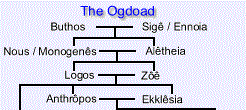
The Ogdoad, as the name suggests, is a group of eight Aeons.

The emanation takes place in the following manner: Depth-and-Silence gives birth to Mind-and-Truth (Nous and Aletheia), who gives birth to Word-and-Life (Logos and Zoë), who gives birth to Man-and-Church (Anthropos and Ecclesia). These Aeonic pairs comprise the Fullness of Godhead (Pleroma), and the first eight Aeons that have been expounded here are the Valentinian Ogdoad.

The Only-Begotten, perceiving with what intention he had been produced, on his part projected with his consort the pair Word (m.) and Life (fem.), respectively father of all things coming after him, and beginning and form-mother of the whole Pleroma.
From them came forth Man and Church (Ecclesia: female), and this is the original Ogdoad. These Aeons, produced to the glory of the Father, wished to glorify the Father by their own creations, and produced further emanations. From Word and Life issued ten additional Aeons, from Man and Church twelve, so that out of Eight and Ten and Twelve is constituted the Fullness (Pleroma) of thirty Aeons in fifteen pairs.

The Apocalypse of Paul

The Spirit spoke, saying, "Give him the sign that you have, and he will open for you." And then I gave him the sign. He turned his face downwards to his creation and to those who are his own authorities.

And then the <seventh> heaven opened and we went up to the Ogdoad. And I saw the twelve
apostles. They greeted me, and we went up to the ninth heaven. I greeted all those who were in the ninth heaven, and we went up to the tenth heaven. And I greeted my fellow spirits.

Paul gives a sign the spirit opens for him the doors of the eighth heavenly realm


The Discourse on the Eighth and Ninth:

"My father, yesterday you promised me that you would bring my mind into the eighth and afterwards you would bring me into the ninth. You said that this is the order of the tradition."

This refers to the eighth stage of ascent to the divine. Prayers to God opens the Nous (that is the mind of the believer) to spiritual vision.


"My son, what is fitting is to pray to God with all our mind and all our heart and our soul, and to ask him that the gift of the eighth extend to us, and that each one receive from him what is his. Your part, then, is to understand; my own is to be able to deliver the discourse from the fountain that flows to me." 


By praying (that is joining the "powers" in silent praise) we can ascend to the eighth: 

"Lord, grant us a wisdom from your power that reaches us, so that we may describe to ourselves the vision of the eighth and the ninth. We have already advanced to the seventh, since we are pious and walk in your law. 


I am Mind, and I see another Mind, the one that moves the soul! I see the one that moves me from pure forgetfulness. You give me power! I see myself! I want to speak! Fear restrains me. I have found the beginning of the power that is above all powers, the one that has no beginning. I see a fountain bubbling with life. I have said, my son, that I am Mind. I have seen! Language is not able to reveal this. For the entire eighth, my son, and the souls that are in it, and the angels, sing a hymn in silence. And I, Mind, understand."

"What is the way to sing a hymn through it (silence)?"
"Have you become such that you cannot be spoken to?"
"I am silent, my father. I want to sing a hymn to you while I am silent."

"Then sing it, for I am Mind."


No hidden word will be able to speak about you, Lord. Therefore, my mind wants to sing a hymn to you daily. I am the instrument of your spirit; Mind is your plectrum. And your counsel plucks me. I see myself! I have received power from you. For your love has reached us."


From that place, the three powers came forth, the three ogdoads that the Father brings forth in silence with his providence, from his bosom, i.e., the Father, the Mother, (and) the Son. (The Gospel of the Egyptians)